















True reproductive justice requires anti-racist advocacy
The term “reproductive justice” is regularly used interchangeably with the term “reproductive rights,” but, in actuality, the two are quite distinct. While “reproductive rights” emphasizes securing women’s legal access to reproductive care, reproductive justice emphasizes an intersectional framework that prioritizes bodily autonomy and holds that reproductive equality cannot result from ensuring legal access to abortion alone, but, instead, results when activists center the most marginalized among us. Reproductive justice, therefore, requires involvement in the fight against racial inequality.
The term reproductive justice was coined in 1994 by a group of Black women called Women of African Descent for Reproductive Justice. These women felt ignored by the women’s movement, which they felt only served the needs of middle- and upper-class white women. The group used the United Nations’ human rights framework to establish the concept of reproductive justice, defined as “the human right to maintain personal bodily autonomy, have children, not have children, and/or parent the children we have in safe and sustainable communities.” They wrote a statement addressed to Congress, which appeared as full-page ads in The Washington Post and Roll Call and featured over 800 signatures.
For Black and brown people in the United States, however, the sense of safety and sustainability necessary to achieve reproductive justice is currently impossible. Racism, including vestiges of slavery, has made the treatment of Black and brown Americans by law enforcement starkly unequal. According to Mapping Police Violence, Black people are three times more likely to be killed by police than white people. In eight out of the top 100 cities in America, police kill Black men at higher rates than the U.S. murder rate.
In a recent call hosted by the reproductive rights organization SisterSong, activists and thought leaders explained how the demand for safe and sustainable communities stands in opposition to our current policing system. “[Reproductive justice] is about our ability to parent in the ways that we want to. That means being able to choose to parent and not to parent without fear of being criminalized or fear of being surveilled,” said author and activist Charlene Carruthers. “I remember the story of the Black women who were turned around from going up to their kids’ school because they were not dressed in the way the school principal thought they should be dressed. That is criminalization. That is part of a long history of institutions and the government saying how Black parents and Black people should look and behave.”
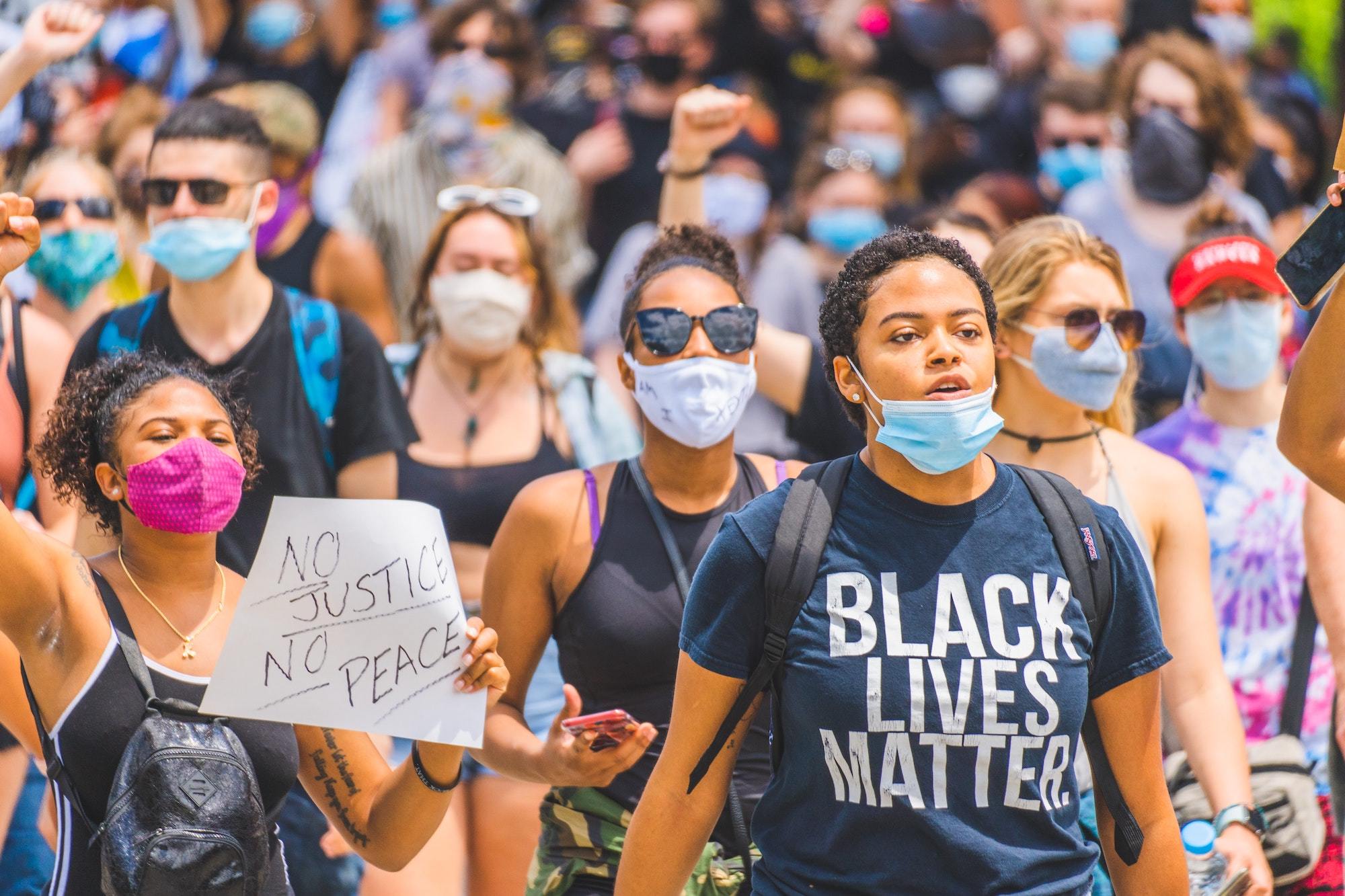
Throughout the protests that have resulted in response to George Floyd, Ahmaud Aubrey, and Breonna Taylor’s murders, police have consistently shown themselves as anti-reproductive justice by knowingly and ruthlessly putting people in harm’s way simply for exercising their right to free speech. Multiple protesters have lost eyes to rubber bullets and tear gas canisters. Police shot at a pregnant woman with “less lethal ammunition” and used tear gas, which is proven to cause miscarriages. All these injuries violate the rights laid out by reproductive justice because, as Monica Simpson, executive director of SisterSong, said, “The part of the reproductive justice framework that charges us to fight for our human right to parent our children in healthy and safe environments does not have an age limit.”
As many have pointed out, when George Floyd lay on the ground with Derek Chauvin’s knee pushing down on his neck, he called out for his mother. In retrospect, this act emphasizes Simpson’s point. Even though Floyd’s mother had died, the fact that her son was murdered and his bodily autonomy violated through state-sanctioned violence is an affront to her right to give her son a life in which his basic human rights are honored. In the call with SisterSong, Dr. Toni Bond explained, “The Black men and boys, the Black women and girls lost at the hands of police brutality and white supremacy not only came from the wombs of Black women, but are also reflective of the generational legacy of the sin of white supremacy.”
Black women and mothers, in particular, suffer at the hands of white supremacy — and any tool that serves white supremacy is inherently anti-reproductive justice, because white supremacy is predicated on the fact that Black lives and their bodily autonomy don’t matter. To achieve true equality, we have to center Black women’s experiences and continue to see the issue of reproductive health care as the intersection of multiple forms of oppression. This means standing up for racial justice and against police brutality.
More articles by Category: Feminism
More articles by Tag: Reproductive rights, Black Lives Matter, Intersectionality, Women of color


