















This Book Asks White Readers to Examine Their Privilege
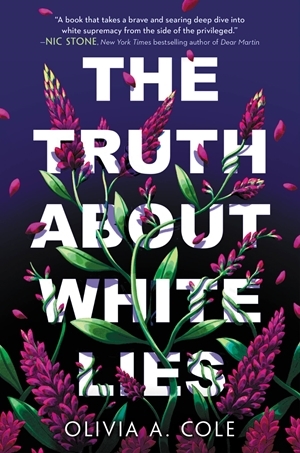
Like the protagonist of her new young adult novel, The Truth About White Lies, author Olivia A. Cole came of age as a white teen girl in Kentucky. Both she and the fictional Shania also often had several startling revelations when it came to how race, segregation, and history impacted nearly all parts of everyday life around them. Those experiences played a big role in Cole’s decision to write The Truth About White Lies, released on March 8 by Little, Brown Books for Young Readers.
When Shania and her mother relocate to the rapidly gentrifying town of Blue Rock, she finds new friendships and relationships as she settles into her exclusive new private school. But as Shania is drawn into the orbit of the wealthy and popular Catherine, she is confronted with several harsh truths about both her new friends and her family history.
We had the chance to chat with Cole over email about The Truth About White Lies, the recent push to bar books about racism in schools, and her advice for teen readers who are still learning to speak out.
In recent years, we have seen several amazing books by authors of color examine whiteness and white supremacy, but not as many from white authors. Can you tell us how you got the idea for The Truth About White Lies and what inspired you to write it?
It’s funny, the framing of the question actually offers at least part of the answer! I started working on the book that became The Truth About White Lies around 2015 when I really realized that the long literary tradition of Black and Brown authors writing about and interrogating whiteness while white authors wrote about whales, etc., had not changed course. From James Weldon Johnson to Toni Morrison to Kiese Laymon, and in YA from Kekla Magoon to Daniel José Older to Angie Thomas, the heavy lifting was and is being done by those oppressed and marginalized by racism. While I have done a significant amount of writing and thinking about whiteness in my nonfiction, I had not, until 2015, carried that work over into fiction. It was the sort of story I didn’t think I was ready to write for quite some time — I didn’t know enough yet, I told myself; I had more research to do. In retrospect, I think I was afraid to do the deep self-analysis that would inevitably come with writing such a book. To understand a white character who is struggling with white supremacist conditioning, I would have to get very personal with my own conditioning and socialization. I didn’t relish the idea. It was not a fun book to write and revise. But as Toni Morrison said, “If there is a book you want to read, but it hasn’t been written yet, then you must write it!”
Shania has a very complicated family life, and she discovers even more family secrets after her grandmother dies. Like many of her (white) peers, Shania does not think much about race but is forced to confront it as she learns about how her family history is so closely connected to her Southern towns. What was it like working on these themes while we are having a national conversation about how to talk about our nation’s fraught history?
It was frustrating in some ways, but also a North Star. As I dove into yet another revision — The Truth About White Lies is the most heavily revised book I’ve ever written — I would look at other white people struggling to articulate the things I was communicating through Shania in the book, and I would tell myself, “This is why you’re doing this. Keep going.” Despite the amount of writing I did about whiteness in essays and articles, in some ways, fiction was the only way some of these concepts could really find their footing for me. There is a significant discomfort that comes with interrogating one’s whiteness, and offering Shania as a sort of proxy was a way to hold up a mirror that white readers wouldn’t immediately flee from. I think there is a lot of value in journaling when it comes to parsing through some of these complicated emotions that arise when doing this work, but journaling, like therapy, only works if one is honest; and white people aren’t always honest when it comes to our whiteness. Even (and perhaps especially) to ourselves. In a novel, there is only so much deflection a reader can do when the author is purposeful about what’s happening on the page. A reader can put the book down, of course. But I hope white readers make it through this one.
While this book wrestles with some pretty big questions, Shania also has to look critically at her behavior on a more interpersonal level. For example, in an attempt to fit in at her new school, she overlooks the racism of the most popular girl at school and even laughs at stereotypical and racist jokes. Those scenes feel so sharp to the reader because almost everyone has been in a situation where they laugh at something they know is harmful or wrong. What advice would you give to teens who are trying to navigate similar scenarios?
A big part of white supremacist socialization and conditioning is nested in etiquette, politeness. Not rocking the boat. Not making things uncomfortable. This is especially true for white women and girls, whose value is wrapped up in “niceness” and agreeability. And all of this is even harder for teens — most things are harder for teens, honestly — because the social dynamics are often even more stressful, and the stakes feel extraordinarily high. That said, one doesn’t have to be tough or loud or abrasive to interrupt racist jokes and to disrupt the white silence that allows harm to go unchecked.
If a person tells a joke that is racist, one can simply ask, “I don’t get it. Can you explain it to me?” Say it over and over as the person joking tries to either shift blame or explain away the harm of their statement. If you don’t feel comfortable with this, at the very least, don’t laugh. Refuse to participate. White supremacy thrives on compliance, and we must not be compliant.
Your books have never shied away from so-called “heavy” topics, and as you know, there are lots of parents and lawmakers out there right now who are actively working to keep books like The Truth About White Lies off of classroom reading lists and out of school libraries. What would you say to your teen readers who are fighting to read these stories?
I would first say, I’m so sorry that the adults in your life don’t take you seriously. I am so sorry that they have so little respect for your intellect that they want to rob you of perspective. I’m so sorry that one adult who wants to control what their child reads thinks they get to have a say about what everyone’s children read. I would also say: I am so proud of you for fighting for these books. We should always fight for books. If you’re fighting for books, then you’re part of a proud tradition. Do not be silent, do not let history be whitewashed, do not stop being curious. Write letters, show up at town halls, organize walk-outs. Do not let decisions that affect your life be made for you. You deserve a say.
Like Shania, you were once a white teen girl from Kentucky. How did your own experiences growing up in the South affect the stories you chose to write today?
Kentucky is a complicated place. Louisville, where I grew up, is more diverse than the rest of the state but still very white. I happened to attend a majority-Black middle school, where my ideas about fairness and what the world was like were quickly deflated, and where I came face-to-face with my whiteness for the first time. Which is not to say I graduated eighth grade with perfect ideas about justice and equity! Definitely not — I spent years tangled up in shame, saviorism, and self-loathing. But also in the years that followed, I became more sharply aware of the codes that white supremacy hides within, the subtleties inside social interactions, especially in a state like Kentucky that exists at the border of “Southern hospitality.” And when I left Louisville and went to Chicago for college — whitely imagining a “better” city that “wasn’t so racist” — I gradually realized that there’s no escaping white supremacy. It looks different in different cities, but it also looks the same. It was an awareness that was like connecting dots in my mind. In the book, Shania’s journey comes before any awareness — what I tried to capture were the events leading up to the awareness, the many straws that land on a camel’s back before it finally begins to bend. When we’re honest with ourselves, we are aware — even if only vaguely — of the moments we choose whiteness over humanity. Some of Shania’s moments of discomfort, the choices she makes in service of something she can’t actually see, are moments I think many white people in any city will recognize if we’re very, very honest — and that’s the point.
Dr. Beverly Daniel Tatum, whose best-known work is Why Are All The Black Kids Sitting Together in the Cafeteria?, described white supremacy and its stereotypes, its misinformation, as “smog.” We’re breathing it from our first breath in this country, and it generally takes white people a lot longer to notice — if ever. First, noticing is a bewildering experience. There’s a lot of anger, a lot of shock. The key is not retreating into the bomb shelter of whiteness — a shelter which is both fragile and well-fortified, I should note — but instead stretching toward the truth, even when we think it feels like we’re stretching too far, that surely we’ll break. We won’t. You won’t. Shania won’t. Keep stretching. I still am and probably always will be.
More articles by Category: Arts and culture
More articles by Tag: Books, Racism, Race


