















The podcast “Marsha’s Plate” centers the black trans experience
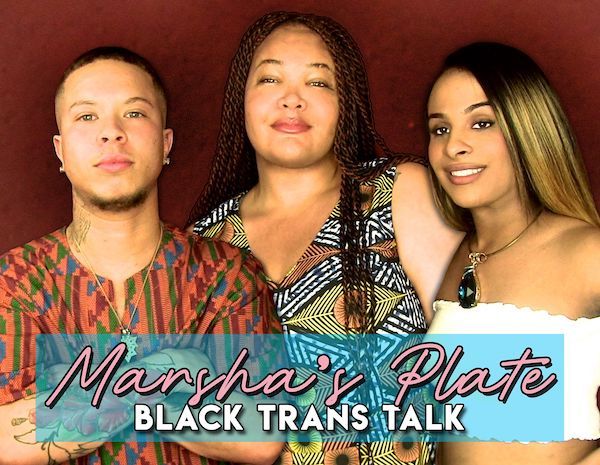
Diamond Stylz will be the first to tell you: Her roundtable podcast Marsha’s Plate is “succulent and dee-vine!”
Each week, the Houston-based activist and her rotating cast of co-hosts — she’s most often joined by friends Zahir “Zee” Raye and Mia Mix — serve up candid conversations about topics ranging from gender reveal parties to the latest installment of the television show Pose from a black, trans, and feminist perspective. Stylz, who also serves as producer for Marsha’s Plate, recently spoke with The FBomb about why she started the podcast, her two decades of activism, and what she hopes audiences will gain from her in-depth reviews of the critically acclaimed FX drama.
This interview has been condensed and edited for clarity.
The FBomb: Marsha’s Plate is an unfiltered, unapologetic show that centers black, trans, and queer experiences. Can you tell me a little bit about how the show came to be?
Diamond Stylz: During the 2016 presidential election, I was happy at first that [the candidates] were at least talking to trans people. You know, saying “transgender” on the campaign and mentioning trans folks on that level and on that stage was rather new to the political process. But nine times out of ten, when a trans person was being talked to or discussed on television [during this time], they were usually a white person and were asked questions about bathrooms — because the bathroom deal was a hot-button topic at the time. And I was really, really annoyed by that conversation because the people who are most affected negatively by any kind of policy that comes out of the White House are going to be black and brown trans folks, not white trans folks. They’re privileged like white people are normally privileged.
Also, talking about the bathroom bill — it’s such a small issue when it comes to trans folks’ lives. We care about many other political problems. For example, we care about housing and health care, we care about economics, we care about workforce discrimination — because those are the things that really affect our survival. I can go pee on a tree! [laughs] You know, the bathroom is important, but it's not important enough to where it should take center stage politically.
Did you see the podcast as a way to bring these more important issues to the fore?
I created the podcast as an answer to what I didn’t see in the political process. We are in a day and age where I no longer have to wait on gatekeepers to allow me to the table to speak my issues. We have the beautiful internet, and I can create my own platform. So I created one that centers black and brown people. It centers black feminist theory. It centers what we as black trans people feel should be the center of the conversation in regards to trans lives. So my podcast analyzes culture and politics from a black trans feminist lens, and I think that’s what was needed that we didn’t have.
It’s my understanding that the podcast is named after the transgender activist Marsha P. Johnson. How did you come to that name for the podcast?
Yes, that is true. Our namesake is Marsha P. Johnson. We wanted to center someone who was black, trans, nonbinary, and who was a pioneer. We wanted to give honor to her name so it would not be forgotten.
The name is also a play off of the title of Solange’s album A Seat at the Table as well. In 2016, one of my philosophies was, “Yeah, we can have a seat at the table. But if I'm not deciding what's being fixed on that table, then you’re giving me access, but you’re not giving me power. Access is not power. So bringing me to the table and letting me just sit there and eat what you fix? I don't like that. I don’t get to decide what is talked about or discussed. So what we offer in the world is Marsha’s Plate. This is what we’re bringing to the table or the cookout for you to munch on and enjoy.
What I found so refreshing about the show is that you and your co-hosts aren’t afraid to tell hard truths, particularly when it comes to issues faced by the LGBTQ community and other marginalized groups, or even dynamics within certain communities like colorism and transphobia. What is it like to discuss such difficult, nuanced topics that affect the larger queer community in such a public way?
I have been an activist since I was 17. I'm 38 now. I sued the Indianapolis public school system to go to the prom in a dress in 1999, and I won. I am the first black trans woman to go to Jackson State University, which is an HBCU in Mississippi. I’m the first trans woman to openly go there and change policies and how they interact with the LGBT community. That was in my early twenties. In my late twenties, I became a YouTuber. I did YouTube for almost 12 years, and it garnered me a kind of popularity. So talking about these hot-button issues with truth and honesty, it's just something that is a part of my brand and the core of my being. And so doing it in public is not a problem for me. I’ve been doing it.
In addition to commenting on the week's headlines and those larger topics, you've also done several recaps of the show Pose. I'd like to ask you about the one you recently did for the episode “Never Known Love Like This Before,” in which the character Candy Ferocity, who is a trans woman, is murdered. What was it like to record a recap of that particular episode, given the recent spate of killings of trans women this year?
Who else but me, or somebody like me? There are tons of “me’s” in the country. And what I mean by that is there are tons of activists out here doing work outside of Diamond Stylz. But a part of doing the work is that we are in constant contact with information that is traumatizing. We are constantly getting emails, articles, and phone calls about trans women dying around the country because we have a platform, and their loved ones know that we can get the word out. So we’re being constantly bombarded with that kind of information, and you can become kind of desensitized to a certain level, right? We’re able to compartmentalize. Any marginalized group that is constantly being oppressed has built up coping mechanisms.
So for me, doing this particular show was not hard at all. It was hard for my co-host that week, but it was not hard for me. And it doesn’t mean that I don’t care, or I’m just stoic about the situation. It’s just that I have learned how to cope with this type of trauma. My job as a person who is reviewing this amazing show, which gives insight into the black, trans, and queer communities in a way that no other show has done before in the history of television, is to give a more in-depth analysis of the issues. People who watch can come to my reviews and say, “Oh, she's connecting the dots for me.” [The creators of Pose] only have an hour per week, but I have as much time as I want. And I can break it down and give you even more insight that you might not be able to get anywhere else. I’m a black trans woman. I have a specific perspective that no one else is going to give you.
You and your co-hosts do such a great job of interweaving the review with your own real-life experiences, like when you talked about the scene in which the other characters banded together and made sure Candy was properly dressed for her funeral.
So with that particular scene, a person who may not be in the community or not had that experience may not realize that as a trans person, if your family has abandoned you, your friends are the ones who have to take care of you in death. And we are not trained to take care of a dead body. So we have to come up with whatever it is we can and muster some type of strength and courage to actually do that kind of work. Think about it: a mortician is prepared or has an affinity to do this type of work. Most people would be like, “Oh, no, I can't do that.” They have difficulty dealing with death. Most people don’t want to be around some dead body! But I was in a situation where I had to do it even though I didn't want to or my friend would have been dishonored. But if I didn't do it, who else was gonna do it? Nobody. So making that hard, selfless choice, to honor someone that you love, it’s just a difficult decision.
I listen to quite a few podcasts that deal with queer issues, but I recently realized that most of the hosts I listened to were cisgender. In order to make sure that I'm listening to all voices talking about the LGBTQ community, I decided to seek out a podcast with trans hosts who talk about trans issues or just general issues through a trans lens. That’s how I found your podcast.
That’s a really important callout because being intentional in regards to what you're listening to and what you’re exposed to, that’s how you expand your knowledge. Let me tell you a funny story. So one of the most popular black podcasts out is The Read, right?
Yes!
So somebody wrote a letter to The Read asking [the hosts] if they know any trans podcasts. And they were like, “No, we don’t know any, but if anyone in our audience knows any black trans podcasts, let us know.” So one of our listeners hit [The Read host] Kid Fury up on Twitter and let him know that he needed to listen to Marsha’s Plate. Kid Fury retweeted it, and once he retweeted it, other people who are avid listeners were like,“Yeah, Marsha’s Plate, Marsha’s Plate!” He got so many responses, which let me know that there are listeners out here! And so the next episode, they said the name of our show, and my views went through the roof. Like I’d never seen that many views in a day — or a week! [laughs] So that kind of exposure on a big show — they didn’t have to give us a shout-out. But I think it was just, like, an accident. Someone called in about it and got a big response, and, you know, I don’t think they made the conscious decision to center us. But think about if everybody did that. And not just for us, but for anything you care about. If you consciously make the decision to center that, in terms of what you support or promote, how wildly could that affect someone’s life.
I think it's one of those things where most people are just going through the motions and consuming the content that’s right in front of them and not making those conscious decisions. It’s like you’re on autopilot.
I call that maneuvering like white people. [laughs]
What podcasts do you enjoy or would you recommend to other people?
My favorite podcast is QueerWOC. It’s hosted by two lesbian women, and they center black queerness and show up in ways that allies are supposed to show up. There’s Tea with Queen and J. The hosts are two bad bitches from the Bronx, and, like we do, they explore culture from a black feminist perspective. There’s Inner Hoe Uprising, which talks about sex and love through a black, pansexual, feminist lens and what millennials are dealing with in the world of dating. And there’s Bag Ladiez, which is hosted by two Latinx New Yorkers, and they give great insight on immigrant issues and the Afro-Latino perspective on black culture.
Do you have any advice for young LGBTQ folks or anyone who may want to start a podcast or pursue this type of platform?
First of all, don’t wait. Do it now. You don’t have to have tons of money. All you need to do is be able to record yourself, which you can do on your iPhone or computer. Don't worry about [production] quality in the beginning, just record your amazing thoughts. Do not focus on how many people are listening. Your focus should be on creating great content. What is your subject, and how are you talking about your subject? And record it and put it out there. There are going to be people out there with whom it resonates who look past quality or listenership. Of course, when you save up, get better quality [equipment]. [laughs] Just don’t think that you can’t start. I started with two raggedy ten-dollar mics from Best Buy, and I upgraded as time went on.
Second, don’t try to mimic anybody else. Do what you feel is in your creative capacity and make it your own. And know that what you bring to the table is important. It is unique, powerful, and nobody else can do it. That’s life, really. You need to be the best you because we need you. Do your show in your way, and think creatively. Don’t think because Marsha’s Plate has three segments that your show has to have three. No! Podcasting is a new medium, and there are no rules.
You can listen to Marsha’s Plate on Apple Podcasts, Soundcloud, and Stitcher.
More articles by Category: LGBTQIA, Media
More articles by Tag: Black, Transgender, Discrimination, Women of color, Racism, Sexism


