















The African women who paved the way for activists today
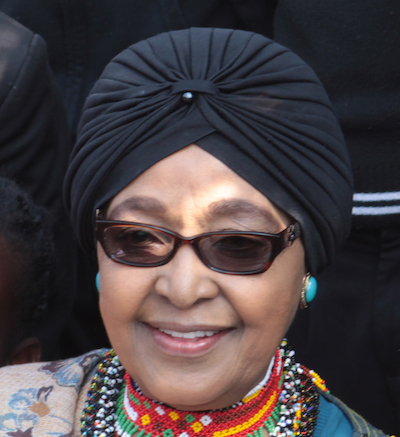
During her life, Winnie Madikizela-Mandela was best known as a South African anti-apartheid activist who led the “Free Nelson Mandela” campaign in the 1980s in an effort to get her husband released from prison. Though she eventually became a politician herself after apartheid was dismantled in 1994 and a new democracy was born in South Africa, her legacy was still often reduced to her role as Nelson Mandela’s ex-wife.
When she passed away in 2018, however, a number of young women in South Africa began to reflect on her legacy. As a result, the #IAmWinnie movement — an online movement that challenged this singular narrative and highlighted the hypocrisy around the construction of Madikizela-Mandela’s identity. Madikizela-Mandela spent years fighting for what she believed in, and because she did, she sacrificed raising her children. She was in and out of prison before eventually being exiled to the middle of nowhere. What’s more, her resistance was often depicted as the actions of a difficult and uncontainable women. As the British filmmaker Pascale Lamche told the Guardian, at the time, South African women were supposed to be “a wife and stay at home and toe the line. And of course women like Winnie Mandela never toed the line: she was volatile and uncontrollable, and that was punished.” These ideas around who she had to be to survive were used to distort her legacy, thus while her ex-husband eventually became known as one of the most loved liberation heroes of the 21st century for taking similar actions, she became known as a contested figure who was forced to straddle roles either as a villain or a heroine in the eyes of the public. Her actions during apartheid were always read out of context of the time, with analysis that unsympathetically represented her as unnecessarily violent and militant in contrast to Nelson Mandela.
Thus, as part of a new revolution, South African women are making efforts to rewrite parts of our history in a way that is reflective, inclusive, and honest about the contributions the likes of Madikizela-Mandela have made during the struggle.This is an effort to challenge this desire to simplify a very complicated time in our history, especially when it comes to how women liberators were and are represented. This has become an important project being driven through different media like The Resurrection of Winnie’ Mandela by the author Sisonke Msimang, visual art exhibitions, films like Winnie that portray her as “one of the most misunderstood and intriguingly powerful contemporary female political figures,” and even politicians who have controversially been petitioning to have Cape Town International Airport, which is the second-busiest airport in South Africa and fourth-busiest in Africa, renamed after her in honor her legacy. Such actions are forcing society to see, humanize, and acknowledge women as they are and not as they are expected to be. Winnie was hardly the only African revolutionary maligned as “difficult.” In her book, Reflecting Rogue, South African professor, writer, and activist Pumla Gqola writes about a number of African feminists who were treated this way. Take Ruth First, a South African anti-apartheid activist and scholar who was killed by a parcel bomb addressed to her sent by the apartheid police while she was in exile in the 1980s, or Wangari Maathai, a renowned Kenyan social, environmental, and political activist who in 2004 became the first African woman to win the Nobel Prize for her leadership of the Green Belt Movement. And then there is Wambui Otieno, a prolific Kenyan activist, writer, and politician who, although born into a prominent family, chose to make her own way and joined the Mau Mau movement — a militant liberation movement that became infamous for launching a guerrilla insurgence against British rule in colonial Kenya — in the 1950s. Otieno also eventually got involved in the campaign to eradicate the "color bar" in Nairobi, which designated separate areas in public spaces for Europeans, Asians, and Africans.
These women made incredible contributions to their respective countries, many without seeing any of the recognition that would later be cemented in our history. But a new generation of young radical black feminists are trying to change that, and are making strides to revive the conversation around the injustice that Madikizela-Mandela was subjected to by her male colleagues within their political party, the African National Congress (ANC). In 1995, Madikizela-Mandela was dismissed from her role as member of parliament because of “human right violations” and “sowing division” that she was accused of committing during apartheid. In reality, Madikizela-Mandela disagreed with the way her party was handling the negotiations toward the end of apartheid; As she argued in an interview with the Evening Standard, she strongly believed “Mandela let us down. He agreed to a bad deal for the blacks during the negotiations,” which is why she spoke out against the transitional government and her political party.
In response to the events that led to her downfall, feminists like Sisonke Msimang, an internationally acclaimed author and activist who has written widely about Madikizela-Mandela, argued that Madikizela-Mandela wasn’t granted the recognition she deserved simply because of her gender. What’s more, Msimang argued that because Madikizela-Mandela challenged gender roles and expectations in a hostile political atmosphere that was dominated by men, her womanhood was essentially weaponized against her, confining her to being treated as an extension of her ex-husband. Her individual identity was increasingly challenged — and her revolutionary influence was often dismissed as merely a proxy of this marital association.
Because of the example she set, now women all over Africa are protesting and speaking out using similar bold tactics that were inspired by the likes of Madikizela-Mandela. Earlier this year, for example, a photo of a Sudanese woman wearing white, surrounded by an inspired audience of protestors all armed with smartphones, went viral. The woman in the photo, which attracted international media coverage from outlets like the Washington Post and Buzzfeed, was later identified as the 22-year-old student Alaa Salah. The moment the photo captured has been hailed as an iconic symbol of the media’s coverage of the protest culture as one in which women participated equally in working to overthrow the nation’s long-standing dictator Omar Albashier. The world continued to see and hear South Sudanese women — who, according to The New York Times, made up two-thirds of the protesters — stand up and speak for themselves.
This activism in Sudan immensely inspiring, especially in the context of 30 years’ political instability in that country, where rape has been used as a weapon of war against women and girls, and where women have long been positioned as victims with no real agency or active role to play against Omar Albashier’s rule.Sudannese women’s demands that their government open its doors to women so that they too can be part of their country’s political process in the form of the nation’s transitional government. is such an important call, especially because Sudanese women have been denied political rights for decades. As Manal Bashir, a Sudanese women’s rights activist, told Michael Atit in an interview for VOA news, “We had been oppressed, discriminated against within our homes, through regulations, even so, we found ourselves pacing behind. So, we have now worked a lot to achieve the change we need in our lives.” At no point in the last 30 years have they felt safe enough to speak up and express their viewpoints and beliefs. Now they are taking it upon themselves to lead the revolution from the front line — just as Winnie Madikizela-Mandela did, and just as we will continue to be encouraged to do now.w
More articles by Category: Feminism, International
More articles by Tag: Activism and advocacy, Africa, Black, Sexism, Women of color


