















South Asian Women Deserve Better Media Representation
Growing up as a young Indian girl in the early 2000s, it only seemed fitting that my favorite movie was Aladdin. It was one of the only movies during its time to portray a female lead who looked like me. My insistence on rewatching the movie was rooted in the idea that Jasmine’s “fairytale ending” could happen to a brown girl like me, too.
Twenty years later, I now see the representation I once revered could not be more dissimilar to reality. But I can’t blame 5-year-old Nandita for loving this movie. She was only offered one version of South Asian women’s lived experiences – a version that has been altered by Western perceptions of what it means to be a South Asian woman.
The representation of South Asian women in popular media is not only minimal, but that small percentage also does not often accurately depict the modern American desi. In fact, on-screen representations of South Asians generally display racist stereotypes, such as nerds, cabbies, and convenience store managers; like The Simpsons’ Apu, and Raj from The Big Bang Theory. These distorted and overly generalized portraits of South Asians in Western media are not only insulting but also contribute heavily to acculturative stress and instances of everyday racism, resulting in rising levels of anxiety and depression within the community.
Another layer of the story is that these caricatures are often portrayed through men, while women are overlooked and lack even a baseline representation. This is not to say that women need to be included in harmful South Asian stereotypes, but rather to say that they are not in the picture at all. One study conducted at Toronto Metropolitan University revealed that South Asian women generally feel as though they are not accurately represented in the media. When South Asian women are represented, they are all too often portrayed as submissive and undesirable. Take Kelly Kapoor from The Office, portrayed by South Asian actress Mindy Kaling. Kelly is the victim of a manipulative relationship with a white male character named Ryan; regardless of how poorly Ryan treats Kelly, she always makes her way back to him. Their on-again-off-again relationship is no doubt an undermining take on women’s self-respect – specifically South Asian women.
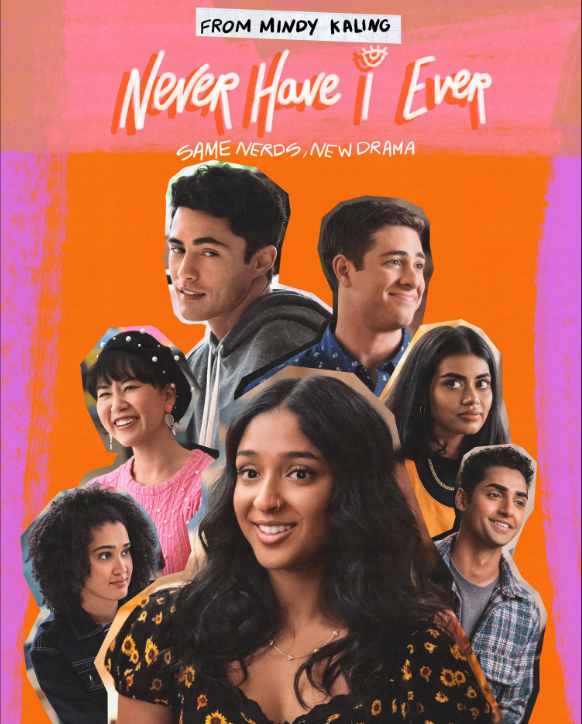
A key point to note here is that these are Western-produced stereotypes. Desi-produced stereotypes are more convoluted than this. They manifest themselves as characters on screen that reflect internalized stereotypes, and plot points often are centered around the fulfillment of White cultural norms. A salient example of this phenomenon is the popular Netflix original series “Never Have I Ever.” Also produced by Mindy Kaling, the show details the life of a young Indian woman navigating high school. While the show as a whole brings necessary South Asian and female representation to the media, the deeper layers of representation aren’t exactly positive. The undercurrent of the program implies that in order to climb the social ladder, the protagonist must make attempts to fit in with her White peers. This idea is incredibly damaging and reinforces negative self-perceptions in impressionable young desi women.
The push for accurate South Asian representation in Western media has been a long time coming. Living in a post-9/11 society has only heightened our need for positive depictions of South Asians throughout our world. After the September 11 attacks, South Asians were the targets of hate crimes and race-based violence in the forms of racial profiling, policing, surveillance, detention, and deportation. The media took these stereotypes and ran with them, making a mockery of South Asians. The implementation of positive representation for South Asian females, specifically, is necessary for creating an equitable media landscape in which all people can feel included.
More articles by Category: Media
More articles by Tag: Asia, Asian, representation


