















Should ChatGPT Be Banned in Schools?
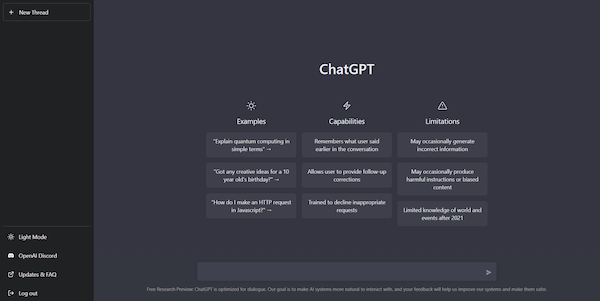
ChatGPT (Generative Pre-trained Transformer) is a powerful natural language processing AI that has gained national coverage and attention since its release less than two months ago. The chatbot, developed by OpenAI, can generate text based on a user prompt, including creating entire academic essays and code. The capabilities of ChatGPT have many people wondering how AI can start being incorporated into daily life, while also raising concerns of AI’s impact on academic integrity and originality.
I heard about ChatGPT on November 30, 2022, the day it was released to the public, when my friend excitedly pulled out his phone as we sat at lunch in our dining hall and demonstrated how the new chatbot could generate highly relevant responses to a stunning range of queries. He plugged in a question from our last assignment in a shared computer science class and I watched as ChatGPT generated code in three seconds that had taken me two hours to work through. It was startling to consider how much potential generative AI like ChatGPT might hold, especially when compared to the limitations of human knowledge and productivity. My friend then began hypothesizing the inevitable topic of human workers becoming obsolete in certain fields, but it feels a bit too soon to be talking about that.
The ChatGPT craze spread quickly across campus. Over the following days, many students experimented with asking the AI to write jokes and explain concepts. We also tried to outargue the algorithm a few times to no avail. It was simply better than us.
Greg Brockman, the president of OpenAI, tweeted that in five days, ChatGPT had amassed 1 million users. We weren’t sure how our school would handle the introduction of such a powerful tool over the next few years, or even the next semester, but the capabilities for potential academic corner cutting (if not outright dishonesty) were obvious. In fact, on January 5, New York City became the first U.S. school district to ban ChatGPT from school servers due to concerns of student cheating. But it hasn’t been banned at my school, and when final exams came a few weeks later, people began admitting that they were using the chatbot to help them write final papers, and the technology was a bit too new for professors to start implementing countermeasures against cheating at the end of the semester.
It shocked us how powerful the AI was but, after all, it was trained on much of the Internet, gathering data from web scraping, articles, Wikipedia, and existing texts to develop a predictive model for human language. While some earlier versions of AI chatbots have struggled with producing accurate or coherent content, the ChatGPT model was fine-tuned through supervised learning, reward training, and reinforcement learning methods to minimize incorrect content.
On the ChatGPT interface, OpenAI clarifies that the chatbot is “a free research preview” with the goal to “get external feedback in order to improve [their] systems and make them safer.” The model was designed to try to replicate as natural a conversation with the user as possible. ChatGPT is currently free while gathering feedback from users, but OpenAI has recently opened a waitlist for users interested in ChatGPT Professional, a paid, greater-access version. The company is exploring ways to monetize the chatbot. Subscription costs after the training period have not yet been announced.
One of the key ways in which ChatGPT is being considered in education is to assist teachers with lesson planning. Although the AI is unable to create individualized lesson plans like teachers can, it can be used to summarize content or generate different prompts for the students to answer. Additionally, while a teacher might be unable to dedicate time to teach every child individually, the chatbot’s capability to succinctly explain concepts can be used to encourage students to ask nuanced questions and explore their own curiosities.
There are concerns, however, that ChatGPT could also have a negative impact on critical thinking and creativity among students when students begin turning to AI to generate ideas, outlines, or even entire papers for class assignments. Educators are beginning to implement various strategies to prevent and detect plagiarism when ChatGPT is used academically. They are trying to minimize the opportunities students have to turn to AI, such as increasing the use of in-class assignments, group projects, and real-time work, which can make it more difficult for students to use AI-generated text.
Teachers are additionally using plagiarism detection software to check student work for signs of AI-generated text. Edward Tian, a Princeton student, created the software GPTZero to detect ChatGPT-generated writing. However, although Tian created the software to combat plagiarism, he stated that he does not support a ban on ChatGPT in schools. In a January 17 NPR interview, Tian said that "it doesn't make sense that we go into that future blindly…. This technology is incredible. I do believe it's the future… And we need safeguards to adopt it responsibly."
Some teachers are now providing students with clear guidelines on how to properly cite materials generated by ChatGPT, and best practices are being established for using ChatGPT in a way that supports academic integrity and original work. As ChatGPT and other AI technologies continue to develop, it will be crucial for teachers and students to adapt to these changes and to use them in a way that enhances their learning and teaching experience.
More articles by Category: Education
More articles by Tag: Technology


