















Reflecting on the Misogyny in ‘Tiger King’
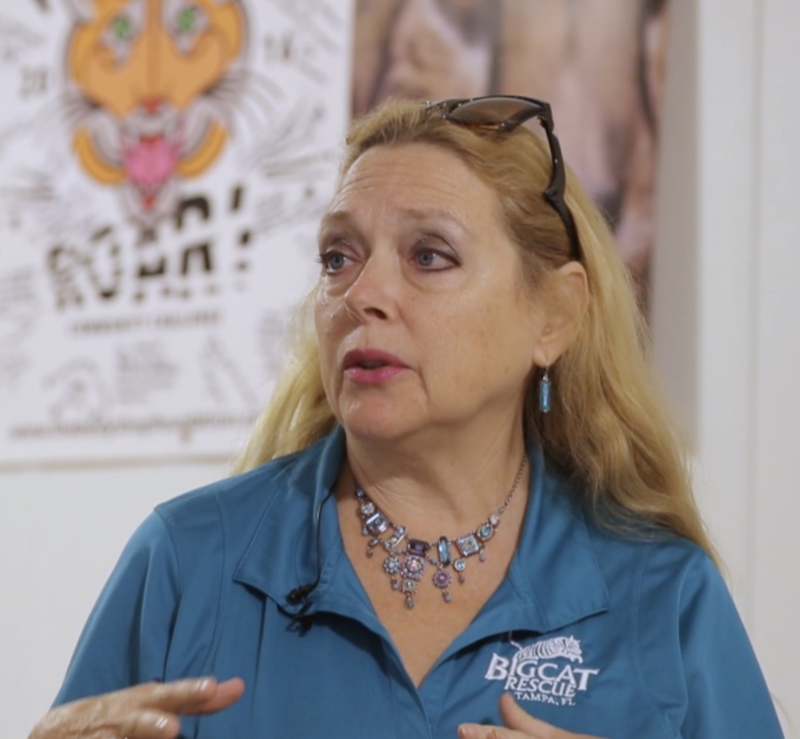
It’s probably not a coincidence that the release and resulting popularity of the Netflix documentary “Tiger King” in March 2020 coincided with the beginning of the coronavirus-induced lockdown. Directed by Eric Goode and Rebecca Chaiklin, the documentary — which follows the eccentric zoo owner Joe Maldonado-Passage, or, as he is most well known, “Joe Exotic” — is entertaining in that it’s hard to take your eyes off of. But lost amid the initial mania surrounding the show is the misogyny at the heart of one of its most pivotal storylines: the relationship between Joe Exotic and his archnemesis, Carole Baskin.
The documentary makes it clear that neither party particularly likes the other, but while Baskin’s dislike mainly takes the form of indirect comments, Joe Exotic demonstrates his hatred with the threat of real violence. Joe Exotic films a music video in which he shoots a blow-up doll meant to symbolize Baskin in the head, and tries to convince his online audience that she is a murderer. Joe Exotic is also ultimately sent to prison for a number of charges, one of which is for an attempted murder scheme aimed at Baskin.
Joe Exotic is positioned as the antihero of the documentary; he is by no means presented as a perfect person, but the documentary regularly underplays his considerably vile actions. As reports later revealed, the extent of his abuse of tiger cubs at his zoo — seemingly a key part of his business model — was not fully covered in the documentary. Exotic was accused of euthanizing tigers who were born cross-eyed (a defect that arises because of inbreeding, which he also facilitated, to produce white tigers) and of sending unwanted tigers to Ryan Easley’s ShowMe Tigers, a circus that is well known for its animal abuse. When a tiger ripped off one of Exotic’s employees’ arms, instead of trying to help this employee or sympathizing with them, Exotic worried instead that “I’m never going to financially recover from this.” This moment was hardly taken seriously in the media and, in fact, became a meme. People were widely able to laugh at Joe Exotic’s narcissistic cruelty and even root for him because of what they perceived as his charisma and humor.
Then there’s a secondary character, Doc Antle, who essentially runs a sex cult. Antle runs a wildlife institute called T.I.G.E.R.S., which he describes as being run by a “great big family unit.” It becomes clear throughout the episode in which he is featured that his relationship with three of his employees — China, Rajanee, and Moksha —is more than just “family.” A former employee, Barbara Fisher, reported how she and the other women in the group were pressured to get breast implants and even to legally change their names. She also discussed how, at the time, she had to live in a modified horse stall.
But Carole Baskin is undeniably framed as the worst villain in the documentary because of the conspiracy surrounding her husband’s disappearance, and because she speaks out about Joe Exotic’s abuse of animals. To be sure, Baskin is no hero or anything less than morally ambiguous. For example, some of the practices at her zoo regarding volunteers and labor practices are questionable. Additionally, the documentary calls her treatment of wildlife into question, although reports have recently shown that her treatment of wildlife is not as bad as the documentary makes it out to be — or at least not on the level of Joe Exotic’s zoo, which the show suggests it is. Yet, “Tiger King” spends an entire episode diving into the theory that Carole Baskin killed her former husband, Don Lewis, while, as previously mentioned, widespread claims of abuse surrounding Joe Exotic aren’t explored in depth at all. The evidence that supports this theory of Baskin as a murderer is compelling, but there is no physical evidence to prove that she did it. In contrast, Joe Exotic’s abuse of animals iis well-documented, to the degree that animal abuse makes up 17 of the 19 charges he was convicted of in his 22-year sentence. Yet, viewers had a field day with the claims against Baskin to a much further extent than they did with any accusations against the men in the show. Baskin even revealed that she got death threats because of the backlash after the show’s release.
The phenomenon we see play out with the Baskin-Exotic dichotomy — of flawed men being able to be lovable antiheroes while flawed women are condemned — is one that seems to show up often in American pop culture. Today’s Carole Baskin is yesterday’s Monica Lewinsky or Marcia Clark. Neither Lewinsky nor Clark was a perfect, but most critiques aimed at them were less about any legitimate wrongdoings than they were evidence of thinly veiled misogyny. For example, Marcia Clark can be rightfully criticized for her work as a prosecutor, but in 1995, in the midst of the O.J. Simpson trial, the media was much more concerned about her bad haircut and old topless photos of her leaked by her ex-husband. Furthermore, the men surrounding these women — most notably former President Bill Clinton in the case of Monica Lewinsky — got off easy because of their charisma or power, a trend that also still shows up regularly in pop culture. And it’s not as if charismatic men in America have ever ended up causing serious harm or anything …
I have seen article after article in feminist magazines about how the ’90s era of female vilification is over, yet we still see women like Carole Baskin bashed repeatedly in the media to this day. We seem to lack the self-awareness to think before we tweet, and grasp whether or not our criticisms are valid or just an excuse to attack women for merely existing. Carole Baskin and her alleged crimes should not be viewed through a morally black and white lens, but rather through the more holistic lens that men in pop culture seem to get, often undeservedly.
More articles by Category: Media
More articles by Tag: TV, Sexism


