















Muslim Representation On Screen Has A Long Way To Go
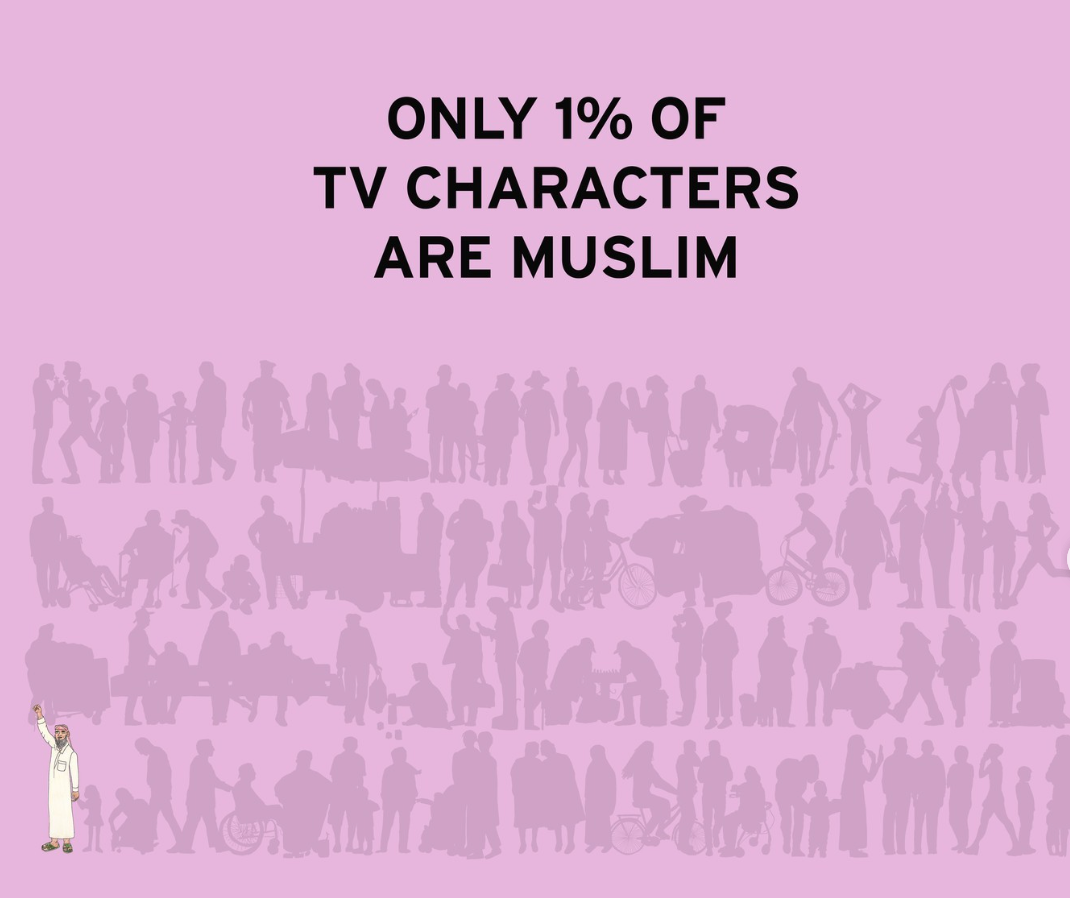
Onscreen Muslim representation has a long way to go. We know as much thanks to USC’s Annenberg Inclusion Initiative, which investigated the portrayal of Muslim characters on television, yielding the discovery that there’s still immense room for improvement.
The study, titled Erased or Extremists: The Stereotypical View of Muslims in Popular Episodic Series, conducted its research in tandem with Left Handed Films, a studio headed by Muslim actor Riz Ahmed, as well as the Ford Foundation and the Pillars fund. The investigation looked at the first three episodes of 200 popular series across the U.S., U.K., Australia, and New Zealand from the years 2018 and 2019 and found that for every 90 non-Muslim characters, there was just one Muslim character with a speaking role. This means that, in 2018, Muslims were only given a 2% share of overall speaking roles, a number that would decrease to about 1% the following year. What’s worse is that these characters appeared in only 16 shows, which evens out to roughly 8% of all the shows studied.
“Muslims make up 25% of the world’s population yet were only 1.1% of characters in popular television series,” said the leader of this research project, Al-Baab Khan. “Not only is this radical erasure an insult, it has the potential to create real-world injury for audiences, particularly Muslims who may be the victims of prejudice, discrimination, and even violence.”
Beyond the lack of inclusion of Muslim characters, the study also found the quality of those included was not ideal. Over 30% of the 98 Muslim speaking characters that appeared across the study committed some form of violence, and another 40% were portrayed as the victims of violent attacks. Thirty-seven percent of Muslim characters were also depicted as criminals. Of these findings, founder of the Annenberg Inclusion Initiative Stacy L. Smith stated that viewers would not only “have to watch hours and hours of content before seeing even a single portrayal of a Muslim character,” but would have to wait “with more time required to find a portrayal that is not linked to violence or extremism.”
“TV shows are the stories we bring into our homes. They play a big part in shaping how we understand the world, each other, and our place within it,” said Al-Kaab. “This study reminds us that when it comes to Muslim portrayals, we’re still being fed a TV diet of stereotyping and erasure.”
Al-Kaab makes a good point, illustrating that quantitative representation doesn’t necessarily matter if the prevailing depiction of said characters is roundly negative or reinforces harmful stereotypes. “For Muslims, this sends a message that they don’t belong or don’t matter. For other people, we risk normalizing fear, bigotry, and stigmatization against Muslims,” Ahmed said, per The Hollywood Reporter. “Networks and streaming services need to embrace their responsibility to ensure Muslims of all backgrounds see themselves reflected in our favorite TV shows.” He also added that it’d be wise for networks and shows to deliberately embrace a broader, more nuanced range of characters and stories instead of only doing so as a “passing diversity fad.”
When it came to Muslim women’s representation on screen, the study found that they are even more pigeonholed than their already narrowly drawn male counterparts. Only 30% of the Muslim characters identified by the study were women, and of those characters, only 21% had jobs, almost all of which had some basis in medicine. That number comes in comparison to the 78% of male Muslim characters who were written as employed characters. As Al-Kaab presented, Muslim women are particularly overlooked when it comes to popular storytelling. More than 50% of female Muslim characters were depicted wearing hijabs, while most male Muslim characters illustrated no costuming trends.
The recent study is reminiscent of a 2021 research project entitled Missing & Maligned, which was also conducted by the same entities that carried out Erased or Extremists. But in the face of this troubling stagnation in representation, the 2022 report includes a call to action across the industry that reads, in part, “We hope television industry leaders take the necessary steps to improve their industry’s standards” and includes resources for said industry leaders to improve their inclusion of Muslim characters and storytellers.
It’s important to examine whose stories get told on screen, especially when certain groups continue to be narratively swept aside for no other reason than disinterest and/or laziness in creation. There are avenues through which the landscape of representation can change; it’s just up to those in power to break their cycle, lest a third annual report delivers further disappointing results.
More articles by Category: Media
More articles by Tag: Islamophobia, Islam


