















Marjoun and the Flying Headscarf embraces the multitudes of being a Muslim woman
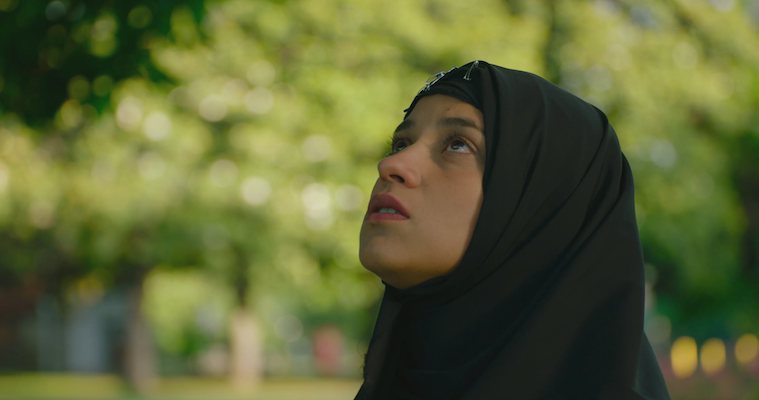
The film Marjoun and the Flying Headscarf — which made its U.S. premiere at the Arab Film Festival in Ann Arbor, Michigan, on June 11 — centers around 17-year-old Marjoun’s quest to seek justice for her father, who has been wrongly accused, and imprisoned, for sending money to terrorists. Directed by Susan Youssef and starring Veracity Butcher, the film takes place in 2006, at the height of over-surveillance of Arab and Muslim communities in a post 9/11 United States. But the story also extends beyond Marjoun’s father’s plight and gives viewers a much-needed view into the inner life of a Muslim American teen girl.
Marjoun’s father’s imprisonment — which was based on the misinterpretation of numerous financial transactions he made to his siblings in Lebanon — leaves him abandoned by his community in the United States and Marjoun, her mother, and her little sister on their own. As Marjoun’s mother descends into depression, and her younger sister remains relatively unaware of the severity of the situation, Marjoun attempts to step up and maintain the family’s structure. She offers to run the convenience store they own and enters an essay competition in the hopes of winning and using the prize money for new legal representation for her father.
Again and again, however, Marjoun is discouraged from taking these actions not only by her mother, but also by a male family friend. This friend, Sammi, moves into the family’s house, takes over their store, and also drags his eyes up and down Marjoun’s body and corners her at her most vulnerable.
At a Q&A session held after the film’s screening at the Arab Film Festival, Susan Youssef said that upon reading the original script 17 years before, an associate, in reference to Sammi, said something akin to “brown Muslim men are already in trouble, do you need to add on to that?” Youssef replied that the film was not meant for brown Muslim men, but for Arab women. While the violence done to Muslim men is acknowledged in the film, it is ultimately about the violence done to Muslim women that so frequently goes unheard.
This statement highlights how even though voices of the Muslim diaspora are still rare in film and TV, when they are present they have mostly been the narratives of brown men, like Hasan Minhaj, Kumail Nanjiani, and Ramy Youssef. In this context, Marjoun’s focus on three Muslim women and the unique issues they face fills a void in the grander scheme of Muslim storytelling.
When they are told, stories about Muslim women usually emphasize the ways they are oppressed by their religion and culture. Marjoun’s problems, however, stem from both structural oppression and broader patriarchal social norms. When Sammii moves into Marjoun’s home, some outside the family see him as a risk to Marjoun’s virginity — but not safety or well-being. Marjoun’s mother even tries to convince her daughter to marry Sammi so that she has a chance to have a life beyond her father’s trial. Her father agress and, loving and gentle though he is, realizes his own naivete too late after witnessing sexual abuse in prison.
This film also avoids emphasizing a lot of the common tropes associated with diaspora narratives, like bold declarations about being othered or trying to be more “American.” This is especially clear in terms of Marjoun’s mother, Amani, played by Clara Khoury. Amani, a Lebanese immigrant, is constantly on the verge of a breakdown. She sleeps through the day, fails to connect with her daughters, and is filled with passive aggression and hurt. We learn about the toll the risk she took to move to the States with her husband, only to land here and find herself alone and in trouble, has taken on her. Amani’s mother refuses to give her money because she married a Shia; she tells her to come back to Lebanon to get married and start over. She has family problems and mental health issues that are in some ways formed by her cultural identity but, ultimately, are relatable to everyone.
Near the end of the film, Marjoun visits the Zen Buddhist monastery in Mississippi where the friendship between Dr. Martin Luther King Jr. and Zen Master Thich Nhat Hanh was established and where interfaith practices and civil rights historically came together. Walking through the monastery in a black hijab, Marjoun is a clear symbol of Arab Muslim women’s place in the struggle against systematic racism in the States. Throughout the movie, Marjoun has been haunted by an unjust legal system, prejudices, institutional barriers, and cultural expectations. She just might be able to make it, but she forever carries with her a burden beyond her control.
More articles by Category: Arts and culture, Media, Religion
More articles by Tag: Criminal justice, Film, Identity, Middle East and North Africa, Women of color


