















Italy’s Prime Minister Is Still the Story, Not the Statecraft
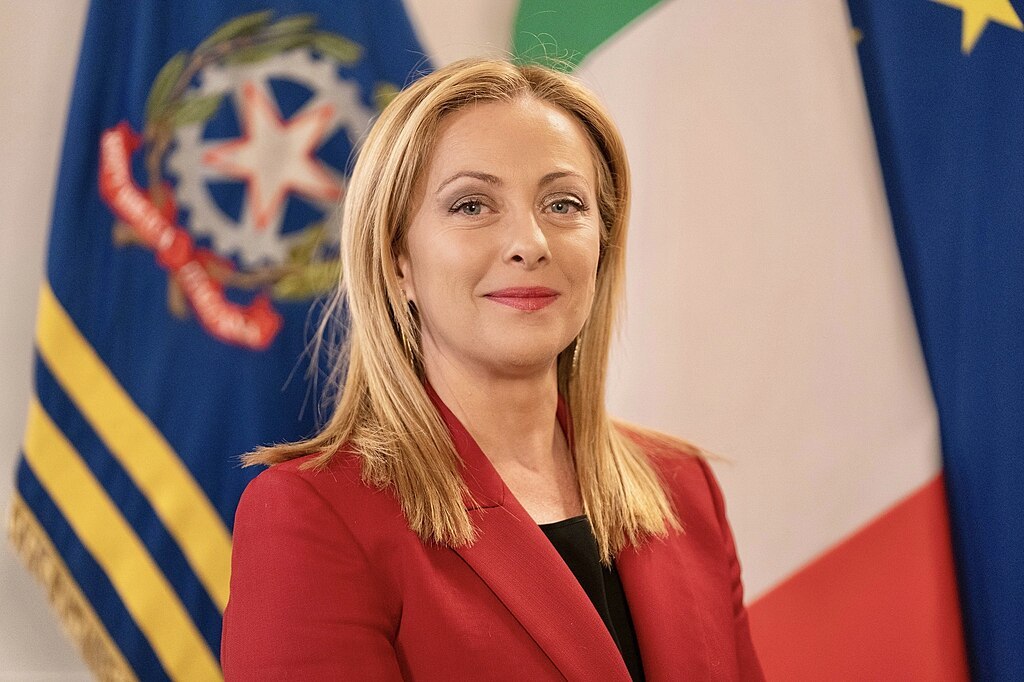
When Italy’s Prime Minister Giorgia Meloni steps onto a summit stage, the conversation too often slides from governance to gossip. That isn’t a “Meloni problem.” It’s the predictable result of a male-coded political marketplace in which women at the apex of power are treated as characters first and policymakers second, in the context of an attention economy that rewards that bias. The woman becomes the headline; the statecraft becomes the caption.
Two viral scenes in 2025 made this phenomenon unmistakable. In Sharm el-Sheikh, during a high-stakes summit on Gaza, American President Trump paused to praise Meloni as a “beautiful young woman.” The clip outran anything about ceasefire mechanics or reconstruction finance. Not long before, in Tirana, Albania’s Prime Minister, Edi Rama, greeted Meloni by dropping dramatically to one knee on a rain-lashed red carpet — a chivalric tableau that dominated headlines while Italy’s migration arrangement with Albania remained a niche concern for policy wonks.
Whatever the intent, these gestures travel as cues: Even at diplomatic altitude, a woman leader may be introduced first as a woman and only second as a leader.
This imbalance isn’t new. From Golda Meir to Margaret Thatcher, from Jacinda Ardern to Sanna Marin, women leaders have been filtered through a “double bind”; they’re expected to be warm yet decisive, scrutinized for tone and wardrobe, and penalized for traits celebrated in men. Meloni is no exception. Her height beside taller men, her timbre at a lectern, even her private life, these details orbit her coverage in ways rarely applied to male peers. Identity becomes click-worthy content; institutional design and budget lines do not.
This sexism is the result of political institutions built by men, for men. Decades of research shows systematic differences in how women in politics are covered, including more focus on persona and traits over policy. Linguistic habits reinforce the hierarchy: Powerful women are more often put on a first-name basis than male peers, subtly lowering perceived status. Gatekeepers of attention remain skewed: across 240 major outlets in 12 markets, only 27% of top editors are women, and in politics, men still outnumber women by more than three to one in executive and legislative posts.
If the frame is skewed, part of the reason is structural novelty. In male-dominated institutions, women leaders are still treated as exceptions. Exceptionality invites human-interest framing such as family and wardrobe, a tone especially prioritized in news cycles built for virality. Meloni understands that economy, she is a sophisticated communicator, and her allies lean into shareability when it suits them.
But the asymmetry does not depend on her choices. When a counterpart scripts courtly theatrics on a state carpet, or a president rates a colleague’s looks from a summit stage, audiences absorb an old pecking order: who is cast as statesman, who as supporting character.
Meanwhile, the policies that change lives struggle to compete with the optics. Since early 2023, Italy’s rules for NGO rescue ships have required vessels to sail directly to assigned (often distant) ports after a single rescue, curbing multi-rescue missions and inviting fines and detentions (although courts have begun to push back). Italian-run centers built on Albanian soil to process some asylum claims are an EU test case that has lurched through delays and court scrutiny. At home, Parliament extended Italy’s surrogacy ban extraterritorially, criminalizing Italians who seek surrogacy internationally.
The remedy isn’t to erase personality — politics is made by people, and symbols matter. The remedy is to reverse the ratio. Lead with consequences: what the statute does, what the budget funds, whose rights are curtailed or expanded, how courts respond, whether promised outcomes arrive. Treat optics as color, not content. Audit the news language, diversify who edits, who produces, and who appears as an expert — because representation upstream changes what counts as “news” downstream. And from the podiums where hierarchies are performed, retire the gallantry and cosmetic compliments. Let the moment be about the meeting, not the meme.
This isn’t about liking or disliking Giorgia Meloni. It’s about recognizing how a male-coded public sphere still reads women in power through a keyhole, and then mistakes the keyhole for the room. A healthier politics, and a healthier press, would make the government the story and put the choreography aside. If we want democratic scrutiny worthy of the name, we should start there.
More articles by Category: Politics
More articles by Tag: Leadership


