















How ‘To All the Boys: Always and Forever’ Breaks the Mold for Teen TV and Film
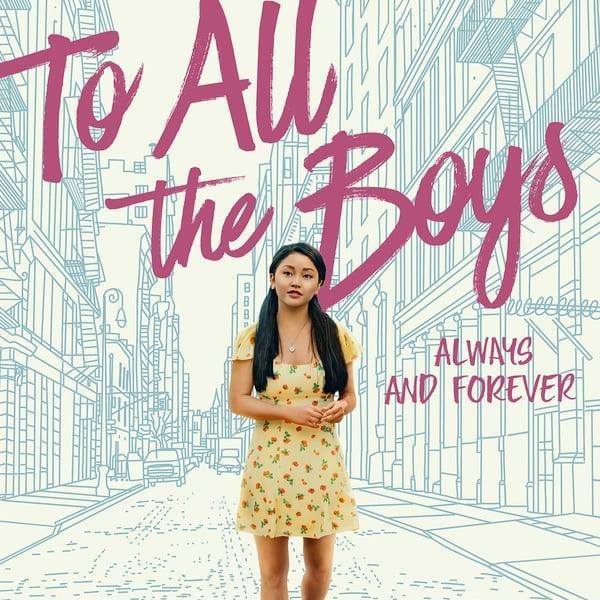
To All the Boys: Always and Forever, the final installment in the romantic comedy film trilogy based on the book series of the same name written by Jenny Han, puts a final bow on the relationship between protagonist Lara Jean (Lana Condor) and her boyfriend Peter (Noah Centineo). Now in her senior year of high school, Lara Jean is forced to confront the possibility of a long-distance relationship after she is rejected from Stanford, where Peter is going, and chooses to attend New York University.
The trilogy as a whole has been recognized for its strong representation of Asian women and culture, and its final installment notably shines in its ability to feature meaningful, three-dimensional depictions of female friendships, blended families, and healthy discussions about consent.
Not only does TATB pass the Bechdel test with flying colors, it features plenty of interesting, nuanced interactions between female characters throughout. Of these, the relationship between Lara Jean and her childhood best friend, and Peter’s ex-girlfriend, Gen (Emilija Baranac), is most compelling. In the third film, their relationship, which by the end of the second film had turned from a rivalry over Peter to a comfortable coexistence, shifts yet again when Lara Jean locks eyes with Gen on the New York City subway while on a school field trip in the city. Gen is attending NYU in the fall and takes advantage of the trip to network with future classmates at a student party, to which she reluctantly invites Lara Jean.
After a night of fast, unexpected connection, the girls impulsively find themselves moving a new acquaintance’s couch via subway — a feat that anyone who has ever ridden it will understand as appropriately quixotic — and, caught up in the moment, Gen tells Lara Jean, “You know, this could be us someday.” The audience witnesses Lara Jean realize that even if she and Gen are no longer close, they share a nuanced history that makes Lara Jean’s choice to attend NYU less of a risk, and may allow them to rediscover their friendship as they transition to young adulthood. Whereas female friendships in media are often portrayed as exclusively antagonistic, in Always and Forever, this type of friendship is one motivation for a young woman to build a future that doesn’t focus solely on her male partner.
Always and Forever also realistically depicts blended families. In the movie, the budding flirtation that had built between Lara Jean’s white father (John Corbett) and his neighbor, Trina, played by Telugu actress Sarayu Blue, over the past two movies culminates in their wedding. Lara Jean and her sisters, Margot and Kitty, accept Trina both as their father’s fiancée and as their own new stepmother — a picture of a blended family that is starkly different from common media tropes of the violent or jealous stepparent, as in It Takes Two (1995) or the classic that made it famous, Cinderella (1950). Trina supports, but never inappropriately encroaches on, the lives of Lara Jean and her sisters, as when she shows she understands it will take them some time to adjust to her presence and when she encourages Lara Jean to communicate with Peter during their breaks. This positive representation is important for an audience likely familiar with the complicated dynamic, considering 1,300 new stepfamilies form every day and at least 10.2% of families are interracial or interethnic.
The theme of blended families is also explored in terms of Peter’s relationship with his father (Henry Thomas), from whom he has been estranged since his parents’ divorce early in his life. After Lara Jean and Peter run into Peter’s father and his new family while bowling, Lara Jean mentions she’d give anything to spend another night with her own mother, who died from cancer before the events of the trilogy. “It will never be OK,” says Lara Jean about Peter’s opportunity to let his father back in, “but at least it could be something.” But his situation is different, he insists, as the scene intentionally continues in silence, without the emotional music commonly included to assert emotional influence. Lara Jean’s mother “didn’t leave you by choice,” Peter says, adding that he hates his father and misses him, and “I hate that I miss him.” In a vulnerable moment for both characters, the movie doesn’t allow either to play the trauma Olympics; both of their pasts and feelings are presented as valid, and both accept they may arrive at the meaning and importance of family in their lives in different ways.
This depiction of healthy and open communication extends from family dynamics to another crucial topic for teenagers: how to navigate consent in relationships and its implications for female autonomy. Lara Jean has never had sex before and Peter has, with Gen. Since Gen leaked seemingly racy photos of Lara Jean and Peter in a hot tub in the first film, they have explicitly agreed to wait until Lara Jean is ready, and reaffirm this agreement early in Always and Forever. While the movie builds towards the anticipated first time happening on prom night, the couple instead breaks up over the fact that Peter sees Lara Jean’s desire to have sex now as a way “to feel close to me” when she “chose to go as far away from me [to NYU] as possible.” It is both a moment that asserts young people do not need to have sex “just because” it is expected, and a rare on-screen example of a male partner taking an equal stake in the need to feel emotionally comfortable having sex — which is, after all, the stuff many feminist dreams are made of. The film normalizes this disappointment with grace: Lara Jean must finally reconcile that being with Peter is “all I’ve ever wanted” with the fact that “I fell in love with New York.”
In the end, TATB fulfills the fundamental romantic comedy criterion of love conquering all when Peter and Lara Jean reunite after the aforementioned wedding. But it also transforms real-life family, friendship, and romantic conflicts into a meaningful exploration of connection, pain, and choice in a way that other teen films don’t; after all, the pair will ultimately continue their relationship long-distance without implying it’s a “forever” deal.
Lara Jean’s model for a young woman who is feminine, emotionally strong, and well-adjusted make TATB a boon to the growing pains of its intended audience of diverse young women, just as its novel approach makes it eminently watchable for older generations and diverse genders. True, the characters operate in a universe where healthy communication, apologies when you’re wrong, and mutual respect are the norm, sure, and that’s for the movies. But it also gives a picture of a world where this could truly exist. Like its Netflix contemporaries Sex Education and Never Have I Ever, Always and Forever sets a new standard for what diverse, inclusive, and empathetic media should look from now on.
More articles by Category: Media
More articles by Tag: TV, Asian American/Pacific Islander, Film


