















Here’s What It Was Like to Attend One of the 2020 Women’s Marches
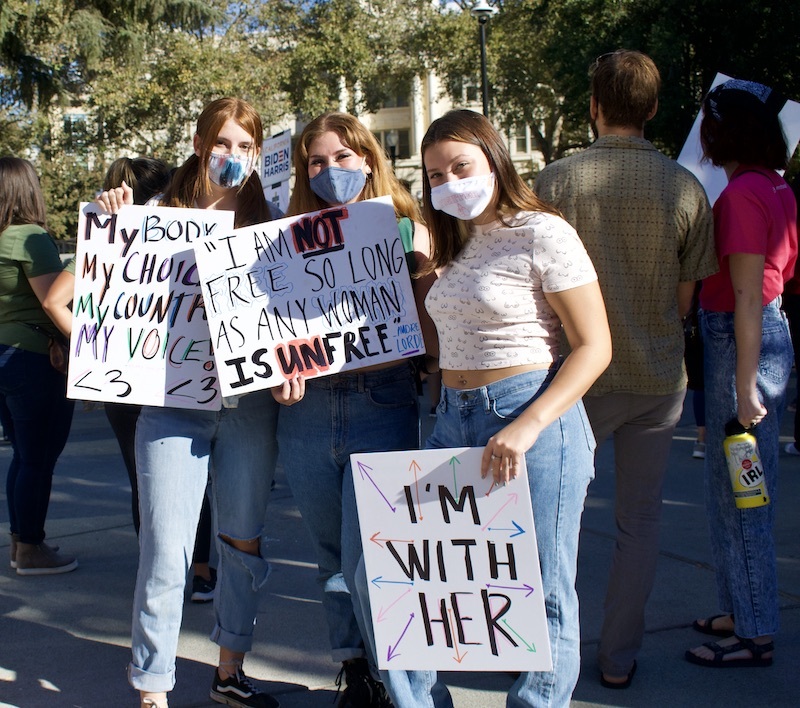
The Women’s March had its first historic rally in January 2017, and organized its most recent march on October 17. More than 430 virtual and in-person sister marches were held across the country, including one in Sacramento. Around 200 people gathered to express their concerns about women’s inequality and frustrations with the current political moment.
“Marching together, you see that people all around you are with you. You come out to the community and see that you’re not alone. That’ll motivate you to join an organization, volunteer your time, or donate your money,” march attendee Chelsea Tibbs said.
Tibbs is an attorney for the Western Service Workers Association (WSWA), a grassroots labor association that brings together people who are experiencing poverty but work in jobs for which it’s difficult to unionize, Tibbs explained. The Sacramento Women's March provided a platform for WSWA and other nonprofit organizations to gather signatures and canvass their associations.
“I don't know if one march is going to change the world necessarily, but it's going to bring people together and bring people out who weren't doing the work before,” Tibbs said. “The speakers we hear today, the people who are canvassing, like Western Service Workers, they’re out here talking about real issues.”
For Jocelyn Avera, a Sacramento resident, marching meant representing the concerns of minority women in America.
“It sucks being a minority woman in America, and something has to change. Something has to give, and I’m no longer going to sit around and allow some dudes at the top to tell me what to do with my body,” Avera said. “I'm not going to allow the people around me to continue to live in a racist, woman-hating, patriarchal society. It’s damaging to us and where we’re trying to go, and I’m not going to do that, I’m going to fight.”
Avera is looking for more than a demonstration, though. “It's time to see legislation change,” she said, including “giving communities the resources that they need."
The march also featured a number of speakers, including Kolieka Seigle, the president of the California National Organization for Women, who also spoke to the need for action on behalf of women of color, including immigrant, indigenous, and Black women.
“Black women have been declared missing and murdered at alarming rates across this nation as justice has escaped us,” Seigle said. “Breonna Taylor was executed by a state-sanctioned home invasion, leaving activists like us to say her name and let it ring out, but feminism isn’t needed?”
Eoiza Deed, an activist in the Sacramento area, also spoke not only before the march but also at a stopping point, in front of the district attorney’s office.
“We must denounce white supremacy that has run this world for centuries,” Deed said. “We denounce your DA system; you will act according to our needs!”
She told the FBomb she believes the Women’s March and many other protests this year are “more dynamic and necessary than ever.”
As demonstrators walked downtown, stopping in front of the Sacramento district attorney’s office and marching near the capitol, protesters began to chant, ”Our voice, our vote!”
Many residents of apartment buildings overlooking the march came out to their balconies to show their support.
The Sacramento Women’s March was an opportunity for activists in this community to stir up a conversation and make a significant, immediate call to action. As Seigle said, “I am asking every one of you to do more than just vote but to lift with all your might to stand for those who cannot, to step up our grassroots organizing, and demand change.”
More articles by Category: Feminism
More articles by Tag: Racism, Sexism


