















Sea Snot Takes Its Toll on the Sea — and on Fisherwomen Particularly

A thick, slimy substance known as “sea snot” began blanketing Turkey’s Marmara Sea at the end of last year. The smelly coating intensified on the coastline in May.
It has been vacuumed up since by the authorities, but there is still snot forming under the surface. Fishermen have left the inland Sea of Marmara and moved west to the North Aegean, fearful that there will be a new outbreak, leaving fisherwomen in particular to suffer the effects of this unpleasant, and environmentally damaging, phenomenon.
“We still can’t see two meters below the sea,” said Sevinc Konkus, a 56-year-old fisherwoman. “There is intense mucilage at the bottom. The divers told me that they lost visibility three meters below the surface.”
Thankfully, she added, at this point, “there is not much sea snot on the surface, and our boat engines don’t clog up anymore. But we can still see some amount of the mucilage on the surface, which comes with the wind and then disappears again.”
Turkey is locked in a losing battle against the jelly-like substance known as sea snot, also called marine mucilage. Mucilage is an overgrowth of phytoplankton, caused by pollution from untreated sewage, agricultural runoff, and rising seawater temperatures due to global warming. Warmer water moves more slowly. It is saltier than cold, and allows the snot to amass in clumps. And the temperature of the Marmara has risen about four-and-a-half degrees in the past 20 years, scientists say.
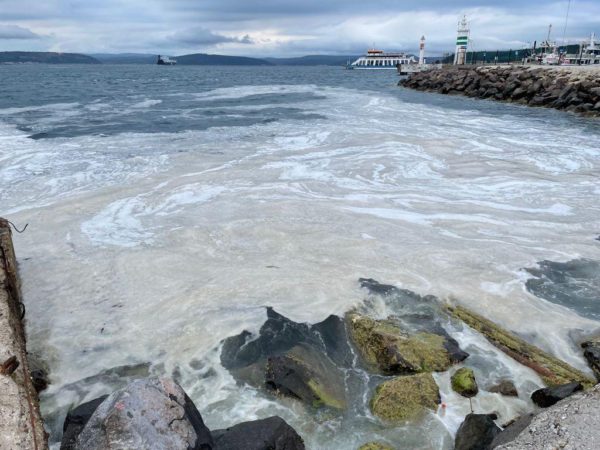
It sucks up oxygen in the water and threatens marine life. The snot forms at the bottom of the sea and bubbles up to the surface, where is can dry, becoming hard enough “that seagulls can land on it and walk around,” Smithsonian magazine reported.
“If you threw a stone into the sea, it wouldn’t sink, and ships were unable to move and leave the port due to the intensity of the sea snot,” Konkus said.
Mucilage was first reported in Turkey in 2007, but this outbreak is the largest on record.
On June 8, Turkish authorities began a massive cleanup operation in the Marmara, in the far northwest of the country, vacuuming up the slime with tanker trucks. They’ve collected tons of the substance at 278 locations and sent them off for disposal. With the help of warm air and fast-moving streams from the Black Sea, the slime has not been seen on the sea surface since mid-July. It begins to break down when air temperatures rise above 75 degrees Fahrenheit, which is warmer than the seawater.
Still, even after the surface snot is cleared, sea-floor creatures like mollusks and corals are at risk from the sunken goop. Coating them seals them off from being able to take in oxygen and whatever nutrients they need.
Mustafa Sari, a professor at the School of Nautical Sciences of the Bandirma Onyedi Eylul University, on the southern coastline of the Marmara, said that while there has been a decrease of the mucilage on the surface, “the sea snot starts meters below the surface, and approximately 15 meters under that there are large amounts of it. Some of it has sunk to the bottom and continues to suffocate the life out of corals and sponges. Most of the sea species there have already died since the April outbreak.”
Due to the massive amount of the mucilage beneath the surface, it’s still impossible to fish in the Marmara. And for women, that could affect more than their income.
“The women who take part in this male-dominated sector are very important,” Konkus said. “I am afraid they will lose their jobs, and go back to house chores and looking after children because of the current outbreak.”
Patriarchal values are still strong in Turkey. Nearly half of Turkish women said that they have never worked, according to a 2020 study from Istanbul’s Kadir Has University. And 44 percent of women who had stopped working said that they quit their jobs because they needed to take care of their families.
Konkus is a board member at the Istanbul Zeytinburnu Fisheries Cooperative, one of the biggest fishery associations in Istanbul. She said that when she started 30 years ago, there were only a few fisherwomen, but today, one out of every 30 people in the Turkish fishing industry is a woman. To encourage women in the fishing industry, Konkus and her five friends have established a society called “Women in Fisheries.”
Right now, she is worried about the women’s challenging work conditions.
“The outbreak has heavily affected fisherwomen, while fishermen continue to do their job in another sea,” she said. “Fisherwomen cannot be flexible like the men because of their other responsibilities, like taking care of children and housework. Because of this, many fisherwomen aren’t able to work now.”
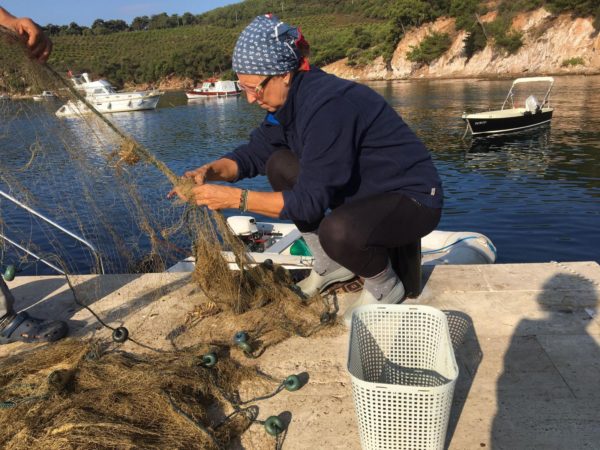
Elvan Ates, 51, has been a fisherwoman for 30 years. She said that with the mucilage, her nets weigh 10 times heavier than normal, and that along with the die-off of sea creatures this has threatened her livelihood.
“There are no fish in the sea,” she said. “Our fishing rods are still filled with mucilage. It sticks to the fishing line and weighs it down so you can’t pull the fish out.”
Konkus said that the women have started taking their nets to a car wash for scrubbing.
“Cleaning mucilage from the nets needs great physical strength, and we cannot do it,” she said.
Neslihan Demiralp, 34, is a fisherwoman who lives in Heybeliada, an island south of Istanbul within the Marmara. She said she’s pleased with the results of the government’s cleanup effort — it has helped her island get rid of the mucilage — but she is worried regardless. She has had a hard time selling fish in recent months.
“People think that the fish in the sea with mucilage is unhealthy,” Demiralp said. “But if the mucilage were poisonous, the fish would die. I eat the fish with my 1-year-old son, if I thought it was unhealthy, I wouldn’t cook it for my family. I am going through hard times financially.”
There is still confusion in the public’s mind about whether to consume fish from the Marmara. The Agriculture and Forestry Ministry has said that fish can be safelt consumed. However, some experts have said that eating mussels and bottom fish would be risky because of the pollution that led to the outbreak in the first place.
Konkus said the fisherwomen have suffered a loss of 90 percent of their usual take because of the mucilage. “It is hard to catch fish,” she said. “It’s even harder to sell it.”
Mert Gokalp, marine biologist said that solving the problem for good will require the right waste management system. To that end, in July, Turkey’s Environment and Urbanization Ministry announced that, after a series of inspections, they have issued a total of $2.73 million in fines to 175 businesses and 11 ships for polluting the water. More than 50 businesses were shuttered because of their failure to abide by environmental regulations.
“We have no other solution.” Gokalp said. “It’s not only the Sea of Marmara — all of our coasts are in danger. All of them have been polluted by water discharge that has not been properly treated, and there is intense pollution caused by industrial waste, domestic waste, and agricultural runoff.”
In the meantime, even with the heavy nets and the drop-off in income, Ates remains optimistic about the future of fisherwomen.
“Fisherwomen have a great passion for the sea,” she said, “and nothing stops women from doing something they want. I believe this situation will get better soon, and that we will continue to do our job.”
More articles by Category: Environment
More articles by Tag: Climate change


