















One Woman Honors Dying First Nations’ Salmon with Art
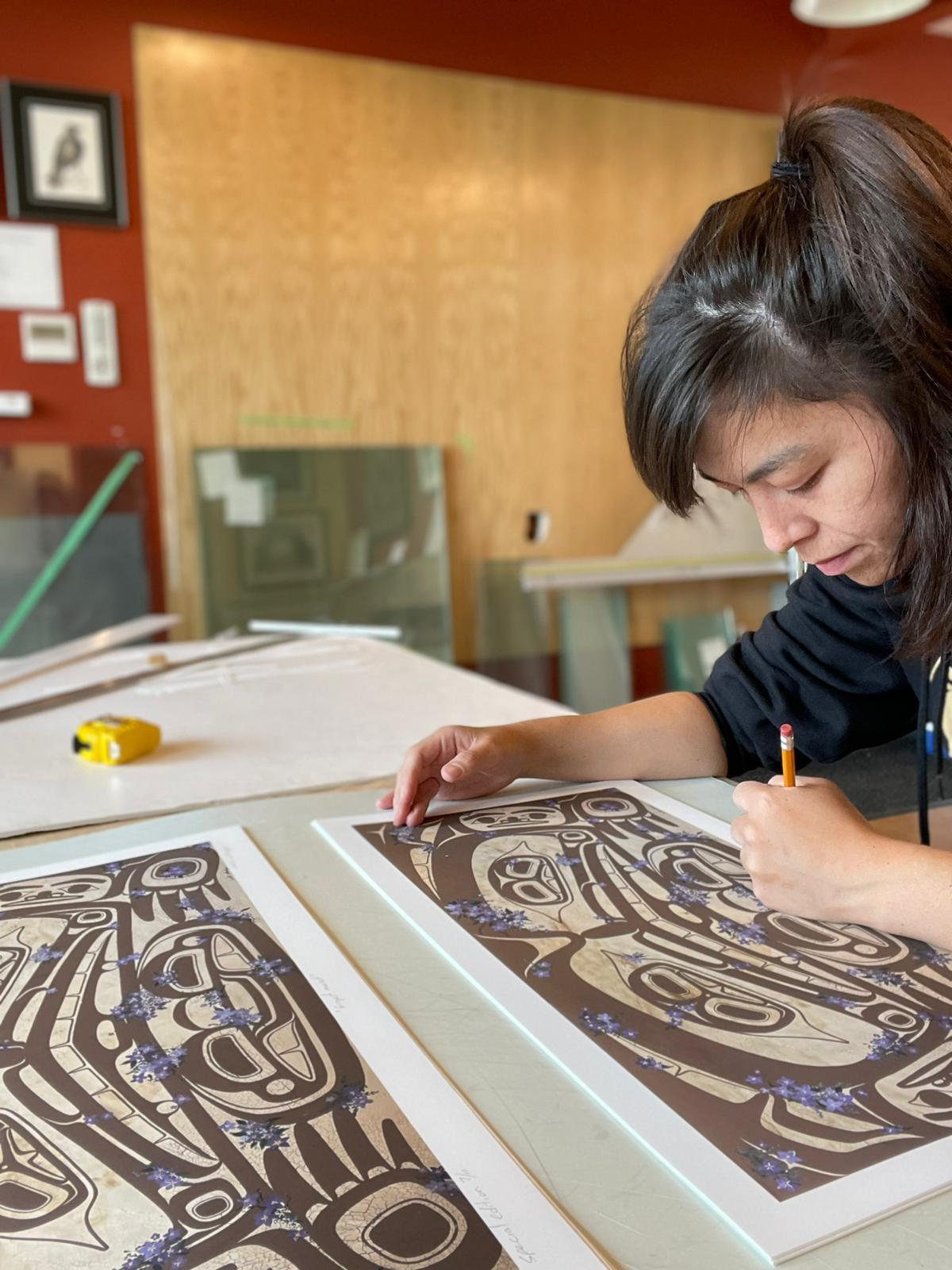
Violet Gatensby, a Tlingit artist from Carcross, in Canada’s Yukon territory, startled a room of delegates from First Nations of the Pacific Coast at an Indigenous leadership summit on Lummi territory in Ferndale, Wash., this past week. Gatensby was a youth delegate at the three-day meeting, where the impacts of climate change and human activity on salmon numbers from Washington State all the way up to Alaska and the Yukon was discussed.
Her 2010 wood carving “Pulling in the Net” depicts how critical fish are to her people as a staple food source. What happens to the fish, happens to the people. So, what she had to say to the group on the first day of the conference was shocking to everyone. She shared that her community had not seen salmon in their river for 60 years — until her mother pulled out a single king salmon last year. When asked during a break why she’d travelled such a long way to attend the conference, she said that she’d come “to listen and learn from leaders all around the West Coast on how to protect the water and salmon.”
Then she uses her craft to project what she's heard.
“I see things in a visual way,” she said. “When I hear words, they come in images in my mind. That’s where my power lies.”
As Gatensby sat and listened, she drew what she was hearing. “Hopefully, in a good way, I can take the words and wisdom from around me and put it into artwork that means something to people,” she said. The artwork that flows through me onto the page — it isn’t mine, it’s the words in the room. Hopefully people can see the beauty in my artwork but also the messaging as well, and then go back to their people with what it is they see in my images.”
Delegates told stories and sang traditional songs with a palpable urgency. Salmon numbers are at an historic low in the region. Heat-related lesions and heat stress are killing the fish. Ocean acidification, higher stream and ocean-surface temperatures, and flooding all contribute to the death of the population. The people gathered in Ferndale also worry that the salmon are starving because heat waves kill the creatures they feed on.
They want their grandchildren to be able to fish the salmon as they and their people have done for millennia.
Each of the nations depends on fishing, not only as a core livelihood but to maintain food sovereignty. Ecologically, the salmon are an essential thread in a complex web. The salmon are a keystone species that feeds a host of animals, including orcas, bears, eagles, and otters. When they die along riverbeds inland, they also nourish the earth, the trees, and the understory. And while the participants at the leadership summit may come from different places with different cultures, languages, and laws, they were unanimous in their agreement that it is time to declare an ecological emergency for what’s going on with salmon across this Pacific Northwest region.
In one of her paintings, Gatensby depicts two salmon with human figures on their backs, representing the dependency of people on the fish. One salmon is angled down, showing the species’ decline. The other, angled upward, represents hope for their return. The imagery is powerful. It speaks to the reality of every community leader at the summit and the awareness that their efforts to save the salmon can’t wait any longer.
The 40 delegates representing numerous coastal nations made an official commitment to work together in solidarity and across colonial borders and boundaries to save the salmon from the ravages of climate change and the industries driving it. They want the Canadian and American governments to respect their inherent right to fish, and to stop countries like China and Japan that have engaged in industrial, non-selective bottom trawling with impunity for decades.
Dana Culatxten Wilson, a prolific fisherman and leader from the Lummi Nation, spoke to the importance of the fish and the looming disaster if the tribes represented in the room don’t act together. “We will always be riding on the backs of salmon,” he said, “but the salmon are running out of time.”
For her part, Gatensby will return home to Carcross and use her art to not only honor the fish, but to help others learn about the importance of saving the salmon. Her pathway is clear. Her fight is already underway.
More articles by Category: Environment
More articles by Tag: Climate change, Indigenous


