















Media Shifts the Climate Narrative: An Example
It’s true: The majority of people only read the headline, not the story. There have been a couple studies in recent years that show that only three or four people bother to read an article before sharing it on social media. Which is why it was so alarming to read the New York Times’s morning email the other day.
The subject header on the email: “The Morning: The climate’s improved future.”
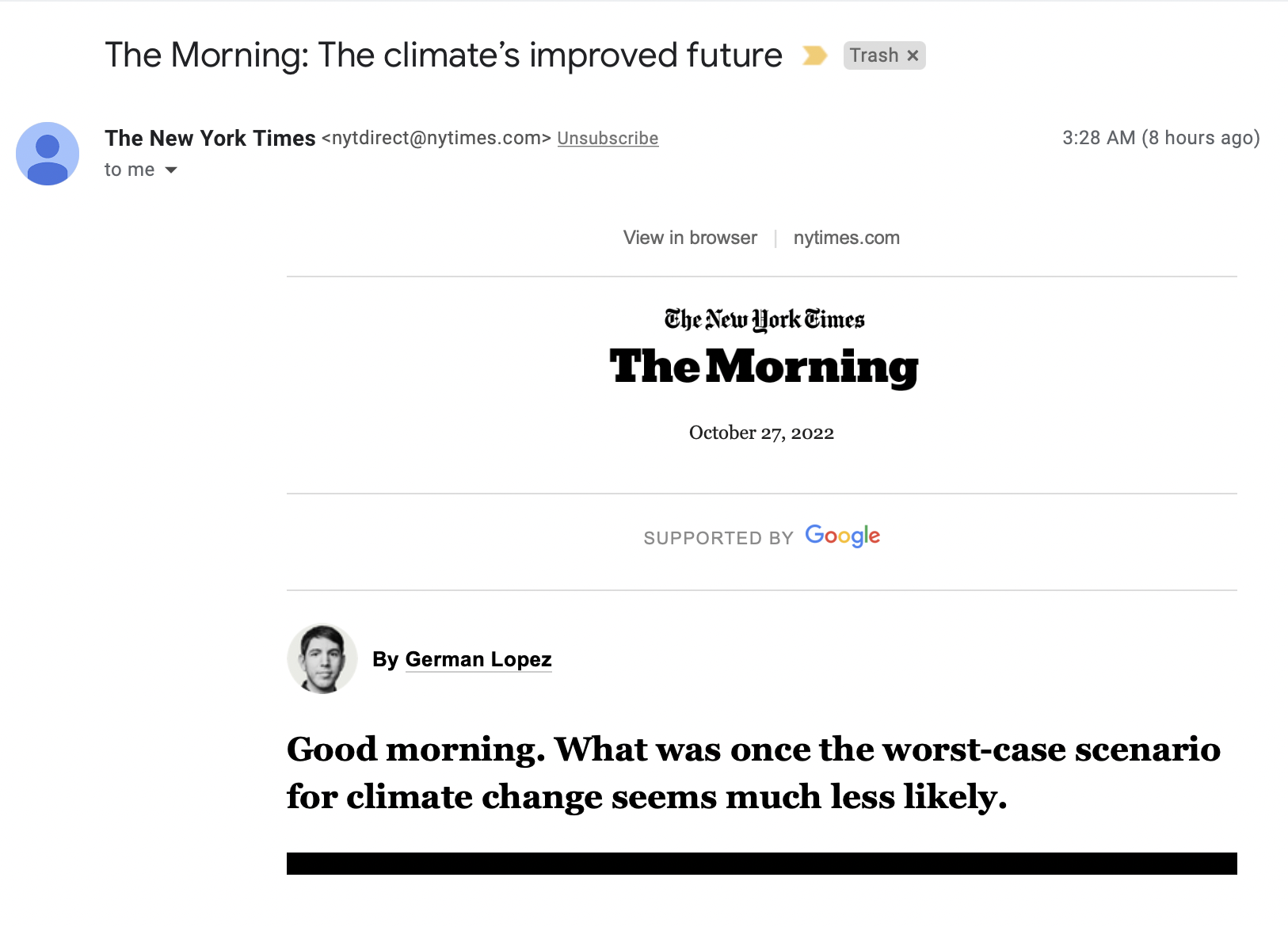
The email itself begins:
‘An optimistic shift’
“Five years ago, the journalist David Wallace-Wells explored a worst-case scenario for climate change: one in which the planet warmed by as much as 5 degrees Celsius by 2100 — causing widespread extreme weather, economic collapse, famine and war. |
“Now, David sees that level of doom as much less likely, he writes in an essay for this Sunday’s climate issue of The New York Times Magazine, where he is a columnist. While 5 degrees of warming once seemed possible, scientists now estimate that the Earth is on track to warm by 2 to 3 degrees. That difference might not seem huge, but it translates to fewer record-breaking floods, storms, droughts and heat waves and potentially thousands or millions of lives saved in the coming decades.” |
At the same time, the news this week has been flooded with doomsday-ish reports about how we are just about past the point in which it will be possible to stop the devastating effects of climate change.
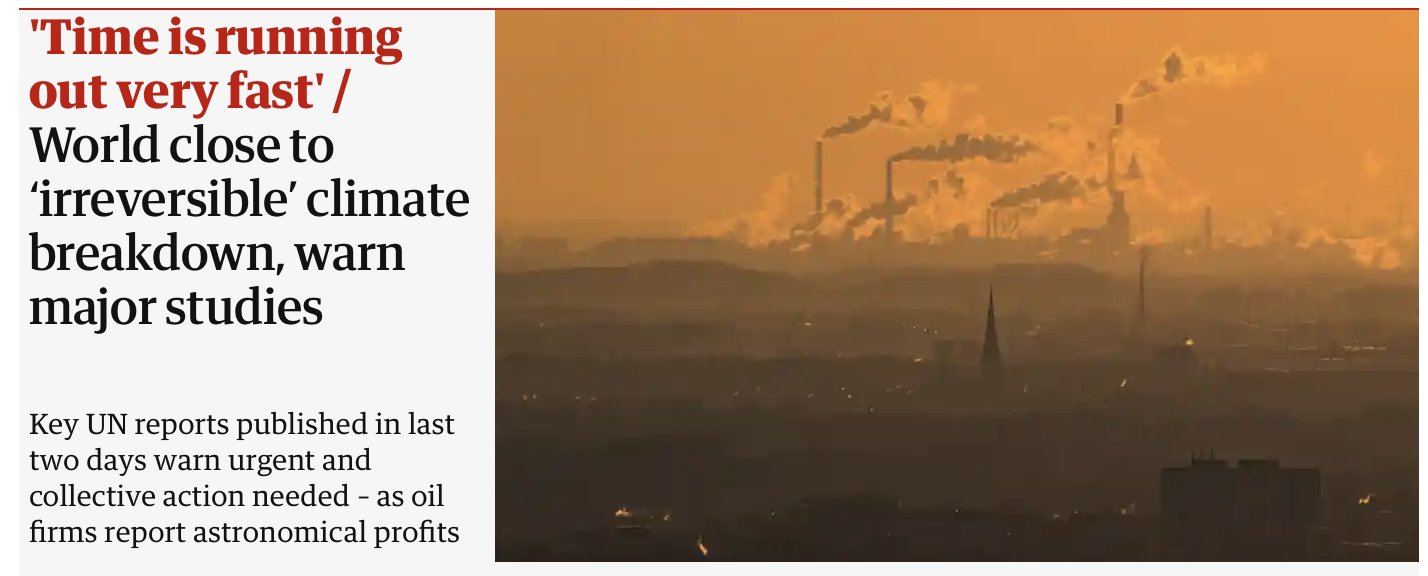
“‘Time is running out very fast’: World close to ‘irreversible’ climate breakdown, warn major studies” shouted a headline on the homepage of The Guardian the same morning I got the Times email.
The lede on the story reads: “The climate crisis has reached a ‘really bleak moment,’ one of the world’s leading climate scientists has said, after a slew of major reports laid bare how close the planet is to catastrophe.
“Collective action is needed by the world’s nations more now than at any point since the second world war to avoid climate tipping points, Prof. Johan Rockström said, but geopolitical tensions are at a high.”
The actual story in the Times goes on to be more evenhanded that it appears in the headline, saying that “with the most terrifying predictions made improbable by decarbonization and the most hopeful ones practically foreclosed by tragic delay. The window of possible climate futures is narrowing, and as a result, we are getting a clearer sense of what’s to come: a new world, full of disruption but also billions of people, well past climate normal and yet mercifully short of true climate apocalypse.” But again, most people only read the headlines.
As journalists, we work hard to put some positivity in our bleak stories — what can be done, how to fix something, who is doing what to make the world better. In this case, however, I fear that damage may have been done. Politicians tout headlines to make their points, and climate deniers, I would imagine, would be perfectly happy to forward that Times email to their supporters and say, “See? They’ve been exaggerating.”
Which is the last thing the suffering world needs right now.
More articles by Category: Environment
More articles by Tag: Climate change, Media


