















Pipeline Fight Puts Indigenous People in Canada at Risk
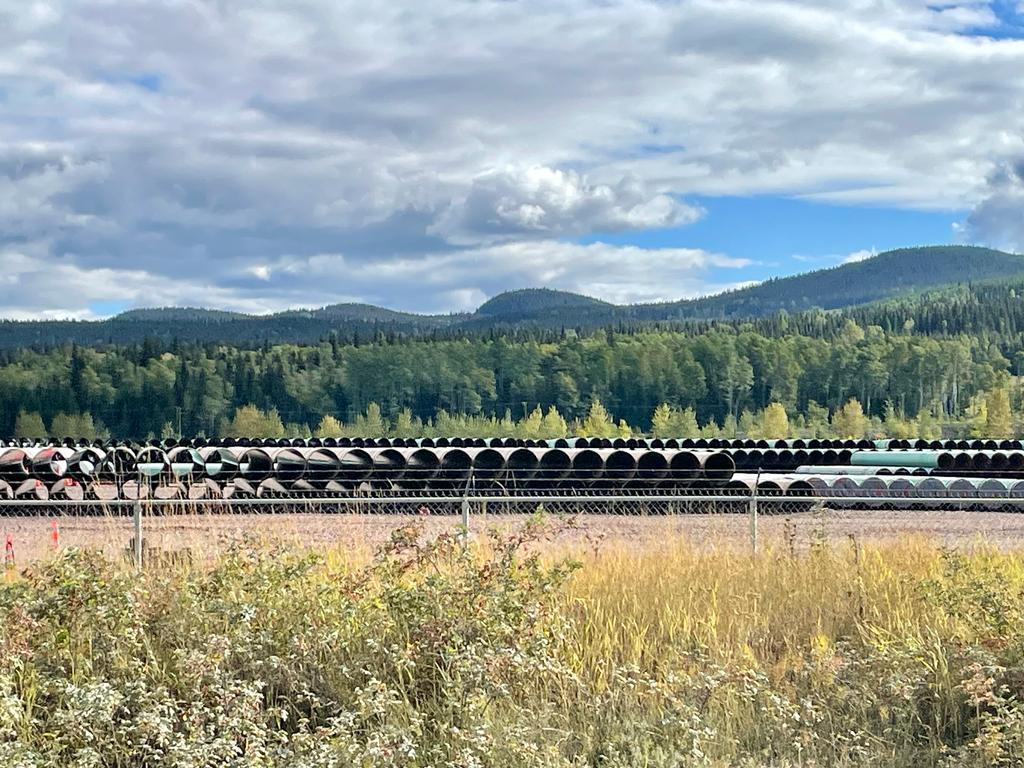
At the 2021 Climate Summit in Glasgow, Canadian Prime Minister Justin Trudeau declared that Canada “would take a leadership role in the fight against climate change.”
Yet nearly two years later, the country seems more unwilling than ever to abandon its entanglements with the fossil fuel industries, which are directly linked to the formation of greenhouse gasses. Instead, Indigenous matriarchs and land defenders in the western province of British Columbia have been leading the charge — standing on the frontlines of an ongoing battle to defend the land, water, and air on their traditional territories.
However, by doing so, they are putting themselves in harm’s way. Defending the land places them consistently in the crosshairs of provincial judicial and carceral systems as well as in the sites of the guns of the Royal Canadian Mounted Police (RCMP). It is a fight few outside of Canada know about.
Two of five pipelines in British Columbia that have been slated for construction are currently being built on unceded Indigenous lands. Historically, hereditary chiefs in British Columbia have had their inherent land rights consistently challenged by the provincial and federal governments — and more recently, in spite of provincial legislation passed in 2019 that was meant to harmonize the UN Declaration on the Rights of Indigenous Peoples with the calls to action of Canada’s Truth and Reconciliation Commission.
The Trans Mountain (TMX) Pipeline will move move oil 714 miles, from the infamous oil sands in the western province of Alberta to the Pacific coast. The Coastal Gas Link pipeline is 416 miles long and will deliver fracked gas from northern British Columbia’s Montney Shale Formation to a liquid national gas facility in Kitimat, on the Canadian West Coast.
In 2018, the Canadian government paid $3.7 billion for the Trans Mountain pipeline. But, in March, the CBC reported that the estimated cost to complete the project had skyrocketed to $23 billion. In addition to the soaring costs of construction, the government has paid the Royral Canadian Mounted Police or RCMP, $20 million to monitor Indigenous protesters who have been fighting to halt these projects. To that end, the RCMP has carried out a number of raids on Wet’suwet’en territory, an area of 13,670 square miles (which is bigger than the entire state of Maryland).
On Nov. 19, 2021, the RCMP carried out a militarized raid against protesters occupying what was called the Coyote camp with a violence that shocked the country. Using attack dogs and officers armed with assault rifles, the police broke through a hand-hewn cabin and violently arrested 14 land defenders. The dramatic raid was captured on video by documentary filmmaker Michael Toledano. On March 29, the RCMP raided the Gidim’ten camp (which is near the Coyote camp) again, perpetuating what Amnesty International has called a “long-standing campaign of violence, intimidation, and dispossession” against Indigenous land defenders.
Canada is often celebrated internationally for its progressive values, multiculturalism, and open immigration policies. Yet recently, the country came under global scrutiny for the destructive legacy of its Indian Residential Schools, a colonial, racist system upheld by successive governments in Canada, which had forcibly removed more than 150,000 First Nations, Métis, and Inuit children from their homes. These children were placed in what were known as “educational” institutions. These human rights abuses lasted from the 1880s into the 1990s, when the last school closed.
Canada is also known for its pristine tracts of wilderness and breathtaking landscapes —much of which would not have survived without the stewardship of Indigenous communities who have protected and nurtured them for millennia.
Editor's note: The fourth paragraph has been amended to clarify the historical challenges to Indigenous land rights.
More articles by Category: Environment
More articles by Tag: Climate change


