















Why I work with rape survivors in Africa
“Has the world forgotten about us?” These words from Fatima, a Darfuri rape survivor, still haunt me.
It was the summer of 2006 and I was collecting interviews as part of my research-based activism with 25 Darfuri genocide survivors at a refugee camp in Chad. In heat that a fellow researcher, who was collecting weather information, measured at 130 degrees, women waited for hours to share their horrific stories about attacks on their villages. I struggled hard to choke back tears as women spoke of rape and of their children who were killed by the Janjaweed paramilitary forces in Darfur, often before their eyes. That trip was a turning point for me.
I felt guilt at first, returning to a privileged, comfortable life in the U.S. as a professor at Penn State. The weight of the women’s sorrow and the need to “do something” about the genocide in Darfur was overwhelming—and paralyzing. My own reaction was baffling and new to me. I had never experienced such a loss for words and action in more than two decades of activism and organizing around social justice issues. I felt a tremendous responsibility to honor these survivors and act on their behalf, but how? As I immersed myself in the transcribed interviews, guilt gave way to the realization that my privilege could be a force for positive change.
“I was able to leave Chad,” I kept thinking. “These women face daily life in a refugee camp.” My inaction was now inexcusable.
I stepped up my role in the anti-genocide and Save Darfur movement, giving talks in living rooms, synagogues, high schools, church basements, and on college campuses. I received a Carl Wilkens Fellowship with the Genocide Intervention Network (now United to End Genocide) that helped expand my activist networks, opportunities, and knowledge about other crises, including rape in the Democratic Republic of Congo. It was during this time that I came across the phrase “worst place in the world to be a woman” in reference to DRC. How could that possibly be, I wondered, given the horrific stories I had heard from the women in Chad? How could Congo be worse?
There should never be a contest over which conflict-ridden region has the most women with brutal tales. But it was clear that my work shouldn’t end in Chad. Still mulling over the provocative but problematic label of “worst place in the world to be a woman,” I realized I had to go to Congo.
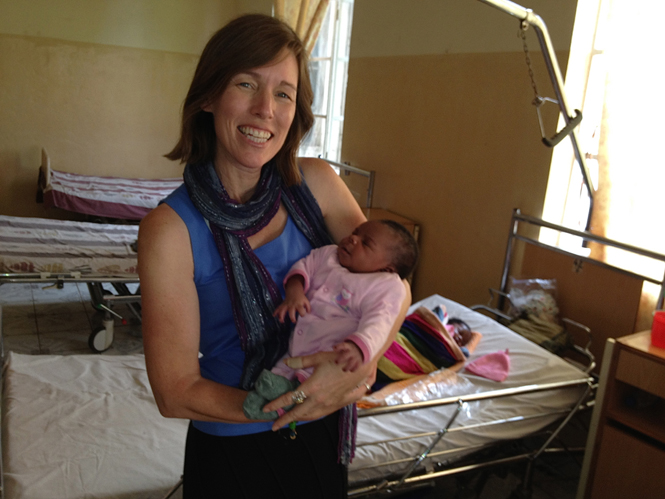
The author holds an infant at Panzi Hospital. On her latest trip there, De Reus conducted focus groups to learn what survivors felt about the children they were giving birth to due to rape. De Reus says the mother of this particular 8-day-old was struggling to accept the baby; she does not appear in the photo to protect her identity for safety reasons.
A simple Google search of “travel Congo” and some luck led me to a young woman from the U.S. who was working at Panzi Hospital—which was founded by Dr. Denis Mukwege and has helped tens of thousands of rape survivors since it officially opened in 1999. Thanks to this woman’s willingness to help a complete stranger, I made my way to Bukavu, a city on the Rwandan border where Panzi Hospital is located. It was the summer of 2009 and I was there for three weeks.
My time at Panzi was transformative. I was able to interview 30 women about their sexualized attacks, the resulting stigma, how they cope, and their hopes for the future. My goal was to record their experiences to support data-driven scholarship and advocacy work around the issues of rape and conflict. Eventually, I would meet with members of Congress, give interviews, and publish my findings. Overall, my goal then, as now, is to reach as many people as possible with the news of what is happening in DRC. While visiting the hospital that first time, I also taught a research methods class to medical students doing their residency at Panzi.
Each of the 30 women I spoke to revealed their stories of unimaginable atrocities, fear, and suffering. The youngest person to tell me her experience was a 15-year-old girl I’ll call Mateso.
At first, I had no intention of interviewing Mateso for my research. She was under 18, and therefore too young to give informed consent as a study participant. But for three days in a row, despite my refusals, she came to our interview location and asked to talk. Realizing that this was clearly important for her, I finally relented. Legally, I couldn’t use her story in my research reports, but I could listen to her.
Mateso described her capture at the age of 13 by an armed group that held her as a sex slave for a year. Just days after giving birth to a stillborn baby, she said, she managed to escape. Kind strangers brought her to Panzi. She had been at the hospital for two years because she required repeated surgeries to repair a fistula that had made her incontinent. (Fistula is a medical condition that can result from pregnancy as well as rape, but that is more commonly due to pregnancy. We see it in conflict zones in part because when a woman becomes pregnant after a man rapes her during war, she often has no access to medical care.)
When I asked Mateso why she thought it important to share her experience with me, she said: “I tell you my story because so many people don’t know. I want you to tell others.”
During my time at Panzi, Mukwege explained that he wanted a nonprofit in the U.S. that could help support his hospital. I was appreciative of the need but sidestepped involvement. I was too busy as a professor. But, moved by Mateso’s courage and request, I returned to the U.S. inspired to act and use my research for advocacy work.
Back home, organizations such as Friends of the Congo and the Enough Project had raised the profile of the crisis in eastern DRC and people wanted information about how to help. Every time I was asked to speak, I realized, my talks were a missed opportunity to raise funds. Audiences were so moved by the women’s experiences, they wanted to donate, but there was no mechanism for them to do so.
Mukwege was thrilled. I was scared. So I turned to my friend, artist Peter Frantz, for help. Together, the three of us officially founded Panzi Foundation USA in 2010. Increased media attention about sexualized violence in Congo, international recognition of Mukwege’s life-saving work at Panzi Hospital, and a mention of the foundation in a Nicholas Kristof column helped our launch. The foundation took off at lightning speed.
Now, the foundation supports transitional housing for survivors of sexualized violence after they leave the hospital. Many women are unable to return home after treatment because they have been abandoned by their spouses and families. In the transitional housing, known as Maison Dorcas, former Panzi patients typically stay for six months to a year. Currently, about 30 women and 50 children can be accommodated, but a new building is under construction that will house 100 women with 200 to 300 kids. Keeping in touch with survivors once they leave the housing program is extremely difficult, as many of them return to rural areas with no phones. But while they are at Maison Dorcas, they can participate in a variety of classes that provide basic literacy, legal instruction, and skills-based training. The hope is that what they learn will help them to be autonomous and provide for themselves despite the stigma and rejection from their husbands and relatives.
I travel to Panzi often to conduct research. On my last trip, I spent three months interviewing patients with children born from rape in order to better understand what they’re experiencing. And although I am unable to return to Chad because of security reasons, I continue to advocate for the women and people of Darfur. For Fatima and Mateso, I want to make sure they are not forgotten.
More articles by Category: International, Violence against women
More articles by Tag: Sexualized violence, Rape, Africa


