















‘#WeAreDyingHere’ breaks the silence on gender-based violence in South Africa
On November 30, 2019, the audience entered the theater at Cape Town’s Artscape Theatre Center, treading on newspapers scattered across the floor to make their way to their seats, their headlines reporting the countless crimes committed against South Africa’s women. The stage was empty, and a soft melody hummed overhead. It was opening night of Siphokazi Jonas’ spoken-word performance titled “#WeAreDyingHere,” which took aim at the pervasiveness of gender-based violence (GBV). In 2019, South Africa was rocked by a string of high-profile cases of crimes against women, and “#WeAreDyingHere” mirrored the country reaching its boiling point.
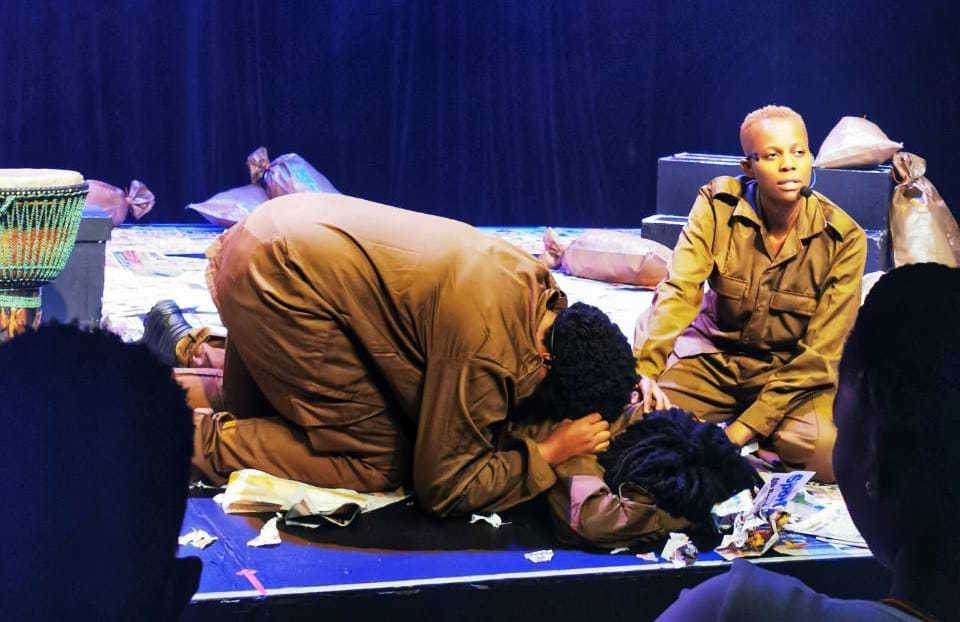
When everyone was seated, the lights dimmed, and women’s voices began to pour from the speakers. The voices were from audio recordings providing testimonies of underage solicitation, sexual harassment, abuse, and sexual assault. As the audio played, lights appeared from the back of the audience. Two women dressed as soldiers bearing torches walked slowly from the back of the theater onto the stage. Then, a third woman appeared in a dim haze of light from the right of the stage, also dressed as a soldier, and joined the others. The lights flashed as the three women stood in a straight line downstage and began to recite a short poem. The opening poem prepared the audience for those that would follow:
These poems are part of what remains of missing names.
These poems can never be a full story.
There are desperate poems elsewhere dying to be said.
These poems might be the only evidence that we were here.
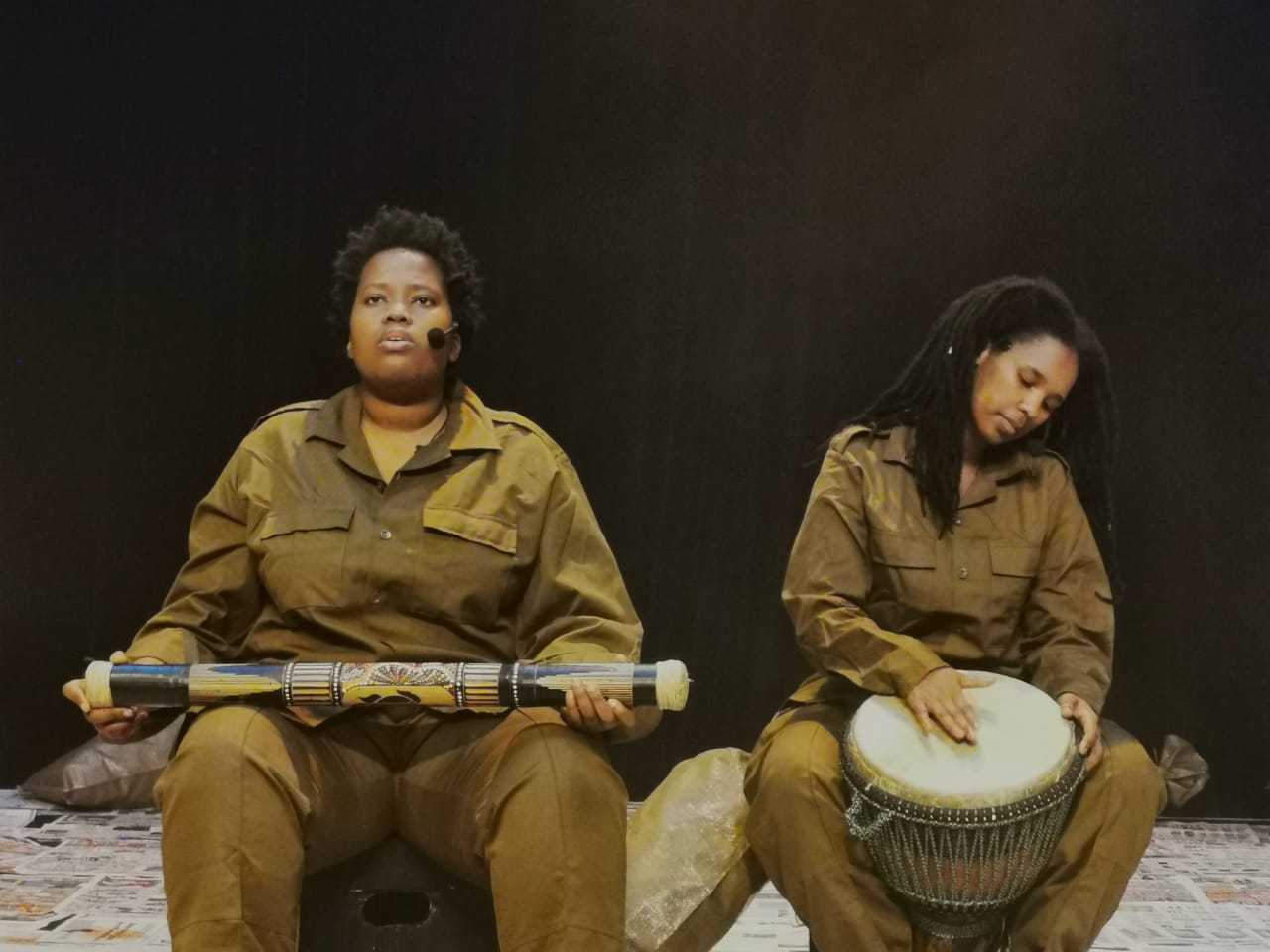
Jonas was the last soldier to join the stage, completing the three-woman chorus who embodied the daily wars waged against women in South Africa. Jonas was joined by Hope Netshivhambe, co-writer of the production whom she met at a poetry workshop; and vocalist Babalwa Makwetu, who wrote the music. Jonas had worked with both women in the past at different spoken-word events. “They were my first choice in sharing this work,” said Jonas.
The women started to work on the production in September 2019. It debuted two months later, during 16 Days of Activism against Gender-Based Violence, an annual global campaign calling for the prevention and elimination of violence against women and girls. Still under development at the time, the women wanted to gauge the level of interest and make improvements where needed, evolving the show to their audience’s needs.
According to a report by the South African Police Service (SAPS), between April 2018 and March 2019 alone, there were 179,683 reported crimes against women, including murder, assault, and sexual offenses.
The production was inspired by a poem Jonas wrote in 2018 titled, “Thanks for the Hashtag, But…,” which she wrote at a time when newsreel of violence against women seemed relentless. Recited in the epilogue, the poem meditated on the everyday violence against women in South Africa and — partly — how tiresome it was to call out the same pain so routinely.
“There is always a hashtag, always someone missing, always a news report,” said Jonas. “We are living in a climate of hashtags.” The one chosen for the production’s title spoke to the level of urgency that the women demanded in order to live free from the threat of being harassed, attacked, raped, or murdered.
The production, which ran from November 30, 2019, to February 29, 2020, received an overwhelmingly positive response. Following the production on opening night, the audience was given time to ask questions and share their own stories. One woman in the audience that night shared that she had attended a funeral for a victim of GBV only that morning. “It was incredibly heart-wrenching,” said Jonas. “We just stood there and hugged without saying a word. So many of us were crying; words were not necessary.”
A second audience member used the forum to share her traumatic experience of being gang-raped in high school. “She was afraid the production would be triggering,” said Jonas. “But she said it was told with so much sensitivity towards victims. It was the first time she truly felt as if she was not alone in fighting.”
The actual conviction rates of crimes against women are unclear. For example, South Africa’s National Prosecuting Authority 2018-2019 Annual Report put the conviction rate for sexual offense crimes at 74.4 percent, the highest rate in the last five years, according to the report. However, the U.S. State Department’s Bureau of Democracy, Human Rights and Labor country report on human rights practices for 2019 appears to dispute that claim: while the National Prosecuting Authority records the conviction rate of sexual offenses at 71.7 percent between 2016 and 2017, the State Department report cites a 2017 Medical Research Council study concluding that only 18.5 percent of rape cases reported went to trial, with only 8.6 percent resulting in a conviction.
What’s more, the State Department report goes on to note the difficulty of bringing cases to trial because of insufficient evidence, rape kit shortages, inadequate police training, and overburdened courts.
In addition to shortcomings in the police and criminal justice systems, South Africa has a culture of silence and shame, which operates to further perpetuate GBV. Victims may be too afraid to speak out for fear of retaliation, of being disbelieved and ostracized from society, or out of mistrust in the justice system. There’s also the stigma of abuse: victims are often treated as if they brought the abuse upon themselves.
Jonas references how silence permeates in “Thanks for the Hashtag But…”:
The police ask what I did to deserve it here.
The family wants to solve this as a family here.
They say I’ll ruin the family here.
Women often choose silence to avoid public scrutiny. In 2018, while 22-year-old Cheryl Zondi was preparing to testify against a popular televangelist in a rape trial, she received threatening calls that told her “God will kill her because she goes against a man of God.”
Zondi was also advised by people she trusted to hide the assault because he wouldn’t go to prison. And, during the trial, when Zondi was cross-examined, the defense asked her how deep she believed the pastor penetrated her and why she didn't scream.
In early February of this year, a judge overturned a rape conviction for a man serving a 20-year sentence for the rape and murder of a sex worker, stating in his judgment that he just didn’t believe there was credible evidence that the sex was non-consensual. “She accompanied him to his room where they spent time together and even drank tea and enjoyed a sandwich,” he said.
The stigma of being single also prevents victims from coming forward. “In most cases, women are encouraged to remain in abusive marriages and relationships because of the shame of singlehood,” said Vanessa Sibanda, a social worker born in South Africa. “Marriage and relationships are considered to be an achievement, so women are stuck between facing shame for being single or remaining quiet, hoping for change by being patient.”
For migrant and refugee women, the silence is motivated by something else entirely: fear of deportation. When xenophobic attacks against African foreign nationals flared in late August 2019, a 30-year-old Malawian woman was reportedly assaulted by a machete-wielding gang looted her grocery story in Jeppestown, a suburb of Johannesburg. She said her attackers accused her of bringing HIV/AIDS to South Africa and taking their jobs. “They think we are prostitutes, and [that] sleeping with us forcefully is not a crime. They think they have a right to rape us,” she told Global Sisters Report.
“Migrant women do not disclose rape and abuse due to fear of being deported,” said Sibanda. “Abusers themselves may threaten to report them to immigration, which acts as a form of silence.”
In September 2019, President Cyril Ramaphosa unveiled the Emergency Action Plan on Gender-Based Violence and Femicide (GBVF), committing about USD $108 million of government to improve access to justice for survivors; campaigns to change attitudes and behavior; strengthening how the criminal justice system responds to crimes; and establishing jobs and economic opportunities for vulnerable women.
Critics of the plan noted the lack of detail and voiced concern for how the money would be allocated. “There is a lot of talk, plans are made, but there is no impactful change, and the effect on the lives of women and girls is devastating,” said Shenilla Mohamed, executive director of Amnesty International South Africa. “The South African government has to do better.”
Creative social projects like “#WeAreDyingHere” work to inspire community activism from the grassroots and demand the government confront its failure to protect women.
Through performance art, Jonas hoped to make an impact on the larger conversation around GBV by employing the body like a stage, screen, or canvas for social issues. “#WeAreDyingHere” aligned the bodies and voices of 3 women with thousands of women desperately fighting for the freedom of their own bodies and voices. Stories of rape, assault, intimidation, and murder were reflected by the women’s own experiences and those of their loved ones. Through these messages, “#WeAreDyingHere” called for the culture that perpetuated GBV to be broken.
In the future, Jonas hopes to see the production go beyond the theater space to offices, schools, and churches—anywhere it’s needed. “We always say how the ongoing violence means we don’t really have a space to say, ‘I am not okay,’ and we have to continue living with the trauma of our experiences,” she said. “This production invites people to step back and breathe before rushing to find answers and solutions. We want to encourage a culture of being okay with being uncomfortable.”
On the production’s closing night, the women dressed in garbage bags, symbolizing the way women are used and discarded. In the final poem before the epilogue, Jonas belted out:
Every step taken in the streets is a prayer to not be seen.
Every prayer made by a woman in the streets is a question to God.
Every breath taken by a woman upon her arrival is a sigh of relief.
What will it take for him to stop?
As if we are a challenge to be conquered.
What will it take for men to stop?
The “#WeAreDyingHere” stage production is now available for livestream. Tickets to the virtual event can be found here.
More articles by Category: Arts and culture, Gender-based violence, International, Violence against women
More articles by Tag: South Africa


