















We Have Yet to Know the True Toll of Nigeria’s Latest Doctors Strike on Women and Children
Ilorin, Nigeria — In late August, a week after Aisha AbdulQozeem gave birth to her son Adam, the infant began exhibiting symptoms of pneumonia. At first, she thought it was because he had been overfed, but when his condition worsened, the family took him back to the maternity hospital where he was born just several days before.
“They told us that the case was bigger than what they could handle, so we had to go to a bigger government hospital,” Toyin Kehinde, Adam’s grandmother, told Women Under Siege in Yoruba. But no government hospital in the city would admit the infant because the doctors were not working. For hours, Kehinde said, she and her daughter-in-law frantically searched for a facility that would admit them. “We dared not go back home because the baby was already dying,” she said.
At last, by some stroke of luck, they were admitted at one of the state’s smaller health facilities with the right medical equipment. “The baby is only still alive today because God says so.”
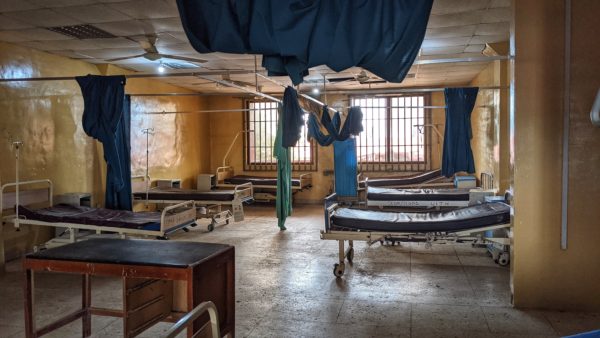
On August 2, Nigeria’s National Association of Resident Doctors (NARD) announced that its members would be going on an indefinite strike over the federal government’s failure to pay their salary — leaving hundreds of care seekers unattended amid a fresh wave of coronavirus infections. Among the NARD’s other demands — which were also unmet by the government — were payment for death insurance benefits to families of doctors who died from the pandemic, hazard allowance, and a minimum wage.
“It is unfortunate that we have a government that willfully goes into agreement but will not favor it, and that is where we have to fight for our members,” said Dr. Badmus Habeeb, NARD’s president. “Doctors are essential workers owed money, some up to 19 months [of pay].”
He emphasized how difficult it is to work without pay and defended that doctors are human beings, too. “Maybe when they start fighting for us, we may consider not going on strike.”
The strike would devastate the country’s health care system, which was already debilitated by the pandemic crisis, and many fear that women and children will ultimately bear the brunt of the consequences.
Habeeb avoided exploring those consequences in-depth but said that any strike action has a negative effect on these groups. “Definitely, it will deny them access to medical care, but that is not our aim.”
An ailing health care system
Since the start of the pandemic, doctors have gone on strike four times over unpaid wages.
The Nigerian government has been known to default on workers’ salaries and not adhere to agreements, forcing a new custom among different trade unions to resort to strikes in order to be paid their rightful benefits. Last year, the Academic Staff Union of Universities, an association of lecturers, went on a 10-month strike over unpaid salaries.
It partly explains why hundreds of doctors emigrate every year in search of more favorable working and living conditions, causing brain drain in one of the country’s most critical sectors. Presently, Nigeria has one doctor for every 5,000 patients, for a population of more than 200 million.
For women and children especially, who have unique and recurrent medical needs, “a lot of things could go wrong” during a strike, said Oyelami H.O., a maternal health nurse in Ogbomosho, a city outside Ilorin. “For example, some pregnant women are hypertensive, and they need to consult [their] doctors frequently because they need to change drugs regularly. Without a doctor’s prescription, they cannot change the drugs, and the nurses can’t do anything about it.”
She explained that there’s only so much nurses and other medical staff can do without a doctor’s training, especially when it comes to prenatal, maternal, and pediatric health, when there are only too many opportunities for life-threatening complications to arise.
Nigeria already accounts for nearly 20 percent of the world’s maternal deaths — a premium that the Nigerian government has placed on the country’s health care system, said Professor Salihu Ajao, a senior lecturer at the University of Ilorin’s medical school.
When strikes like this happen, people are often forced to patronize either more expensive private clinics — which are out of reach for most Nigerians (much less for the more than 80 million people living below the poverty line and often cannot afford the charges from subsidized government hospitals) — or backstreet hospital operators.
A shadow market of health care delivery already exists in Nigeria, dominated by uncertified doctors who stand in as a supposedly cheaper option for Nigerians who cannot afford private care. But using their services is dangerous, especially for women seeking reproductive or maternal health care: women have reportedly died from unsafe abortions and caesareans performed by these “quack doctors.”
Ajao said that the government’s belligerence is a motivating factor in the continued widespread proliferation of backstreet doctors — not only in its refusal to pay actual qualified doctors but also through its feigned ignorance of this market.
“It is their [the government's] responsibility,” said Ajao. “Are they saying they don’t know where these quacks are? They set up here and there — mushroom clinics — and the government looks the other way.”
All attempts to reach officials at the Ministry of Health for comment on the strike's effect on women and children were unanswered.
The country’s poor drug regulatory practices also make room for self-medication, a common practice in Nigeria, as an alternative to seeking medical care — another dangerous option, particularly for women and children.
In response to NARD’s strike, the government sued the trade union at the industrial court, which ordered the union to suspend its strike. But NARD rejected the ruling and ignored the court directive.
A temporary truce
NARD eventually called off its strike on October 4, after 63 days (by comparison, the last doctors strike lasted only 10 days). But the truce seems tentative, and temporary. NARD agreed to return to hospital wards after the government promised to meet some of the union’s minimum demands — like salary arrears and hazard allowance — within the given six-week time frame, which ended on November 15. At the time of reporting, Badmus said that the government has indeed begun fulfilling those agreements, and a new strike does not appear to be on the horizon.
While Ajao sympathizes with the reasons forcing doctors to go on strike, he laments the uncountable fallout for women who were denied critical health care in that time. “In a country where our demographic statistics are bad, we are unable to appropriately document how many women die during such strike actions,” he said. “It is unfortunate, but that is where we find ourselves.”
“The subject matter is critical,” Dr. Osagie Ehanire, Nigeria’s minister of health, told Arise News in a televised interview in late August. “We do not know the statistics of persons who may have been lost as a result of doctors not going to work.”
“In my own view — and I have always told the resident doctors [this] — we need to be aware of the fact that we are custodians of life of people, and we need to always know that there is no amount of money that has not been paid that we cannot talk about, but none of it is worth the lives that may be lost.”
“The government should just be honest with the agreement they are signing with the various associations and unions, [and] I am telling you, the strike will go away,” Ajao said. “We know the solutions to our problems, but we do not have the willpower to implement them.”
More articles by Category: Health, International
More articles by Tag: Nigeria, Maternal health


