















The Troubling Vaccine Hesitancy Among Pregnant Women in Kashmir
Pulwama, Indian-administered Kashmir — Since the COVID-19 global pandemic began in March 2020, Salma Jan, 32, has caught the disease twice; the second time was March of this year, when she was in her second trimester. She is currently six months pregnant with her first child.
“When I was quarantining, I was thinking about my baby’s safety and all the bad things that could happen to me,” she said.
Since recovering from her last infection, Jan hasn’t left the house — not even for a prenatal check-up — out of fear that she might become infected once again.
To date, roughly 300,000 cases have been recorded in the Indian region of Jammu and Kashmir since the start of the pandemic. It is far less than what the rest of India has suffered, but health care access and infrastructure are longstanding issues that have grown to critical concern after the abrogation of the autonomous status of the region on August 5, 2019, which further constricted access to basic health care and emergency services. In Kashmir, there is one doctor per 3,866 people, compared to India’s overall average of one doctor to 2,000 people.
But Jan, like many pregnant women in Indian-administered Kashmir — and other parts in India — is not yet vaccinated.
According to guidance from the U.S.-based Centers for Disease Control and Prevention (CDC), pregnant women are at increased risk of severe illness from COVID-19 compared to non-pregnant people. Additionally, they are at increased risk of preterm birth and other adverse pregnancy outcomes.
Digital news outlet IndiaSpend reported that the second wave of the pandemic in India, which began in early February of this year, has affected pregnant women much more severely than the first had, and has also caused more maternal deaths. But officials have yet to publish data on maternal deaths related to COVID-19.
A source from the Divisional COVID Control Room Kashmir, who requested to remain anonymous, told us that some 2,550 pregnant women had tested positive in Kashmir since 2020.
The Federation of Obstetric and Gynecological Society of India (FOGSI) has recommended COVID-19 vaccination for pregnant and lactating women, stating that “there is no obvious basis for excluding pregnant or lactating women from vaccination.” But the Indian government has been conservative, citing a lack of clinical trials. Jan said that her gynecologist advised against getting vaccinated on the same grounds.
“The COVID-19 vaccine is just three to four months old in India,” said Dr. Basharat Pandit, an obstetrician from Pulwama, where Jan lives. “We don’t have any data about its effect after nine months of pregnancy.” He told us that he isn’t encouraging his pregnant patients to get vaccinated.
Several obstetricians and gynecologists we spoke to in Kashmir were reluctant to give their opinion about pregnant women getting vaccinated, preferring instead to wait on a formal order from the government of India.
Masooda Akhter, a social worker from Anantnag in Kashmir, is eight months pregnant. Like Jan, she has also sought guidance from doctors about whether or not she should get vaccinated. “But there was no positive response,” she said.
“Doctors are not sure about how safe the COVID-19 vaccine is for us, which is very confusing,” said Jan.
Vaccine skepticism and myths
Recent data shows that women in Jammu and Kashmir, as well as in some other parts of India, are lagging behind men in terms of vaccinations administered. In fact, Jammu and Kashmir, Delhi, and Uttar Pradesh have some of the most skewed sex ratios.
Several women we spoke to, who are from rural areas across Kashmir, believed unsubstantiated claims that vaccines caused trouble with menstruation, fertility, and pregnancy.
“I heard that if a woman gets the vaccine, she won’t conceive,” said Shaheena Bano, 36, from Shopian. She said that no women in her locality between the ages of 18 and 40 have been vaccinated.
Rabiya Jan, 28, a lactating mother from Pulwama, said that she and her friends have concerns over the side effects of vaccination. “They say it causes problems in menstruating women,” Jan said. “I was about to get vaccinated, but when I heard different opinions from different people, I thought it is better not to do so.”
One such opinion came from Jan’s neighbor, a health worker, who told her to wait before getting vaccinated.
Indeed, more than 80 percent of health care workers in Kashmir have avoided inoculation, citing “mistrust and misinformation.”
“Some simply want to wait as they are fearful of being first in line,” said Dr. Nisar-ul-Hassan, president of the Doctors Association Kashmir (DAK).
“Vaccination is safe for everyone,” said Dr. Amir Lone, an obstetrician and gynecologist. “It is just that there is not enough data regarding how safe vaccination is for pregnant women. We will have to wait for that.”
A long history of mistrust
According to the most recent census data, 72 percent of the region’s population lives in rural areas. Lone said that those residing in rural areas in Kashmir do not have access to smartphones and therefore rely on word of mouth for news, which leaves them vulnerable to misinformation and, by extension, vaccine hesitancy.
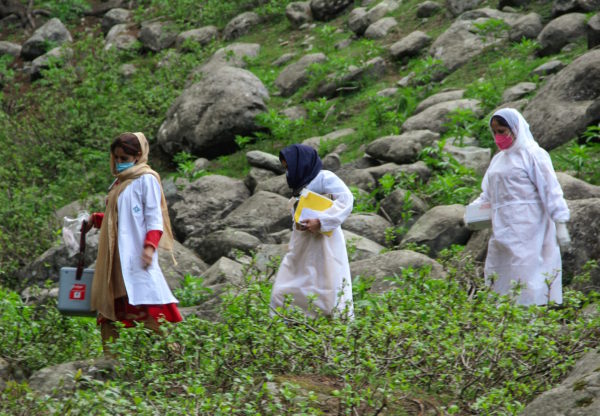
The lack of awareness in these areas is also due to a lack of health care facilities and infrastructure. Hence, doctors and paramedics have been assigned to reach remote areas where online registration is inaccessible. The regional government launched door-to-door vaccine drives to identify those who were in home isolation and needed timely vaccination.
Dr. Mahnoor Qadri, the Srinagar district vaccine and cold manager from the United Nations Development Programme (UNDP), told Women Under Siegethat this initiative is aimed at vulnerable groups in remotely-inaccessible areas, slums, and other areas in Kashmir to ensure that the hardest-to-reach populations would get vaccinated.
According to Qadri, the administration has started vaccinating people ages 18 to 45 several months ago, and now 15 percent of this age group has been vaccinated with at least the first dose.
A long history of mistrust
But progress has been slow — and hard-won — for the Indian government.
“People at times don’t allow us to enter their houses,” said Najma Parvaiz, a field worker from Trichal village in Pulwama. “They feel vaccines are unsafe for them and that, [with] vaccination, the government is jeopardizing their lives.”
Parvaiz and her team saw that much of the hesitancy was due to the people’s mistrust in health workers for their collaboration with the Indian administration for these drives. In Kashmir — a disputed region between India and Pakistan that both countries claim in its entirety — the Muslim-majority population has historically suffered abuse, including egregious human rights violations, by the Indian government, with the aftermath of violent crackdowns from the abrogration two years ago still plaguing the region.
Some health workers have filmed and taken photos of patients during their vaccine drives in Kashmir, which has angered locals who felt that their privacy was violated and accused the health workers of perpetuating a false sense of trust in the Indian administration. In several videos that have gone viral on social media, locals are seen having confrontations with the health workers during these door-to-door drives.
“It is definitely exacerbated by the acute mistrust of Indian policies,” said Ather Zia, a political anthropologist from Kashmir. “It is hard for people to believe that Indian necropolitics toward Kashmiris can change.”
‘Who doesn’t want to be safe, after all?’
On June 25, the Ministry of Health said that pregnant women can go for vaccination. “Vaccination is useful in pregnant women, and it should be given,” said Indian Council for Medical Research Director-General Dr. Balram Bhargava, adding that the government will soon release its guidelines for this specific group.
But Salma Jan and Akhter still maintain their reticence. “I can’t take the risk right now,” said Jan. Akhter, however, said that if her doctor clears her for vaccination, then she has no problem with it.
“Who doesn’t want to be safe, after all?” she said.
India has no time to waste in getting as many of its citizens inoculated as possible. The Delta variant, a highly transmissible variant of the coronavirus, is now present across 174 districts in India, and its sub-lineage, Delta plus, has been detected in 48 samples in ten states.
While virologists do not yet know how lethal the Delta plus variant is, the health ministry has already warned eight states, including the Jammu and Kashmir, to implement containment measures.
“Considering the current situation, I think it is high time to make vaccines mandatory for pregnant women,” said Dr. Nisar-ul-Hassan, DAK president. “The government must conduct more awareness programs and reach out to people personally wherever vaccine hesitancy is.”
More articles by Category: Health, International
More articles by Tag: India, Kashmir, Maternal health


