















Placing blame: Report debunks misconceptions about wartime rape
The media loves to generalize about war, and with it, wartime sexualized violence. But ignoring nuance does nobody any favors—neither the survivors themselves, nor those who are trying to stop it.
We’ve written about the problem with asserting that rape in Syria is deliberate, even as we track a slew of reports from that conflict on our crowdmap. We’ve also heard from experts about how hard it is to draw big conclusions from statistics—how the numbers on wartime rape, no matter what, usually don’t add up. Now, a report from the United States Institute of Peace (USIP), written by Dara Kay Cohen, Amelia Hoover Green, and Elisabeth Jean Wood titled “Wartime Sexual Violence Misconceptions, Implications, and Ways Forward” looks at simplifications that even experts tend to make, and dispels generalizations about who is committing rape—and why.
One of the report’s most intriguing findings is that government forces are “more likely to be reported as perpetrators of sexual violence than rebels.” But are researchers getting this right? While it is quite possible that a government may perpetrate rape and other forms of sexualized violence more than other actors in a given conflict, Cohen, Hoover Green, and Wood explore reasons why this reporting may be skewed.
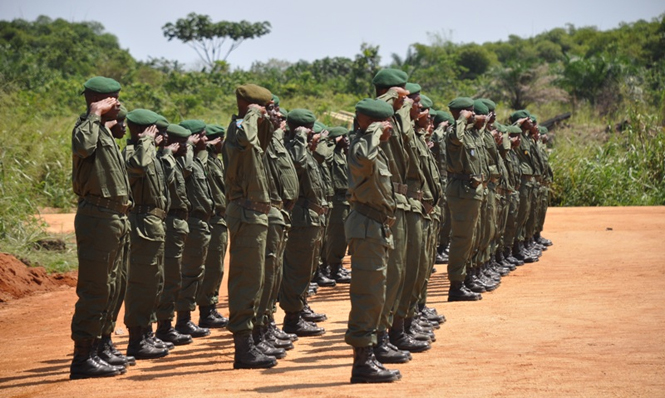
A government battalion in the Democratic Republic of Congo. Researchers say there are reasons to believe that state forces do in fact comprise the majority of the perpetrators of sexualized violence in war. (U.S. Army Africa)
For one thing, the authors point out, those who report on or study rape in war may find it advantageous to emphasize government responsibility for the violence. “Research shows that states can be effectively named and shamed,” the authors write, “and recent international campaigns have aimed to do just that.” As co-author Hoover Green told WMC’s Women Under Siege, “Rebel groups typically operate somewhat informally, whereas states often are parties to various agreements about human rights.” Thus it’s reasonable to expect that activists are more susceptible to pointing fingers at governments.
On the other hand, Hoover Green said, a rebel group that announces its participation in human rights conventions might be ripe for naming and shaming as well. For instance, she said, some rebel groups in Syria have already made such declarations. When that happens, she explained, there may be less of a bias toward blaming state actors more than rebels for human rights violations like rape.
Either way, there are reasons to believe that state forces do in fact comprise the majority of the perpetrators. Hoover Green said that researchers’ findings might in fact be correct. (And so far, our research into sexualized violence in Syria shows that about 70 percent of the alleged perpetrators in our crowdmap reports are government or government-aligned forces.) But as with everything war-related, there is still no single easy answer as to why that might be the case.
One reason Hoover Green floated as to why government actors might be disproportionately responsible for rape is that they are “less likely to engage in educational campaigns that teach recruits about the purposes of war and violence.” Citing her co-author Cohen’s research, she said that differences in the ways rebel groups and government groups are socialized could be a contributing factor as well. Because new recruits in government forces are “less likely to know one another, trust one another, and/or have a set hierarchy than are recruits in rebel groups,” she said, their relatively low social cohesiveness can breed more acts of rape.
But aside from state and rebel forces, there is another key, but often overlooked, group of perpetrators: civilians.
The general population, the authors write, make up a “large proportion” of wartime rape. WMC’s Women Under Siege has written previously that sexualized violence during conflict can alter the rate of sexualized violence after conflict. As writer Laura Bates highlighted on our site, a 2010 Oxfam report on eastern Democratic Republic of Congo found a startling change in post-war behavior: “from 2004 to 2008, the number of civilian rapes increased by an astounding 1,733 percent or 17-fold, while the number of rapes by armed combatants decreased by 77 percent.” The idea is that conflict-related rape can “normalize” rape among civilians both during and after conflict.
An important emphasis in the report is placed on the fact that even when rape is actually perpetrated by state forces, that does not mean that it is strategic.
“It’s rhetorically useful to say ‘They’re doing it on purpose,’” Hoover Green said, “and that’s true on the level of the individual rapist. Nobody rapes by accident. On the other hand, presenting rape as if it has one single cause is not a wise choice.”
As we’ve written in our in-depth profiles of conflicts, there is great variance in the ways ways that sexualized violence has been used as a tool of war. Armed forces do not always utilize rape and other forms of sexualized violence strategically, in a way that is ordered from some higher authoritative power—although that doesn’t mean it is not frequent, or tolerated by commanders. Regardless of whether a soldier decides on his own to rape a civilian or is ordered to by his military superiors, those superiors are still responsible for the crimes under international criminal law. Justice means holding not just the direct perpetrators accountable, but also those who oversee them.
“If we ignore bottom-up mechanisms like group socialization in favor of arguing that rape is part of a top-down plan, the policy that’s produced is going to focus on command decisions rather than group dynamics or institutions,” said Hoover Green. “I think that could be disastrous.”
The report gets into popular misconceptions as to who the victims are, as well as how we falsely think that rape is ubiquitous in all wars, that the perpetrators are always men, and that given the opportunity, “men will always rape.”
Why does all this matter? Put simply: “Just as well-substantiated research findings carry implications for policymakers, knowing more about the gaps in the knowledge base can help policymakers avoid the pitfalls associated with incomplete data, and highlight areas where greater efforts are needed.”
And that’s one thing we hardly need to debunk: that greater efforts to stop the ongoing sexualized violence against women globally are sorely, vitally needed.
More articles by Category: International, Violence against women
More articles by Tag: Rape, Military, Sexualized violence


