
















Twenty-five years of breathing in dust has led Mireille Mbale to drink milk when she can afford it; it is what she believes will guard her against lung disease. She makes less than $5 a day. Years of the eastern Democratic Republic of Congo’s brash sun have dried her exposed skin.
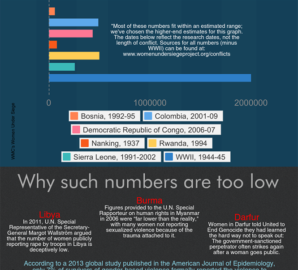
We know there’s a problem but we don’t know how big it is. That’s what governments, scholars, and others argue when trying to figure out how to allot funds toward this problem of sexualized violence in conflict. If we don’t know the numbers, they ask, how can we help properly? How can we mount prosecutions? Offer reparations? Put in place proper advocacy? So the thinking goes.

With the 16 Days of Activism Against Gender Violence starting tomorrow, November 25, I thought I’d share some of my favorite recent reads on gender-based violence, whether close to home or far afield.
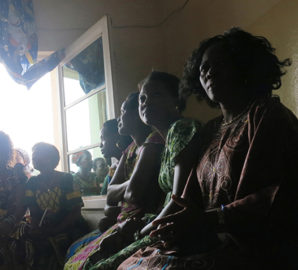
A young woman seems to have attached herself to me one day at Zaatari, a refugee camp holding at least 120,000 Syrians in the middle of the Jordanian desert. Her name is Abeer and she is the less obviously beautiful, older sister to a 16-year-old girl who has been married off to a much-older Libyan food distributor. He gave the girl a watch, perfume, and water when they met.

The war in Congo is like a snake. Sometimes it slithers by and you see it and feel terror; other times, it hides in the trees, waiting. Everywhere I traveled in the country with the Nobel Women’s Initiative in February, I felt that ever-present fear—and exhaustion from so many years of being either attacked or on the lookout.
There were so very many stories. Stories of women physically torn apart, leaving stains of urine on chairs from fistula they suffered from violent rape. Stories about sexual enslavement that left teenage girls hysterically crying and unable to finish speaking. Stories of erasure—of women who had been left by their husbands and shunned by their own children because men had raped them.

I’ve been reading King Leopold’s Ghost, by Adam Hochschild, which tells the utterly brutal colonial history of the Democratic Republic of Congo. Early on in the book, the author laments the lack of African voices on record that tell the history of the country. Instead it is a history told by the conquerors, as all history generally is. There is no shortage of evidence, however, that the Europeans who colonized the area inflicted terrors on black men and women that are stomach-sickening.
While the Geneva II talks about peace in Syria gear up to begin on January 22, I thought I’d put our latest numbers and information on sexualized violence in Syria up here for you to see. I recently laid out what we know about this at a talk at the Heirich Böll Foundation in Berlin, embedded below.
Bloodshed, famine, rape, internal displacement. There are truly few things as awful as the reality of living through modern warfare. The horror, suffering, and pain caused by war are acutely felt on an individual level. Often though, that pain is endured quietly, out of view, while the media focuses on bombs falling and guns firing.


Sometimes I read something that makes the movement of the world, the very air in the room, freeze to a stop. That’s what happened recently when I read a letter written by an activist in the Democratic Republic of Congo named Neema Namadamu. I read it once, then I read it again. Instead of describing why it had such a profound effect on me, I’m pasting it in full below.
