















Burma sends war criminal to represent human rights record at UN
Today, as part of the UN Human Rights Council’s “Universal Periodic Review” process, Burma will be questioned by every country in the world on the nooks and crannies of human rights abuses happening inside its borders. Unique from the other reviews taking place over a two-week period, Burma’s delegation is being led by a documented perpetrator of war crimes and crimes against humanity: minister of home affairs and major general of the army, Ko Ko.
The International Human Rights Clinic at Harvard Law School issued a report in 2014 addressing war crimes and crimes against humanity taking place over two years in eastern Burma’s Kayin State and Bago Division. The report, recounting the brutality with which the Burma military has fought a decades-long civil war, concludes that General Ko Ko is responsible for torture, murder, enslavement, pillage, rape, attacking civilians, and forcible transfer of a population—and that enough evidence exists for the issuance of an arrest warrant for him. These crimes were carried out as part of “civilian clearing” operations in which soldiers were told to “do whatever they wanted” to civilians in certain areas. This no doubt contributed to the systematized use of sexual violence for which the Burma military is notorious, and local human rights groups have documented appalling cases of rape and impunity. In fact, soldiers were told they would not be punished for rape unless they were reported in the media.
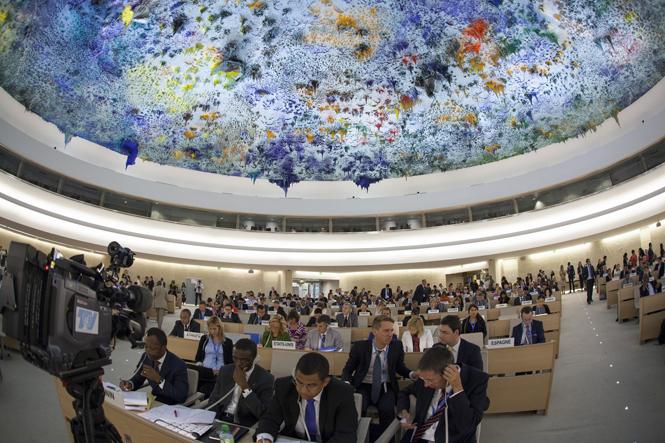
The UN Human Rights Council, seen here, is currently reviewing the human rights records of UN member states. Today, Burma, a country with a series of war crimes to answer for, is under scrutiny. (UN Photo/Jess Hoffman)
Harvard’s report wasn’t exactly news to human rights advocates working on Burma. Indeed, Burma has the unenviable distinction of being named in every one of the UN secretary-general’s reports on conflict-related sexualized violence and children in armed conflict. Still, the report is unique for naming specific individuals for committing specific international crimes, and even more unique for naming the sitting Minister of Home Affairs and the head of Burma’s UPR delegation, Major General Ko Ko as responsible for these crimes.
Owing to its strategic location, abundant natural resources and highly public (yet substantively lackluster) transition to democracy, Burma enjoys uniquely forgiving treatment on the international stage. Specifically, the opening of Burma to Western investment and the distancing of itself as a diplomatic ally with China has drawn the attention of the UK, Norway, Japan, and Australia. It is considered by many the high-water mark of foreign policy successes of presidential hopeful and former Secretary of State Hillary Clinton and is one of few notable blips on President Barack Obama’s “pivot to Asia.”
However, the deeper and more troubling issue is with Burma’s constitution, which grants immunity for government personnel (including military personnel) from prosecution for acts done in their official capacity. Under these laws, even if, by some miracle Ko Ko were tried for war crimes or crimes against humanity, it would be done in secret, under secret laws, and its outcome would be at the discretion of Burma’s commander-in-chief (which is an unelected, independent position superior to the president). What’s more, Ko Ko cannot be arrested or indicted at the UN, being enshrouded in an impenetrable immunity as part of his “Head of UPR Delegation” status For all intents and purposes, Ko Ko is invincible.
Worst of all, Ko Ko is just one of many. Burma’s almost 70 years of conflict and its accompanying depravity produced countless other war criminals, commanders and soldiers alike, that are all going unpunished and unfettered.
While appalling, sending a war criminal to the UN to defend their human rights record is politics as usual in Burma—where much of the government is populated by former-junta elite and active military. It also underscores how despite being touted as an example of reform, and regardless of the outcome of the general election being held on Sunday, Burma has not and refuses to change.
More articles by Category: International, Violence against women
More articles by Tag: United Nations, Law, Rape, Sexualized violence


