















As Time Slowed in India’s Justice System, an Eight-Month-Old Rape Victim Grew Up
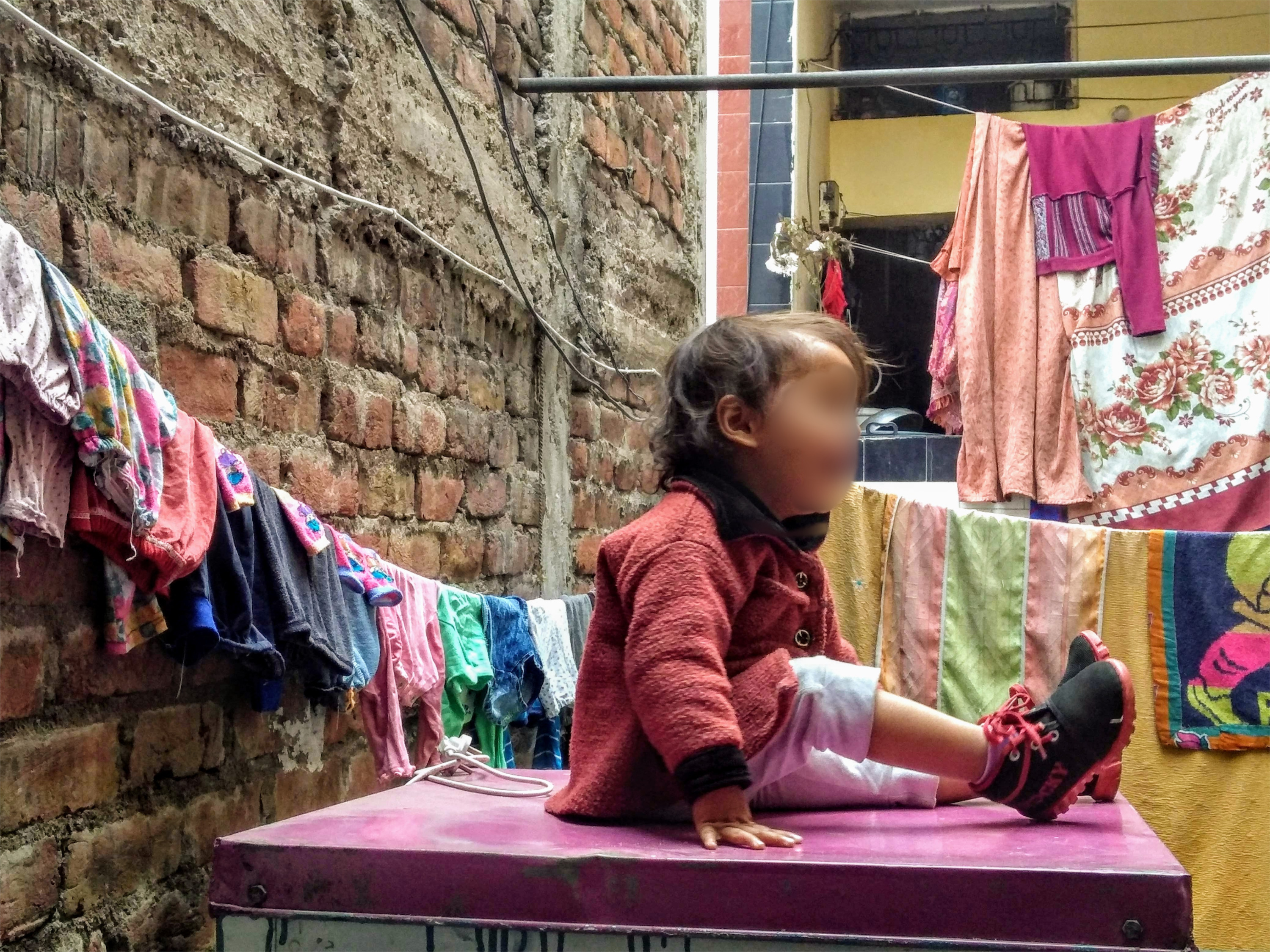
The phone call begins innocuously enough: Will I help research primary schools for her two daughters — Pia*, three, and Pari*, four-and-a-half years old? I agree wholeheartedly.
Then, the conversation swiftly and darkly pivots into familiar territory.
Manju*, the girls’ 24-year-old mother, has asked me the inevitable question: Nirbhaya’s rapists had been hanged. Do I think that Suraj, the man accused of raping her daughter Pia, will be fittingly punished?
I have no answer.
Pia was raped on January 28, 2018, in the family’s one-bedroom living quarters while her parents were both away at work. She was only eight months old.
Left under the care of her extended family of uncles and aunts, including her 28-year-old cousin, Suraj — all of whom live on different floors of the same shanty house in northwest Delhi — Pia was discovered lying in a pool of her own blood and excrement by her horrified mother when she came home from work that morning.
Suraj, with his wife and child, lived on the floor above Manju’s, with a single staircase connecting the two. When Manju came home, she found Suraj ambling in the narrow alley outside their house, apparently drunk, telling her that her baby had been incessantly crying. He shadowed her to her room. When Manju asked him if he had been in their home, she said, he appeared visibly disconcerted by her question and fled upstairs.
Acting on Manju’s First Information Report (FIR), a document prepared by the police when a victim lodges a complaint of any cognizable offense, her local police station investigated and arrested Suraj. Today, almost two-and-a-half years — and multiple surgeries — later, the trial of Pia’s rape drags on, with no end in sight.
As Manju and I discuss Suraj’s possible punishments, she admits her biggest fear: She doesn’t want Pia to grow up forever marked by what happened. What if schoolmates and their families pointed her out as the girl who was once that eight-month-old baby? “They’ll say, ‘There’s that girl who was raped before she turned one,” said Manju.
Her next question stumped me: “Suraj won’t be acquitted, will he?”
Frayed family ties
I first met Pia’s family at their home not long after the rape had occurred, sometime between their numerous hospital visits. The parents seemed eager to speak with me, to share their fears of their new reality. I followed up with them several times, including when I shot a documentary for a news outlet as part of a crowdfunding campaign to help cover Pia’s future medical and educational costs.
For those early stories, I asked family members several times if they’d heard anything that morning. “Nothing,” they maintained, refusing to say more.
It was the first glimmer of a severing of ties: a young couple had left their baby and toddler with the extended family; the baby was raped; and the extended family intransigently denied culpability. The shell-shocked parents couldn’t fathom the idea of leaving their children with the family again.
At the time, Manju said that her husband’s relatives blamed her for going out to work in the first place, conveniently absolving her husband, Gokul*, of the same sin. But their taunts bore fruit — Manju stopped working as a domestic worker to stay home with the girls. She has no plans of returning to her job anytime soon.
“What if something happens again while I’m away?” she once asked me. Manju doesn’t say it, but the guilt is written across her face.
Now, they live off the meager wages Gokul makes as a day laborer, as well as the occasional donations from people who call, they say, after happening upon their story – and annual installments from a fixed deposit in the bank that a media company had set up for them.
For Gokul, his grief is steeped in a deep sense of loss and betrayal at having been let down by family. “Suraj is my own nephew,” he told me. “How could he have done this to my daughter?”
Many a time, Gokul has returned home to hostile relatives, who’ve relentlessly accused him of besmirching the family name — and for “being in it for the property papers.”
“I already have my share of the house, signed over to me by my father,” he claimed. “Why would I ever do that?”
Suraj, meanwhile, is currently in jail, as the case remains ongoing.
Suraj’s mother and his young wife, Gokul and Manju claim, still harangue them in the days before a court hearing to take back the case. They implore them to think of the family.
“They’re all on the side of Suraj in this legal battle,” said Gokul and Manju. “Where was the family when we needed their support?”
An afterlife
The couple have said that they can’t find it in themselves to move out of the house Gokul had lived in since he was a boy, and where Manju has lived since she married him six years ago.
But their decision to stay has also bred paranoia, birthed after months of confinement under the same roof where their daughter’s alleged rapist had lived — it seemed like a natural progression.
At one of the hearings for Pia’s case in court, Manju and Gokul asked for CCTV cameras to be installed at various corners outside their home. They no longer felt safe, they told the court. The magistrate granted the request, and on one visit in early 2019, I found the couple feeding the children their lunch, squatting quietly in front of what looked like a television program — except it wasn’t. The four-part screen showed grainy visuals of the alleyway outside, the staircase leading up to their landing, the front door, and the door to their room.
“The media, the crowds, don’t come here anymore,” Manju recently told me in February. She’s been thinking as much for the last two years.
It was obvious that, while it stung, she had more important things to worry about — like getting her child justice.
The case drags on
Pia’s case was filed under India’s Protection of Children from Sexual Offenses (POCSO) Act, which handles all cases of offenses against children. All POCSO trials are held in fast-track courts, but even fast-tracked cases can roll on for years as India’s justice system constantly plays catch-up with the backlog.
At the directive of India’s Law Ministry, the country’s high courts last year supplied data to the ministry on rape and POCSO cases pending trial. Both the data on pending cases for rape (compiled before March 31, 2018) and the POCSO Act (compiled before June 2019) showed that the cases have a lag time of a little over a year.
As of June of last year, more than 96 percent of the total 1,66,882 pending rape cases are registered under POCSO — a sobering number.
“POCSO Act also directs that… the trial be completed within six months. However, despite strong law and policy framework, a large number of POCSO Act cases and rape cases remain pending across the country,” the Law Ministry noted in its report.
It is a reality familiar to Gokul and Manju.
When summoned, the couple wake up at dawn, bathe and perfume their toddlers, seat them in the nook of one arm, and take public transit to Tis Hazari District Court, where they wait their turn on one of the benches outside the courtroom.
At the last hearing, in November 2019, Gokul watched as Pia pirouetted prettily in a new frock (many have been donated or bought for them), giggling with abandon meters from the room where her trial was underway. “When will all this be over?” Gokul muttered.
After the hearing, the four make the long journey back home, the girls perched comfortably in the middle, looking like participants in a three-legged race.
Since hearings began in April 2018, Pia and Pari’s parents have been to at least eight of them. Manju’s own testimony has been given intermittently over five months in 2019. That length of time has been the hardest, she often says, the waiting between two to three months before the next summons.
By that standard, a verdict is likely some distance away.
Suspended justice
“Will the judge ask us what sort of punishment we’d like for Suraj?” she asks.
I answer in the negative and she sounds disappointed.
“What if Suraj is released on bail and comes back to hound us?” Manju asks me over the phone.
The chances of that happening are slim. While bail is permissible under almost every law under the Indian Penal Code, even Section 302 (applicable to murder), it is a lot harder under the POCSO Act. Certain variables will come into play, like whether the offense is rape, sexual harassment or stalking, or whether there are chances of the accused tampering with evidence if let out.
In late 2018, I sat in on a hearing in which Suraj asked for bail on account of his toddler son being ill. The magistrate decisively turned him down.
On June 22 of this year, Suraj had again applied for bail. His wife and mother were spurred by the case of a 62-year-old convict dying of COVID-19 in a Delhi jail, as well as by the Delhi High Court extending the interim bail by 45 days for more than 2,000 undertrial prisoners.
“I told the judge that if Suraj returns to this house, we will have no option but to flee,” she says over the phone. “My daughters will not be safe. Besides, I know they are only taking advantage of the crisis to rush for bail.”
The judge ultimately denied bail. But under the current lockdown, Pia’s case remains at a standstill. On June 13, in light of the pandemic, Delhi’s courts unanimously decided to restrict operations until June 30. It eventually extended that restriction to August 31. All “urgent matters,” the Delhi High Court decided, would be handled via video conferencing – with judges hearing matters from their respective residences. The next hearing won’t take place until after the restrictions are entirely lifted. Until then, Manju and Gokul wait.
For the last few months, the two have been talking about moving out and finding a new home. But the hunt is a mirage. The very motivations that make them want to move pull them back. Neither wants to bring up their daughters in the home of their baby girl’s alleged rapist and a family who’ve turned their back on them. The reality that they continue to inhabit a crime scene has shrunk an already tiny space into a claustrophobic microcosm.
“I feel stifled here,” Manju has said, over and over again.
And yet, she’s determined not to move until the trial is over. “I don’t want to leave until he’s punished.”
More articles by Category: Gender-based violence, Girls, International, Violence against women
More articles by Tag: Sexualized violence, India


