















A needed controversy over sexualized violence in Democratic Republic of Congo
In August 2010, reports began trickling out of Democratic Republic of Congo about another tragic episode of mass sexualized violence perpetrated by rebel troops over four days in the eastern town of Luvungi. The International Medical Corps, or IMC, an American aid group, was first on the scene to provide help and assessment. Their data informed reports by UN Peacekeeping that indicated that there were 37 victims; months later, an official UN document stated that 387 civilians had been raped.
But in a recent issue of Foreign Policy, journalist Laura Heaton challenged those figures, suggesting that the numbers were inflated and that rape receives more international aid and consideration than other pressing humanitarian issues in DRC. Two IMC aid workers who were at Luvungi at the time, Micah Williams and Will Cragin, responded. In a later Foreign Policy article, they disputed Heaton’s claims of misrepresentation and the privileging of sexualized violence by the global aid community.
While we will never know exactly what transpired at Luvungi, these disparate perspectives and the controversy over whether Heaton’s argument is valid highlight the need for candid conversation about Congo.
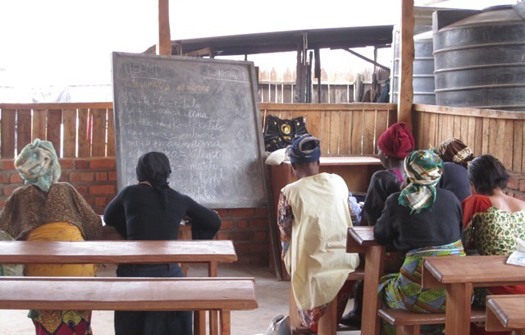
Survivors of sexualized violence take a literacy class at Panzi Hospital in Bukavu, Democratic Republic of Congo. (Lee Ann De Reus)
The level of mass atrocities occurring in DRC is undisputedly catastrophic. At Panzi Hospital, a general referral hospital run by Dr. Denis Mukwege and with which I conduct research and fundraising, 19,270 survivors of sexualized violence were treated from 1999-2012. These are some numbers we know. While Heaton and IMC may disagree on Luvungi particulars, the unifying fact is that sexualized violence, like many problems in Congo, is a symptom at the intersection of failed economic, social, and political structures. Yet persistent oversimplifications by media, aid agencies, development organizations, advocacy groups, academics, and other well-meaning parties distort the world’s perceptions of DRC. The result is an ineffective response to violence that only applies a band-aid to human suffering and stifles Congolese self-determination. In order to break this cycle, we have to better understand and address the atrocities and their root causes. And, as with other conflict-ridden regions, we can’t assume we know better than the country’s own population.
The narrative about sexualized violence in Congo is crafted primarily by outsiders—often, non-Congolese individuals who lack a nuanced understanding of the issues. Survivors, and the Congolese who work with them, rarely control the stories coming out of their own country. Indigenous knowledge is routinely dismissed or neglected. But as Williams and Cragin state in their Foreign Policy rebuttal, “…in any debate over rape in eastern DRC, Congolese women and girls who have been most affected deserve the final say on truth.” Outsiders who come to help—and I am one of them—need to listen to survivors’ experiences, rather than simply broadcast their own perspectives.
Inherent in these outsider-built narratives are provocative sound bites like “rape capital of the world” and “worst place in the world to be a woman.” These labels, used to engage the public or influence funders, are reductionist and perpetuate a stereotype of Congolese men as rapists and women as victims. This is epitomized by the self-serving “hit-and-run” researcher or journalist who swoops into Congo, re-traumatizes survivors with insensitive interrogation, and then uses their images and words with no regard for the survivors’ privacy and safety.
Examples of such exploitation and inadvertent harm are countless.
I was at Panzi Hospital in 2009 just days after an outside women’s rights advocate had encouraged Congolese survivors to go public with their stories in Bukavu. This activity, based on a very Western notion of empowerment, backfired for at least one participant, when her landlord decided to double her rent because of her association with wealthy whites. In the wake of this, neighbors and staff at Panzi had to scramble to find housing and an attorney to rectify the situation.
In another example, a visitor to the hospital gave out $100 bills to survivors when moved by a woman’s story. This upset an already fragile dynamic within this community of survivors. It made women who had received the money targets for theft, and left them in the precarious position of trying to break a very large bill. Those do-gooder dollars didn’t necessarily help the women who received them.
In 2010, a Scandinavian journalist included a survivor’s story and photo in a book that was available in a Bukavu library. The woman who had granted the interview was uneducated and had a limited understanding of book publication and distribution. She had hid her attack successfully—until her husband discovered the book, read his wife’s story, and subsequently abandoned her due to the stigma associated with rape.
I observed yet another example of exploitation this fall when a U.S. university research team arrived in Congo to implement a study with survivors. The principal investigator used Panzi’s logo without permission, aggressively pursued staff for access to women, and gave gifts to any survivor who told her story—corrupting the research process.
“Rape as a weapon of war” is another oversimplification used to explain the ongoing abuse of women in DRC. While the term does apply to some patterns of violence during the region’s conflict, it disregards rape in other contexts (such as domestic violence that occurs in the home), overlooks other forms of violence (like torture), and implies that there is an actual war when Congo is technically post-conflict.
Outsiders also regularly cite the exploitation of mineral resources as the source of war-related rape. According to the prevailing narrative, these illegally extracted conflict minerals fund the armed groups who commit the atrocities. While there is certainly some truth to this explanation, its narrow focus distracts attention from the larger structural factors at the root of violence: Congo is a failed state. It is ranked 186 out of 187 countries in the 2012 Human Development Index based on indicators of health, education, and income. It lacks basic infrastructure and, consequently, an ability to provide education and security. The result is unprecedented levels of sexualized violence in a context of corruption, impunity, and economic failure—all of which is exacerbated by interference from neighboring countries.
Research suggesting an increase in sexual assault committed by civilians, although contested, further substantiates the need to examine other structural factors such as the prevailing cultural attitudes towards women and men. In a recent blog post, human rights lawyer and freelance journalist Kirthi Jayakumar states that wartime discrimination and violence is “proof of a prevalent undercurrent of socio-cultural dynamics that speak of gender discrimination in peacetime. If there were no prevalent concepts in peacetime of honour, shame, sexuality, sacredness of virginity and modesty, gender violence cannot function so effectively in war.”
Further complicating matters, the civilians who perpetrate these attacks may be former child soldiers. In a March 2012 interview about legal aid for rape survivors in DRC, the director of Uvira Hospital in South Kivu reports that he is seeing more cases of civilian rape, but that the perpetrators are often former child soldiers who were not effectively integrated into society. Again, a larger issue is in play.
When aid and effort are aimed at female survivors of sexualized violence only and not also at root causes, the atrocities persist and other needy segments of the Congolese population get left behind. For example, programs that address child soldiers, trauma treatment for men, or maternal health for non-victims are shortchanged. I met a young Congolese doctor in 2011 who ran a small struggling clinic for a mostly Pygmy population on an island in Lake Kivu. He explained that because sexualized violence where he worked was rare, he did not qualify for many funding opportunities or hold much appeal to private donors. It pained him greatly to watch this community suffer from a lack of services.
As someone who works to raise funds for Panzi Hospital, I know that our donations also fall short due to enormous demand. Not only is there never enough funding for rape survivors’ medical treatment, but the sheer volume of patients with attendant health complications means little money is left to support Panzi’s literacy classes and other post-treatment programs. Funds for support of grassroots organizing that could lead to structural change are practically non-existent. Yet a holistic approach is required to stem sexualized violence. Although my own research and activism focuses on helping rape survivors, I believe that we must tackle underlying causes of rape with the same energy. Heaton as well as Williams and Cragin seem to agree.
Sexualized violence dominates the headlines about Congo because it is shocking and grabs attention. While it’s true that the focus on rape has galvanized global empathy, action, and needed funding, I agree with Heaton that “the numbers [regarding rape] inevitably lead to a focus on the sensational, while ignoring the troubling underlying dynamics.” Williams and Cragin understand this, too, writing that IMC’s programs around gender-based violence aim to “increase the overall health and wellbeing of communities.” For all their disagreement, both articles in Foreign Policy acknowledge that a macro-level approach is important.
Yet for those of us involved with Congo as outsiders, how do we address the disconnect between these multifaceted realities on the ground and our culture’s proclivity for simple compelling stories that sell newspapers, attract philanthropy, and drive policy?
Aid, development, advocacy, and media organizations must take responsibility for their role in this dysfunctional scenario by listening to Congolese narratives, communicating the complexities of the issues they address, and ensuring accuracy in the data they provide. Donors, funders, and policymakers must expand their scope and support initiatives that tackle the origins of problems and facilitate Congolese self-determination. Concerned individuals must educate themselves about the country so they can make wise choices about how to best use their voice, skills, or money to make a difference.
The controversy about Luvungi is an opportunity. It’s time to break through outsider narratives of rape and help confront the complex causes of suffering in DRC.
More articles by Category: Gender-based violence, International, Violence against women
More articles by Tag: Africa, Sexualized violence, Rape, War, DRC, Congo


