






TV’s Unruly Women, Brought to You By Women Creators
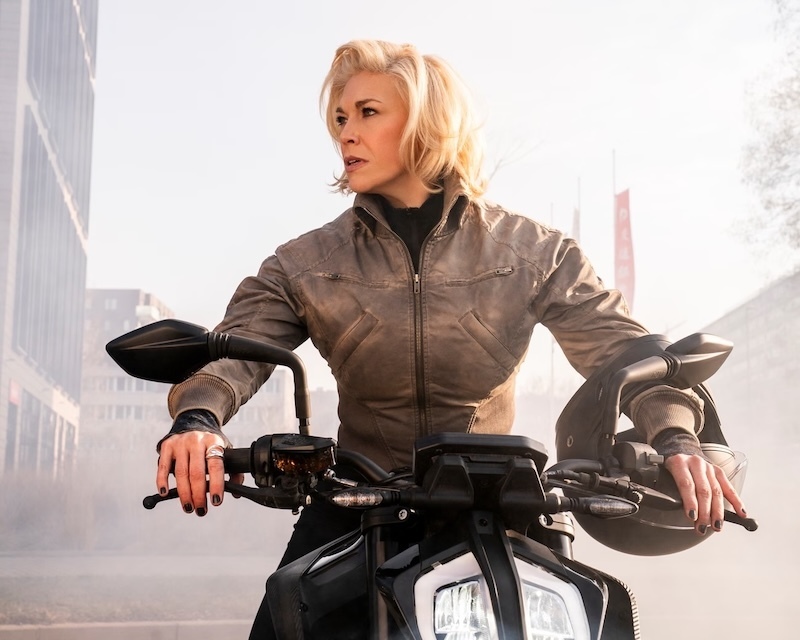
It’s like a scene out of a James Bond movie. In the opening sequence of this summer’s action dramedy, Ride or Die, Hannah Waddingham plays an experienced assassin on the hunt for her target. She refuses to follow her handler’s instructions, relayed through her earpiece, to take the shot at her mark from a distance. Instead, she skis down a mountain, kills the man up close and personal with a steak knife, disappears into a crowd, and reappears in a bar flirting with, then bedding a much-younger bartender. Created, written, and produced by Tessa Coates for Amazon Prime, Waddingham’s character, Judith aka Whiptail, is as complex, compelling, and driven as any male action hero.
Ride or Die is a clear hit, pun intended, becoming the number one show on Amazon after its debut in July, with a 96% Rotten Tomatoes score. And yet, it’s one of a dwindling number of series created by a woman in 2025–26. According to Boxed In, an annual study tracking women’s employment and representation in television, the percentage of women creating streaming series bounced from 27% in 2023–24 up to 36% in 2024–25, and down to 24% in 2025–26. The percentage of women creating broadcast programs declined slightly from 20% in 2024–25 to 19% in 2025–26. The numbers of women creating shows on both platforms are now lower than they were almost a decade ago in 2017–18, when 25% of programs on streaming services and 21% of broadcast programs had at least one woman creator.
Why does it matter? Creators are the visionaries who mold the characters and narratives audiences see on screen. It’s no surprise that when a series has one or more women working in this gatekeeping role, they employ more women in other key behind-the-scenes positions, as well as feature more female characters in major roles on screen. On programs with at least one female creator, women comprised 22% of directors, 48% of writers, and 33% of editors. On programs with exclusively male creators, women accounted for 14% of directors, 17% of writers, and 25% of editors. Females made up 47% of major characters on programs with at least one woman creator but 43% on programs with exclusively male creators.
Arguably, women also tend to create female characters that take up more space and are more central to the action. Scholar Kathleen Rowe calls these characters unruly women. They break the rules and reorder the social hierarchy by challenging authority and refusing to live their lives subordinate to men. Using the last decade as a framework, female creators have leaned in to unruly female characters, in both comedies and dramas, replacing the once-popular adorable dope character. According to Bonnie Turner, the producer and co-creator of That ’70s Show and 3rd Rock From the Sun, adorable dopes are highly sympathetic, younger female characters reluctant to speak their minds for fear of alienating or offending others. In the early seasons of The Big Bang Theory, Penny (Kaley Cuoco) was an adorable dope character, referring to herself as “stupid” and as intellectually inferior to the male characters on the show. Recently, the program’s creator, Chuck Lorre, stated that it took time for the writers to learn that Penny brought an emotional intelligence to the show that the male characters, particularly Leonard and Sheldon, lacked. Whereas adorable dopes are limited by their ability to express themselves as they are people pleasers, unruly females created by women over the last decade have no such hesitation. Standouts include characters in Ride or Die, Hacks, and The Marvelous Mrs. Maisel.
Writing for RogerEbert.com, Sherin Nicole refers to Hannah Waddingham’s Judith and Octavia Spencer’s Debbie as “ungovernable women.” As they traverse Europe, trying to evade a variety of assassins and government agents, the best friends recover from lifetimes of betrayals in their relationship with each other, and with men who have sold them out and taken them for granted. As critic Lucy Mangan noted in The Guardian, “You don’t realize until it’s over how unusual it is. Two fiftysomething actors playing fiftysomething parts that allow them to be funny, dramatic action heroes.” Watching Waddingham walk into a room and command it is a real thrill, as is seeing Debbie’s quieter realizations of what she is actually capable of achieving, after living a life as the woman behind her simpering and much less talented politician husband. The spine of the story is the friendship between these women who know each other well enough to finish each other’s sentences.
Another streaming series featuring a best friend duo, HBO’s Hacks, was created by Lucia Aniello, Paul W. Downs, and Jen Statsky. In this award-winning comedy, Jean Smart plays Deborah Vance, a stand-up comedian in her third act who partners with 20-something writer Ava Daniels (Hannah Einbinder) to refresh her career. The clock is clearly ticking for Deborah, personally and professionally, upping the stakes in the series. Throughout its run, Deborah displays a level of ambition almost unheard of for mature women. Deborah’s desire to host a late-night talk show and to perform a show at Madison Square Garden propels the action. We actually see her chasing her dreams, spurred on by the modern sensibilities of Ava.
The characters in Ride or Die and Hacks are incredibly unique in that they have somehow survived the culling process that seems to take place for actresses in television. According to the Boxed In study, the majority of female characters are in their 20s and 30s, while the majority of male characters are in their 30s and 40s. Female characters begin disappearing in their late 30s and early 40s in alarming numbers, dropping from 38% of all females in their 30s to just 15% in their 40s. The percentage of male characters remains the same in their 30s and 40s. Women in their 50s comprise only 9% of all female characters, and women in their 60s and older only 4%. In Ride or Die, Waddingham is repeatedly reminded by the director of her agency (Bill Nighy) that she is a woman “of a certain age” and should retire. On Hacks, Deborah is similarly challenged by a vindictive network executive (Tony Goldwyn) when she refuses to stay silent about walking away from her talk show after he demands she fire Ava.
Perhaps because stand-up comics make spectacles of themselves by telling jokes in public settings — another characteristic of unruly female characters — The Marvelous Mrs. Maisel (2017–2023) also deserves mention as part of the shift in character types over the last decade. Created by Amy Sherman-Palladino, Miriam “Midge” Maisel takes center stage as a stand-up comic. In the show, set in Manhattan in the late 1950s and early 1960s, Rachel Brosnahan plays Midge, a young Jewish wife and mother who is left by her cheating husband, Joel (Michael Zegen). While she supports Joel’s awkward attempts at stand-up comedy, Midge is the one with the real chops and appetite for show business. On stage and off, Midge’s penchant and desire for a public life are too much for Joel.
But one of the most revelatory scenes in the series comes at the end of its final season when Midge’s father, Abe Weissman (Tony Shalhoub), speaks with a group of friends at dinner. Having witnessed Midge’s drive and her resulting success, Abe admits that he nurtured his son but not his daughter. The realization rocks him to his core. “Everything I thought about the roles of men and women I think is completely wrong. I have done exactly the wrong thing for both my children. My daughter owns the apartment I’m living in . . . my daughter bought it. My daughter was dumped by her husband out of nowhere . . . instead of collapsing from the weight, she emerged stronger. A new person, so I thought. But now I think perhaps that was who she was all along. I never really took her seriously. My son, Noah, I look seriously. I would take him to Columbia with me every week so he could dream of what he could be. I don’t remember if I ever did that for Miriam. I don’t think it ever occurred to me . . . What could she have been if I had helped her and not ignored her, not ignored who she really is? My daughter is a remarkable person and I don’t think I ever said that to her.” Abe’s recognition of Midge’s unruliness and his admiration for her feel like a step forward in the portrayal of unruly female characters. Abe, the patriarch of the family, makes this admission, not because Midge asks for it, but as a result of his own personal growth.
Unruly female characters are unwieldy, complex, and resilient. They don't hesitate to speak up for themselves, pursue their ambitions, and unapologetically push the boundaries of women's dreams and action. They also tend to be created by women (think Roseanne Conner, Murphy Brown, Marvel’s Jessica Jones, Grey’s Anatomy’s Miranda Bailey). For years, activists, film critics, and scholars have made the underemployment of women as film directors an issue. It is time for similar advocacy on behalf of women as creators in television.
More articles by Category: Arts and culture, Media
More articles by Tag: Media, Television, Women's leadership


