















‘This is not marriage, this is legalized rape’: New Report Outlines Strategies to End Child Marriage Worldwide
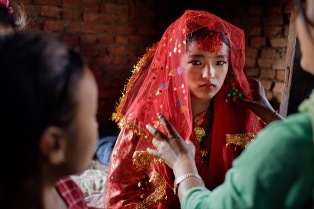
Child marriage is among the most devastating issues facing women and girls worldwide. Today, there are 640 million women who were married as children (under the age of 18), and more than 200 million of them were married under the age of 15. A new report released today, Accelerating Efforts to End Child Marriage, shines a light on the detrimental impacts and root causes that drive child marriage across the globe and outlines strategies for making meaningful progress toward ending this practice that traps millions of girls each year in cycles of poverty, violence, and lost potential.
Produced by the Institute of Global Politics (IGP) Women’s Initiative at Columbia University’s School of International and Public Affairs, the report was commissioned by Sheryl Sandberg, founder of Lean In, with support from former Secretary of State Hillary Rodham Clinton, faculty advisory board chair of the Institute of Global Politics, both known as longtime advocates for women’s and girls’ rights and advancement. As they write in the foreword, “A girl forced into marriage doesn’t only lose her childhood. She loses years of education, economic opportunity, and autonomy. She will spend her life navigating consequences she never chose.”
Clinton further states that as Secretary of State, she “made ending child marriage a commitment within our focus on women and girls in foreign policy. The State Department expanded our tracking of child marriage in annual human rights reports to call it out as the human rights violation that it is and strengthen accountability.”
WMC covered an October report that explored the persistence of child marriage in the U.S., and this new report provides global context, showing that although there has been some progress in reducing the incidence of child marriage, prevalence rates remain high worldwide. “Over the last 25 years, we’ve seen the global rate of child marriage decline, going from in one in four girls married as children to one in five,” said Rachel Vogelstein, professor and co-director of Columbia University’s Institute of Global Politics Women’s Initiative, who co-authored the report with co-director Jennifer Klein. But she notes that “recent challenges — from significant cuts in foreign aid to backlash against women’s rights — threaten to slow or even reverse progress.”
The new report illuminates that the detrimental effects of child marriage — which include poor health, reduced educational attainment, and intimate partner violence — also undermine prosperity and justice in communities and countries. Drawing from her lived experience, Dr. Fatima Maada Bio, first lady of Sierra Leone and advisory member of the report, has been an outspoken champion for ending child marriage. Since 2018, she has led the Hands Off Our Girls campaign, a movement aimed at addressing and combating gender-based violence, prostitution, and under-age marriage.Her work helped fuel momentum for child marriage to be outlawed in 2024 in Sierra Leone — a country that for decades had one of the highest rates of the practice in the world — and she has remained a vocal advocate calling for worldwide attention and policy change.
Bio spoke emotionally about the critical need to raise greater awareness and to finally end this practice. “Let us talk about what is actually happening to our young girls around the world,” she told me. “First of all, it takes away their rights to even contribute to nation building. These are young girls who are potential leaders. These are young girls who can, if given the opportunity, change the world. But then we use this forced marriage, allow them to be abused by allowing men to rape them freely and take away all their pride, their confidence, and everything.” She continued, “It doesn’t matter how many times we go to court and get justice. You do not feel justice when you stand in front of that mirror knowing full well that a man has abused you. So instead of looking for justice, why not just stop it? We just need to stop it.”
Bio doesn’t mince words when it comes to speaking the hard truths about this issue, which she feels is necessary in order to evoke the appropriate global outrage needed to finally address it. “We just need to stop being nice about this. It’s not ‘early’ marriage, it’s forced marriage. This is not marriage, this is legalized rape. We have to call these things as they are. We cannot be pretending as if this name is too harsh. No. What is harsh is that man sleeping with a child — that is harsh. That girl’s dream being killed by an old man — that is harsh.”
The report addresses the obvious moral case for putting an end to child marriage. But to make the case to governmental leaders, it also delineates the negative economic impacts of the practice. “I wish we would just pay attention because of the human rights abuses here,” said Sandberg. “I want everyone to care about this because it is fundamental to the rights of girls and women all over the world, but what really gets the world to pay attention is those human rights abuses and the economic cost. Every country is looking for economic growth. And what I think is new about this report is we’re putting a hard number on this. This is costing the global economy $175 billion every year. That is in reduced lifetime earnings, increased health risks, higher maternal and infant mortality. So this is an issue that has a moral imperative and also an economic imperative.” She added, “I think what the first lady and I, and this whole committee working on this report, are trying to do is get people to pay attention — of course the people who care about global human rights, but also the people who care about economic growth.”
That $175 billion in losses to the global economy per year, amounting to almost $2.5 trillion by 2040, far exceeds the amount of funding that will be needed to see a significant reduction in this practice. The report shows that reducing the rate of child marriage from one in five to one in seven over the next five years — a 30% reduction — would cost $1.3 billion annually over this period.
Vogelstein explains, “The report outlines an achievable strategy to accelerate progress toward ending child marriage even in a resource-constrained environment. We call on governments and partners to double down on the most effective interventions to reduce child marriage.”
The report identifies three pillars of such interventions. The first is investing in girls’ education. The report states that “successful programs to provide education for girls can include cash and in-kind transfers to support girls’ schooling, targeted life skills programs that build proficiency in areas such as digital and financial literacy, and programs that remove barriers or increase access to schooling for girls.”
The second intervention is promoting health services to reduce adolescent pregnancy. “Health education and access to services, including contraception, help delay pregnancy by increasing girls’ agency,” per the report. “As a result, girls are less likely to get pregnant and be married as children — particularly in places where fears about teen pregnancy drive community support for child marriage — and therefore are less likely to die or face complications in childbirth.”
Third is supporting programs to shift norms that perpetuate the practice of child marriage. “This starts with using the expressive power of government condemnation by enacting legal prohibitions on child marriage,” the report states. Additionally, since passing legal prohibitions alone is insufficient, this can include “engagement with community and religious leaders, as well as the engagement of men and boys who can be strong allies in efforts to end this practice.”
The report makes clear that ending child marriage is core to global economic development. As Clinton and Sandberg wrote, “The math is unambiguous: Every year we delay action, we permanently limit girls’ education, health, and lifetime opportunity, and burden societies with avoidable deaths of young mothers and babies. And countries bear those losses for generations. Child marriage remains one of the most urgent, preventable violations of the rights of women and girls. And addressing it matters for our global economic future as much as our moral leadership.”
“Failure to accelerate the pace of change will result in hundreds of millions of child marriages over the next two decades — with costs to entire communities, economies, and nations,” Vogelstein said.
At this pivotal moment for making progress toward ending child marriage, the hope is that this report will help finally make this issue a top priority on the global agenda and spur countries and communities to take collective action.
“We are saying loudly and clearly that we don’t want this issue to be ignored anymore,” said Sandberg. “I think it takes the global community coming together. No matter what else is going on in the world, no matter what is happening at a geopolitical or an economic cooperation level, there are issues that we are united on because we’re human. We’re not at a moment where there’s broad agreement on many things, but this is one where there’s literally not another side to this issue. This is a custom that should be illegal and should be enforced as illegal all over the world.”
Sandberg continued, “At this moment, when you think about all the issues women and girls face, there are so many important issues, but if you peel it back, what is one of the most fundamental things we could do to protect girls around the world? It is to work on this issue. As the first lady, Fatima, says, this is legalized rape, this is sexual slavery. And this is happening not to one, not to two, but this year 12 million girls are going to get married in the world under the age of 18. Twelve million. So at a moment where we are worried about the opportunities women and girls have all over the world, this is one where we can come together as a global community and prevent 12 million girls from being in a position where they can be raped every single day legally.”
To really move the needle on this issue, more domestic resource mobilization and foreign investment are needed to help fund programs that work on the three most effective pillars of intervention, as well as broader efforts to end child marriage. The report shows that current levels of global funding — approximately $60 million per year — are drastically insufficient. This rate of investment affords less than $1 of funding a year for each of the more than 70 million girls at risk of child marriage between 2025 and 2030.
To mark the release of the report, a launch event is being held today, March 4, at Columbia University’s School of International and Public Affairs. The event, which will be livestreamed, will feature discussions with Clinton, Sandberg, Bio, Columbia IGP Child Marriage Advisory Council cochair and founder and champion of Girls Not Brides Mabel van Oranje, and other advocates and survivors, exploring what it will take — culturally, politically, and financially — to accelerate change and protect generations of girls who deserve the chance to determine the course of their own lives.
As van Oranje so aptly points out in the report, we can all play a part in helping to end the detrimental practice of child marriage. “Ending child marriage requires the action of many: families, communities, governments, traditional and religious leaders, multilateral and regional agencies, donors, researchers, civil society members, and others. Everyone has a role to play — and we are more effective when we work together.”
To read the report Accelerating Efforts to End Child Marriage, click here.
More articles by Category: Girls, International, Politics
More articles by Tag: marriage, Child Marriage, International


