















In Potomac Primaries, Obama Gains with Clinton Core Voters
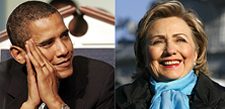
Barack Obama not only scored convincing victories in the Potomac Primaries Tuesday, he ate into Hillary Clinton’s core constituencies of women, older voters and Latinos.
That raises questions about whether she can hold onto those groups in the March 4 primaries in Texas and Ohio, as she has predicted she would.
Before then, on February 19, elections will be held in Wisconsin and Hawaii. Obama had another huge rally at the University of Wisconsin as the size of his wins in Maryland, Virginia and the District of Columbia became clear. Wisconsin, however, also has a critical mass of older, less-affluent voters who might gravitate to Clinton’s meat-and-potatoes economic messages more than to Obama’s more ephemeral message of hope. Hawaii should be a blowout for him, however, since he grew up there.
Clinton and Obama will have one other day in the spotlight: a February 21 debate in Austin, Texas, cosponsored by CNN and Univision.
Clinton will have to move smartly to prove the critics are wrong, to show that she is a viable candidate after losing eight straight electoral matches with Obama. She flew to El Paso, Texas, on Tuesday to meet a large and enthusiastic crowd of Latinos and to start trying to do just that.
By now, it is clear that Obama is attracting massive numbers of new voters to the primaries. In Virginia, the Democratic vote was up 150 percent from four years ago to more than 900,000—and nearly all the newcomers voted with Obama. The Democratic vote was twice that of the Republicans in Virginia.
Exit polls were not conducted in the District but those in Virginia and Maryland shed much light on the evolving demographic support for Obama.
Clinton held onto white women in both Maryland and Virginia but not by much: 54-45 percent in Virginia, 56-38 in Maryland. Black women opted for Obama in numbers only slightly less than did black men, 85-15 percent in Virginia and 82-17 in Maryland.
Obama took the votes of single women, formerly a strong pillar of support for Clinton, by 66-34 in Virginia and 59-38 in Maryland. And they were a big chunk of the electorate: 35 percent in Virginia, 28 percent in Maryland.
Women still make up a majority of voters. In Virginia, the Democratic primary electorate was 57 percent female, 43 percent male; in Maryland, 62 percent female to 38 percent male.
In the Republican votes, the gender breakdown was far less pronounced. In Virginia, voters were 53 percent male, 47 percent female. In Maryland they were 51 percent male, 49 percent female.
Here are other pertinent exit poll numbers:
Under 30 voters: they were 14 percent of the total vote in both Virginia and Maryland and went 75-25 for Obama in Virginia, 64-33 in Maryland.
60-plus voters: they were 25 percent of the voters in Virginia, 23 percent in Maryland and went 54-46 for Obama in Virginia, 48-47 percent for Clinton in Maryland. This broke with patterns in all previous primaries where Clinton had almost a 2-1 edge with these voters.
Hispanics: Hillary kept a majority of these voters but Obama took 45 percent of them in Maryland, a sizable chunk as well in Virginia. This reverses the pattern in Nevada and California, two earlier states with sizable Latinos populations.
In addition, Obama had an across-the-board appeal to those with lower incomes as well as the more affluent voters and to those with high school as well as college education.
The Virginia election came against a backdrop of rapid change in the state that a half-century ago had shut down its public schools rather than admit blacks after the Supreme Court ordered desegregation. Today, the prosperous Northern Virginia suburbs of Washington, D.C., comprise one third of the population and this is an ethnically and racially diverse group with jobs that range from high-tech to Defense Department out-sourced contracts.
Even more telling is the evolution on issues of race. The nation’s first black governor came from here: Douglas Wilder, now mayor of Richmond and an Obama supporter. The current governor, Tim Kaine, won a squeaker election a year ago with the strong backing of blacks and independents; both he and his wife support Obama. A top Kaine aide, Stacey Brayboy, had taken leave to run Obama’s South Carolina campaign before returning to run the Obama campaign in Virginia.
The remarks about Obama by former President Bill Clinton continued to backfire. At a Jefferson-Jackson dinner in Richmond last weekend, Wilder rejected Bill Clinton’s description of Obama’s opposition to the Iraq war as a “fairy tale” and said, “A time comes and a time goes. The president has had his time.”
The ex-president’s controversial remarks on race also were mentioned by two Bronx lawmakers who protested the Clinton campaign’s removal of Patti Solis Doyle, whom Senator Rev. Ruben Diaz and Assemblyman Jose Peralta praised as “a Hispanic woman who has helped to build Latino support for you throughout the nation.” They said they would be troubled if she was blamed for recent Clinton losses instead of “others involved with your campaign, including former President Clinton, who have caused serious problems and embarrassing situations for your campaign.”
As Obama took the lead with elected delegates, supporters in both camps noted that, so far at least, their voters vowed to stay hitched in November, saying they would have no problem supporting a candidate they had not backed in the primary.
That is just one of the contrasts with Republicans, where former Arkansas Governor Mike Huckabee confounded pollsters who had said the party’s conservatives had come around to backing Senator John McCain. Instead, they went overwhelmingly for Huckabee in Virginia, where they comprise nearly half of the GOP voters, even though McCain pulled out a victory with the votes of the less ideological Republicans in Northern Virginia.
More articles by Category: Politics
More articles by Tag:


