















AI and the New Age of Misogyny
At this moment, we are poised at the edge of a precipice. Advances in artificial intelligence, virtual reality, robotics, and metaverses are about to transform our world at a scale and speed we struggle to grasp, because it has never before happened in human history.
Although there is no single definition, AI is the product of training computers to learn and to solve problems, often using huge amounts of data. In the past few years, the global conversation about AI has exploded as we’ve seen a wave of new, widely available tools bringing the concept into the spotlight, sparking a frenzy of investment and, with it, media attention.
But amid the headlines expressing panic about eventual human extermination, job losses, and political impact, there is an alarming lack of focus and concern on the impact on women. Impact that is already happening now, not decades in the future.
We need to be less concerned about what a malevolent AI of the future might do and more concerned with what some malevolent humans are doing right now with existing technology.
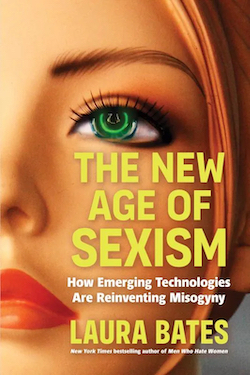
Of course, some of these technologies are entirely benign, many of them useful, some groundbreaking and game changing. But some of them have the capacity to replicate existing harms and amplify them in the foundations of the future society we are progressing towards at high speed. In researching my new book, The New Age of Sexism, I’ve uncovered a deeply worrying catalogue of ways in which new technologies are re-embedding misogyny in our daily lives.
Already, algorithms used to determine credit offers, health care access, and court sentencing are in place across the world and have been proven to discriminate actively against women and minoritized communities. Tools that are trained on vast data sets can unintentionally replicate the existing forms of bias and inequality inherent in that data.
And women’s lives are already being devastated as a result.
Already, many thousands of women have had intimate images and videos of themselves captured and shared across websites with millions of monthly views; they just might not know it yet.
Already, schoolgirls are being driven out of the classroom by deepfake pornography created for free at the click of a button by their young male peers.
Already, women are being sexually assaulted on a regular basis in the metaverse.
Already, men are using generative AI to create “ideal” virtual companions — the women of their dreams, customized to every detail, from breast size to eye color to personality, only lacking the ability to say no.
Already, you can visit an establishment in Berlin where an artificially animated woman will be presented to you, covered in blood and with her clothes torn, if you so desire, for you to treat her however you please using virtual reality.
AI-driven technologies are evolving and multiplying — not yearly, not monthly, but daily. However, technology itself is not the problem here. In fact, many of these emerging tools possess the potential to have a transformative positive effect on our society. What matters is how we shape and use them.
We’ve arrived at a critical moment. We are building a whole new world, but the inequalities and oppression of our current society are being baked into its very foundations. And if the harassment and violence that have blighted the lives of women and minoritized communities for centuries are being coded into the fabric of the future systems, environments, and programs that will form the basis of all our lives over the coming decades, unravelling those forms of prejudice is going to become a million times harder. Worse, that prejudice might become entrenched and even exacerbated, dragging the most vulnerable in our society backwards as we supposedly hurtle forwards into a glittering new world.
Despite the risks to already vulnerable communities, public and governmental concern about the potential threat from emerging technologies tends to focus almost exclusively on fears of evil robots taking over the world, job losses, and the erosion of democracy. This is clear, for example, in the case of deepfakes — digitally manipulated images and videos giving the false appearance of a person doing or saying something they didn’t. Intimate image abuse of women makes up around 96% of all deepfakes, yet a Europol report on “law enforcement and the challenge of deepfakes” mentions the word “women” just once and contains only a couple of brief paragraphs on deepfake pornography in its 22 pages.
My 2020 book Men Who Hate Women warned of a rising tide of extremism that nobody was talking about — a virulent misogyny that threatened deadly consequences. The following year, Jake Davison, a man immersed in incel hatred online, carried out the worst mass shooting the U.K. had seen in over a decade. There is a similar urgency here.
Only now we are talking about a whole new age of misogyny. AI is on course to infiltrate practically every aspect of our daily lives. And the impact on women’s lives will be inestimable.
I have experienced and witnessed the misogynistic weaponization of technology firsthand, from feeling utterly powerless when men have used publicly available photographs of me to create sickening sexualized images to watching helplessly as women have been assaulted in front of me in the metaverse.
We do not have the luxury of time to wait and see how things will pan out or trust that “glitches” will eventually be fixed. Relatively speaking, these technologies are in their infancy, but now is the time we must act. The pervasiveness of emerging technology and the speed and scale of digital transformation mean that such issues may become impossible to fix if they are left unaddressed. We have a fleeting moment of opportunity to define whether they will create a world that is full of new possibilities, accessible to everybody, or a world in which existing inequalities are inextricably embedded — a dazzling future that drags women and minoritized groups backwards.
Tackling this is not impossible. We can take pointers from the Framework Convention on Artificial Intelligence being developed by the Council of Europe: a model for how common-sense regulation can ensure that AI tools remain consistent with human rights, whilst remaining conducive to technological progress and innovation. We can support feminist organizations like Glitch, who are systematically resisting the negative gendered impacts of emerging technologies. We can act collectively to let our political representatives know that AI regulation is important to us.
We are standing on the edge of a precipice. We must take action now, before it is too late.
The New Age of Sexism is published by Sourcebooks and available now.
More articles by Category: Feminism, Misogyny, Online harassment, Science and tech
More articles by Tag: Artificial Intelligence, Technology, Gender Based Violence


