















Women Paying the Price For Men Being Dummies, Yet Again
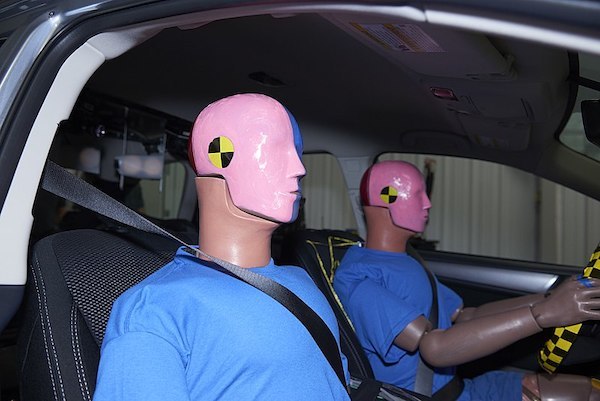
Learning how to drive is already a daunting task, but it can become even more so when you learn about how cars’ safety is determined. Crash test dummies are one of the key tools used to determine a car’s safety. But relatively little attention is paid to the fact that those dummies only represent half the population — and that has consequences for women drivers.
In February of this year, an Insurance Institute of Highway Safety (IIHS) study showed that women are still more likely to be injured in car crashes despite men being more reckless behind the wheel; women are two times as likely to be severely injured, and three times as likely to be moderately injured in car crashes.
Why? Men and women obviously have different bodies, but crash test dummies (or anthropomorphic test device, also known as ATDs) are all the same — and are all built like men.
Some car manufacturers caught this discrepancy earlier than others. Some car manufacturers have used “female” ATDs since the early 2000s. It’s great that manufacturers, like Volvo, have done this, but that doesn’t mean they’ve done it right. As of 2019, “female” ATDs are about five feet tall and 110 pounds, which is not an accurate representation of the average woman. When female ATDs aren’t built to represent most women, safety features that work for those ATDs, like airbags, are not guaranteed to work for real women.
Of course, it’s worth noting that men are more likely to engage in riskier driving practices — such as drinking and driving, speeding, and not wearing seatbelts — and are more likely than women to strike other vehicles. Men also tend to drive bigger vehicles: the IIHS study found that 20% of men were in pickup trucks when in accidents compared to less than 5% of women.
Despite this, women still pay more for car insurance and cars, for that matter. Most large insurers charge women between the ages of 40 and 60 higher rates than men, and many often charge women upwards of $100 more per year than their male counterparts. A poll done by the Consumer Federation of America (CFA) showed that two times as many Americans think that men pay higher premiums than women even though the opposite is true.
It is not nearly as safe for women to be behind the wheel compared to men, and with an average of 16,438 car crashes a day in the U.S. alone, we need to do something about it. The IIHS says that the gap can be closed with targeted safety improvements by manufacturers, but it takes about 20-30 years of biomedical research and testing to build and fine-tune each ATD model. Until then, we can continue to raise awareness about this problem and pressure companies — from insurance to carmakers — to do better.
More articles by Category: Feminism
More articles by Tag:


