















This Book Explores The Contradictions In Feminist Media
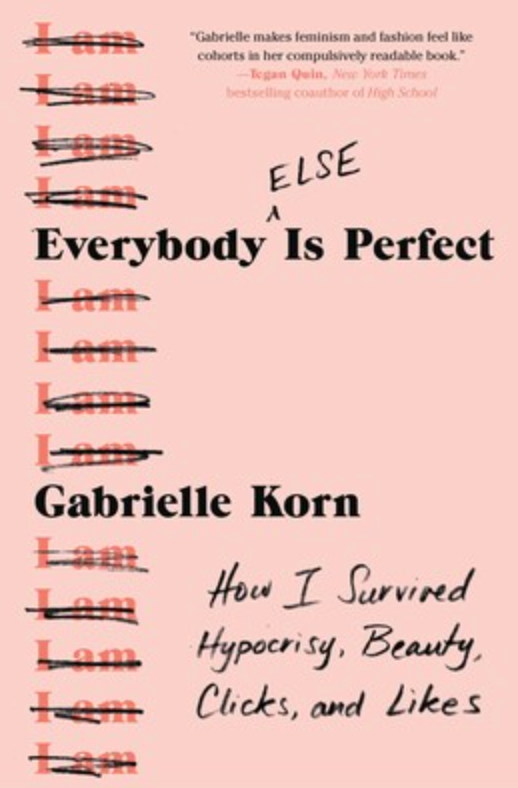
At 26, Gabrielle Korn became one of the youngest-ever editors-in-chief who was also openly gay when she assumed the position at Nylon in 2017. That accomplishment may appear to be the makings of a success, but Korn says hers was rippled with imperfection. Korn’s choice to leave that top job is the subject of her new book, Everybody (Else) Is Perfect: How I Survived Hypocrisy, Beauty, Clicks, and Likes — a book Korn says is an exploration of how she survived an imperfect industry stilted by itself.
After Korn graduated from the NYU Gallatin School of Individualized Study, she spent a brief time working at an abortion clinic before finding herself at Refinery29 in 2013. In that role, Korn scored tickets to fashion week, borrowed top-trend clothing from designers, and traveled to Italy for the launch of beauty products (all paid for, of course). It was the stuff most aspiring fashion editors dream of, but Korn felt conflicted about reporting on eyeliner after dedicating her academic life to studying feminism and being a local LGBTQ activist. But, she told the FBomb, she learned that beauty and feminism aren’t mutually exclusive.
“Doing the least is still a reflection on how you approach the idea of beauty, and that's kind of how I started covering it,” Korn said, adding that her reporting at Refinery29 covered “alternative choices and what those choices mean and the experience of not using beauty in a normative way.”
But by the time Korn moved to Nylon in 2014, she began to notice contradictions between feminist messaging on magazine covers and the actions of the people who determined that messaging. Korn said she felt she was part of a group of people “committed” to institutional change at Nylon, such as moving away from fatphobia and homophobia in the magazine’s content. But that work was largely performative, Korn said, in that she saw little evidence that those feminist ideals were being implemented in the workplace culture itself.
“Staff was not becoming more diverse, women weren’t getting paid or treated better, Black women still were discriminated against,” Korn said. “It was a very surface-level shift, and that was really frustrating for me.”
In Everybody (Else), Korn explains how this performative feminism in women’s media persisted by discussing the diet culture at work among the magazine’s staff. While the body positivity movement was espoused by women’s media at the time, Korn said the need to be thin still dangerously dominated the magazine’s internal values. Conversations about bone broth replacing a meal or gifted unlimited barre toning classes upheld an unsaid rule that thinness was a priority, and Korn said that she began to absorb this messaging about her self-worth.
“I underestimated the degree to which I had internalized the messages about being skinny,” Korn said. “I thought, I'm self-aware, I have the politics, I'm a feminist and queer. These things don't affect me. And then the next thing I knew, I was sitting in a doctor's office, being told my test results.”
Amid her tenure at Nylon, Korn was diagnosed with anorexia nervosa, an eating disorder that affects more than 30 million people in the U.S. Korn raises a key point in Everybody (Else) about this period in her life: losing weight wasn’t planned or intentional. Korn said despite her increasingly thin body, she still saw herself as the same eager student who wrote research papers about queer theory in college and volunteered with the NYC Dyke March. The weight loss was subconscious, a result of contemporary feminism “policing” her self-love.
Korn explores in Everybody (Else) how new Instagram-friendly feminism shares flaws with the body positivity movement. Namely, while both movements are aimed at empowering women, they fail to do so because they make women feel they must achieve a prescribed ideal in order to be accepted, Korn said. As a result, women who don’t fit those ideals — who are LGBTQ, not thin, and/or not white — are considered less valuable members of these movements, and their exclusion from brands, media, or communities feels merited.
“In the end, the loudest, most body-positive voices end up belonging to those whose bodies aren’t actually all that marginalized,” Korn writes. “It’s a confusing fusion of empowerment culture and white privilege … in our newly woke world of marketing based on ‘positivity,’ the blame is placed on women.”
Korn explains this further in her chapter “Fashion Weak,” in which she discusses how big brands espoused feminism and body positivity, yet continued to send rail-thin white models down runways. To Korn, the issue is that in this value system, thin women are considered better feminists than other female-identifying people.
“Just because you feel bad about your body and you're working really hard to maintain skinniness is not the same as oppression,” Korn said. “Your struggle to love your body is not the same as a plus-size woman's struggle to be respected at work. Because the movement has been so co-opted and appropriated and repurposed to make women feel better about themselves, it's been really diluted.”
Everybody (Else) is an archive of the last decade in print media, and the reader sees Korn come into her own as an editor at the same time the industry is shedding its skin and taking a new form. Korn said the ability to receive real-time feedback on reader engagement ultimately killed print media, which structurally upheld performative feminism and lacked content that reflected real women’s interests.
The print and digital facets of Nylon are like two characters in Everybody (Else), like jealous sisters vying for the most attention from higher-ups. Both sides behold the tenuous tradition of women’s fashion journalism at the same time they paddle forward and embrace new trends. Korn’s career stays on the digital side, but she said she wished she had spent more time investing in relationships with Nylon’s print team before the print staff was laid off and the publication was folded in 2017.
Ultimately, digital wins, and it’s this move that earns her the role of editor-in-chief at age 26. But the story of her promotion, how silently it happened, reveals an even quieter truth about women’s media today: the whims of male CEOs who can change lives in an instant.
Korn also makes a point of writing about her salary from her first job at Refinery29 to her editor achievement at Nylon. She said she’s received “mixed reviews” on her chapters about an under-30 woman already making six figures asking for more money. But Korn said she wished she could channel her “ballsy” self who wouldn’t let her work be cheap.
“I think this is something that happens to young women a lot in media,” Korn said. “We’re totally taken advantage of, because we're young, and people look at us and they see a bargain. They see someone who's going to work really hard for not a lot of money, and that just leads people to burn out and leave.”
The theme of love in Everybody (Else) is dominant, from self-love to loss of love to love for what one does at work — and the ways that love can be distorted to a point of abuse. Korn said that her job at Nylon was “metaphorically not that different” from some of her most abusive relationships. Staying at the magazine was in part a result of of not understanding what she deserved. A number of heartbreaks foreshadow her ultimate break-up with Nylon: Korn receiving her anorexia diagnosis, the end of a serious post-college relationship, and her loss of a grandparent. But the reader has watched Korn get back up from each of these setbacks and grow, so that by the time she decides to leave Nylon, they don’t doubt her ability to overcome the loss.
Korn said the writing process brought her out of the devastation of leaving the job and revealed positive parts of the transition: “The process of writing the book ended up really being the processing of the experience.”
More articles by Category: Body image and body standards, Feminism
More articles by Tag: Books


