















The Power of a Ponytail
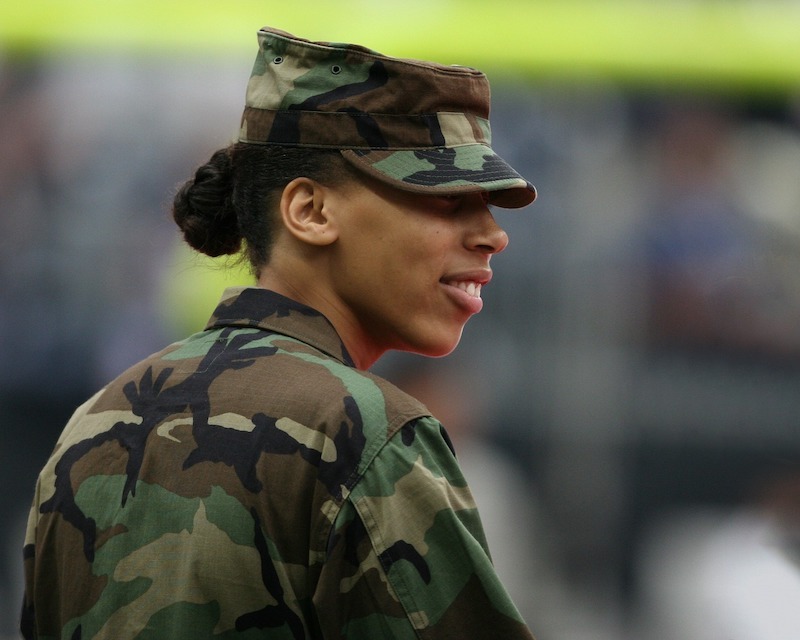
Neha Sharma is no longer guaranteed a headache by 10 a.m. As a first lieutenant in the U.S. Army, Sharma used to feel brain-searing pain just hours after starting her workday, her shoulders aching from the strain her tight bun hairstyle placed on her scalp. A mild bald spot had started to develop on her head; she worried about her hairline.
“If I could wish for one thing in the military, ever since I've joined, I wish we could have had ponytails,” Sharma said to the FBomb. “I have really thick, curly, heavy hair. And, you know, putting it in a bun every single day, I see significant hair loss, damage to my hair … I've always, always felt really strongly about that, but never really advocated for it because I never thought my voice would be heard in that way.”
For a long time, it didn’t occur to Sharma that she could make a change to the grooming standards because the Army’s rules about the way soldiers can and can’t wear their hair historically have been determined by “white men in the military [who] hate change,” Sharma said.
What Sharma is implying is that the Army’s grooming regulations have failed to account for the force’s steadily growing population of female-identifying people and people of color in the overall active duty force: 16% women in 2017, up from 9% in 1980 and just 1% in 1970, according to a Pew Research Center report. The same report found the number of racial and ethnic minorities in the military has also grown, from 36% in 2004 to 43% in 2017.
“Short hair, daily beard shaving … are not typically conducive to the style of hair you would find in Black populations,” Sharma said. “All changes to grooming standards since have been to accommodate people of color.”
The Army announced revised Army Regulation 670-1 earlier this year, which went into effect February 24. Changes included a new policy on breastfeeding or pumping in uniform, the option to wear earrings, lipstick, and nail colors, and no minimum hair length for female soldiers, “allowing multiple hairstyles at once,” according to an Army press release. But the revised rules allowed ponytails only with some uniforms, which Sharma and other colleagues found to be a huge letdown.
“I really felt the disappointment,” Sharma said of the February revisions. “We were so close, and so many of us have constantly voiced our concerns and just consistently asked the senior leaders that are present on social media: Why can't we have ponytails?”
In sharing her frustration over the decision on social media, Sharma quote-tweeted Sergeant Major of the Army Michael Grinston in what was “probably not the best idea for a junior officer to do,” she said, but worth the risk for change. When retired Sergeant Major General Tammy Smith saw Sharma’s and other soldiers’ tweets, she asked Sharma, First Lieutenant Kait Abbott, and other colleagues who had advocated for change to assemble a position paper proposing amendments to the grooming standards.
“Major General Smith was kind enough to champion for us and asked for the panel to reconvene and readdress this,” Sharma said, adding that they eventually found the issue was that the panel actually didn’t have enough information on ponytails and hair to make an informed decision.
“We met virtually over multiple time zones, from Texas to Germany, to work on the proposal paper, and Major General Smith met with us once to provide guidance and direction,” Abbott told The FBomb. “It was … surreal, to say the least. At no point in my young Army career did I think I was going to even have the chance to influence policy change. It's incredibly humbling seeing the social media response … women celebrating the change, and talking about how much of a benefit it is to their health.”
But Sharma said despite her Twitter advocacy, “It did take my white friend [Kait] exercising her privilege, and opening that door for us, and Major General Smith exercising her monumental privilege with her rank and her race.”
The reconvened panel approved its authorization of ponytails with all uniforms on May 6 in a move that revised the February guidance on grooming standards — before Sharma and her colleagues even got the chance to present their paper.
“When I tell you though, one of the happiest days of my career, of my life. I'm not even exaggerating,” Sharma said. “It gives female-identifying people the freedom to feel feminine in their uniform … it’s all internal and all it does is just make us feel better. It just gives you more agency in who we are ... it doesn’t have to be about just being a woman, it’s just basic human needs for people with long hair.”
The change also speaks to the way advocates like Sharma and Abbott can use external resources, such as Twitter, to legitimize their cause and prompt internal institutional change. Sharma said the “little microcosm of military people on Twitter” allowed their group to “leave rank at the door” and access high-ranking officials who wouldn’t hear their call otherwise.
While social media was the birthplace of the movement, Abbott said, it took a combination of “standard and nonstandard channels” and “an incredible amount of luck” to achieve their mission, not to mention leaders “who are willing to listen … and adjust if there’s not legitimate reason to hold fast to the old way of doing things.”
“Let me be crystal clear ... complaining on social media was not a forcing function for change,” Abbott said. “I think social media absolutely is a great mechanism to get candid feedback from the force ... an unofficial command climate survey, if you will. But I think there's a lot of blinders people have in regard to how policy changes work. Having an ally in internal channels is absolutely necessary to any advocacy efforts.”
She added that providing data to leadership about the issue is also extremely important when pursuing any policy change.
“This wasn't done because we just didn't like buns … This was done to provide options to women whose health is being affected by the old version of the regulations,” Abbott said.
Ponytails won’t impact Abbott’s day-to-day life too much because she “personally doesn’t love the look,” but she added that the change was necessary for other women such as Sharma, who has found a new sense of motivation and control following the revised AR 670-1.
“I have a great ponytail, dammit,” Sharma said. “I’m walking around, I feel great. I feel like I look great. I don't have a headache … I don't have to worry about my buns coming loose. If I have to … range walk somewhere, start moving quickly, I don't have to worry about [whether] my buns are gonna come loose.”
According to Sharma, these changes “by and for women of color” show how such a small change as ponytails signals to future generations what kind of change is possible for an institution like the army, and that keeps her hopeful.
“It's just, it's so many little things, and it's just so nice,” she said, reflecting on the change. “It's just a little bit of peace. I feel like I can just breathe a little bit more.”
The Army did not reply to the FBomb’s request for comment.
More articles by Category: Feminism
More articles by Tag: Military


