















Protests Break Out Over The Death of Mahsa Amini
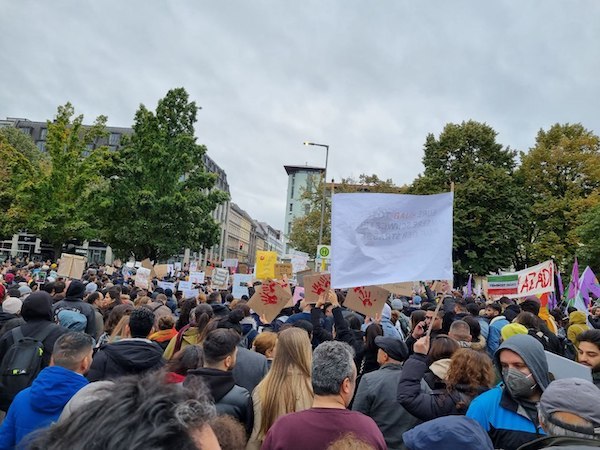
Worldwide demonstrations are taking place in support of Iran’s uprising, calling for more freedom regarding the country’s strict hijab mandate.
This outpouring of solidarity and support started after Mahsa (Zhina) Amini, a 22-year-old Kurdish woman who was arrested by the regime’s “morality police” for loosely wearing her hijab, fell into a coma and eventually died in custody Sept. 16.
This news came weeks after Iranian President Ebrahim Raisi signed off on a stricter set of rules on Aug. 15 enforcing women’s dress code, even stating government officials would begin using facial recognition on public transport to identify violators.
The Islamic Republic of Iran Broadcasting (IRIB) also quoted Mohammed Golpayegani, the Iran secretary of “Headquarters for Enjoining Right and Forbidding Evil,” saying female government employees would be fired if their social media profile pictures did not conform to the new laws as well.
Thousands of women and men took to the streets of Iran in the week following Amini’s death, burning their hijabs, cutting their hair, and chanting slogans such as “Mullahs get lost,” or “Death to the Supreme Leader,” to call for an end of the Islamic republic.
Since then, over 159 cities have held rallies in her name, including New York City, London, Seoul, and Tokyo.
Videos on social media showed burning police stations, fire engines, and bus stops. Iranian student groups have also claimed more than 110 universities, faculties, and educational centers went on strike.
Starting Oct.1, witnesses near Tehran University, Tabriz University, and Sharif University campuses showed hundreds of anti-riot police arresting and/or holding protestors hostage, sharing videos on social media platforms like TikTok and Instagram. Students have also called upon the United Nations Human Rights Council for help via social media using tags such as #FreeIran and #SharifUniversity.
The Iran Intelligence Ministry and Security services warned the public on Thursday, Sept. 22, against the “anti-government protests,” blaming them on foreign agents and terrorists, according to Reuters. The ministry also stated, “the exploitation of recent incidents by counter-revolutionary movements, any presence and participation in such illegal gatherings … will result in judicial prosecution.”
According to a Washington Post article, Parliament Speaker Mohammed Bagher Qalibaf also stated these protests aim to topple the Iranian government and that “creating chaos in the streets will weaken social integrity, jeopardizing the economy while increasing pressure and sanctions by the enemy.”
This is one of several ways the Iranian government has been trying to suppress and censor the coverage of these protests as well as how the country’s police have been cracking down in response to protestors.
At least 92 have been killed nationwide so far in Iran’s protests by the country’s security and police forces, according to the Norway-based Iran Human Rights (IHR) NGO. In addition to this, 41 people were killed in the city of Zahedan Friday, Sept. 30, during protests regarding accusations of a Chabahar police chief raping a 15-year-old girl from the Sunni Baluch minority.
“The killing of protesters in Iran, especially in Zahedan, amounts to crimes against humanity,” IHR director Mahmood Amiry-Moghaddam said in an Alarabiya news article. “The international community has a duty to investigate this crime and prevent further crimes from being committed by the Islamic Republic.”
More articles by Category: International
More articles by Tag: Iran


