















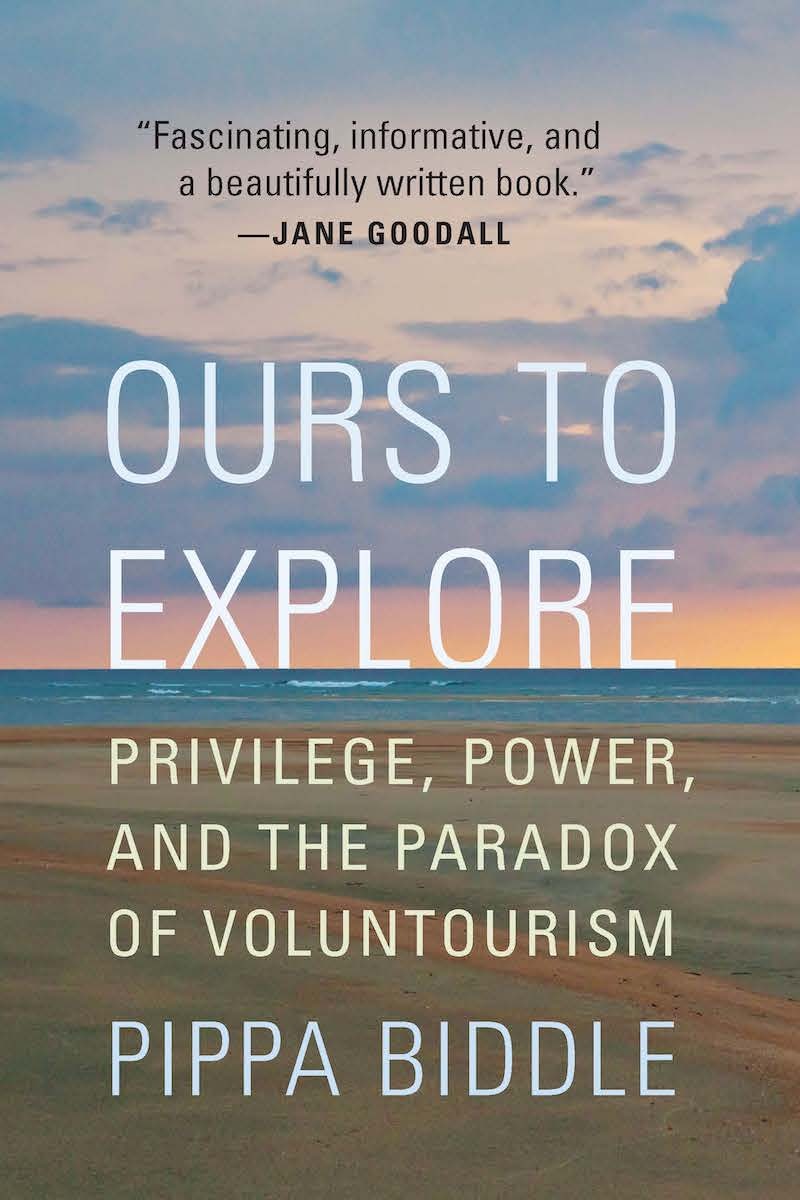
An Excerpt from 'Ours to Explore: Privilege, Power, and the Paradox of Voluntourism'
A young woman in scrubs is assisting a doctor. The sounds of metal scraping on bone fill the small operating room. The patient groans in pain. Exhausted, hungry, and sweating under the lights, the young woman says she needs to step away for a moment to clear her head. She sits on a stool in the corner, and another volunteer slides into her place beside the doctor. Moments later, the young woman on the stool crashes to the ground, unconscious. Chaos ensues.
This moment was the shock point of Volunteers Unleashed, a 2015 CBC DocZone documentary that I also appeared in. In the documentary, Larsa Al-Omaishi, the volunteer who fainted, was presented as the embodiment of the voluntourism problem. When she watched the film for the first time, she was infuriated. What had happened was more complex than the simple story of a silly young volunteer biting off more than she could chew. She wanted to share the real story by revealing the whole story.
Larsa graduated from Duke University in 2011 with a degree in neuroscience. Shortly after graduation, she started working in brain trauma research through the Barrow Neurological Institute in Phoenix, Arizona. “Where I was working, I kept getting told, ‘no, you can’t do that unless you’re a doctor.’” So she resolved to become one. She was accepted to medical school at the University of Queensland with a start date of January 2014.
The spring before starting medical school, Larsa had no significant obligations and did not feel like staying in her job just to fill the time before hitting the books. “I just thought about how easy it would be to sell everything I had,” she says, “and then just leave for a few months. Could I do that?”
She did the math and decided that yes, she could. “Which was actually wrong,” she laughs, “I should have noticed that.” But she didn’t, so she started looking into programs that could potentially jumpstart a career in international health.
….
When International Volunteer HQ (IVHQ), a for-profit voluntourism provider that has sent more than one hundred thousand volunteers around the globe since 2007, notified her of her acceptance to a four-month program with two months at an orphanage and two months at a local clinic, she was elated. She quit her job, booked her flights, and was off to Tanzania.
The Olorien Community Clinic is a project of New Hope Initiative, a faith-based nonprofit with medical, orphanage, and education projects in India, Kenya, Nicaragua, and Sierra Leone in addition to Tanzania. In Arusha the clinic operates in partnership with the Olorien Bible Baptist Church and American donors. On paper, it sounds slick and professional. What greeted Larsa at the clinic was sobering.
“I remember seeing a lot of sick people—a lot of really sick people,” and painfully limited resources. She remembers one child in particular, probably three or four years old, who had come in with a bad burn. “The doctor, using no electricity, had managed to successfully create a skin graft from her stomach onto the burn on her thighs. That was the first time that it dawned on me that this wasn’t your typical Western medical clinic. This was going to be really hard. I realized, ‘I’m going to see a lot of sick people that I’m not going to be able to do anything for.’”
She was asking herself, “what am I doing here?” before she had even started.
Larsa had been surprised when IVHQ accepted her as a medical volunteer. Yes, she had her EMTcertification, which required two hundred hours of study, a written test, a practical test, and shadowing, but she had not started medical school—apparently one of the requirements of the program. When the cohort of volunteers she would be working alongside arrived, she realized how low the bar for entry really was.
Many were only volunteering for a week or two, barely enough time to learn the ropes. Some had not been accepted to medical or nursing school, yet. A number were premed students still pursuing their undergraduate degrees, eighteen- and nineteen-year-olds who had taken a few biology courses and wanted a hands-on experience for their medical school applications. Most had no bedside manner training, no medical training, and no ethics training. Larsa watched them take pictures of patients’ wounds and infections without permission and complain when they weren’t allowed to hold a scalpel or take the lead…
They were eager and wanted to learn, but they didn’t know their limitations. Some of their errors were funny, like when a student put a stethoscope in their ears backward. Other errors were less humorous. No, they should not be begging nurses to let them try drawing blood. No, this was not the place to practice stitches, even if the doctor would reluctantly coach them through it. No, patients are not canvases for students’ learning curves. The clinic personnel seemed reluctant to tell volunteers when they’d gone too far, so Larsa tried to help keep them in check when they wanted to get hands-on by explaining why they couldn’t just try cutting someone open.
It was exhausting, and it was only a matter of time until she’d hit a wall.
Adapted from ”Ours to Explore: Privilege, Power, and the Paradox of Voluntourism” by Pippa Biddle by permission of Potomac Books. © 2021 by Pippa Biddle. Available wherever books are sold or from the Univ. of Nebraska Press 800.848.6224 and at nebraskapress.unl.edu. Email your preorder confirmation to the author at pippa@pippabiddle.com and you will receive a signed and personalized bookplate.
More articles by Category: Feminism
More articles by Tag: Discrimination


