
















When an Instagram private group of twenty schoolboys from Delhi's elite schools fantasizing and degrading their female classmates went viral, it was supposed to offer a cultural reckoning for India's teens about misogyny and gendered violence. Then, it took a dark turn.
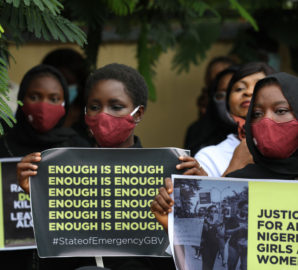
As reports of domestic and sexualized violence surge under lockdown in Nigeria, NGOs and government agencies must adapt their responses to meet the challenge.
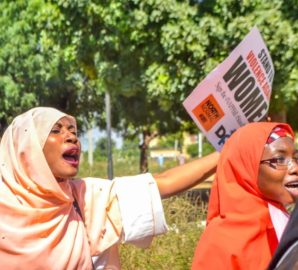
Rallies across Nigeria's northern states push for protections for victims of sexual and gender-based violence, led by young women who are challenging the roles they occupy in a deeply conservative society.

J.K. Rowling immediately received backlash after sending a tweet that implied only women menstruate.

On June 7, Iran passed a new law criminalizing the emotional and/or physical abuse of a child — the first of its kind in the nation.
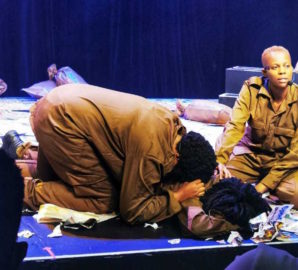
A spoken-word performance takes aim at the pervasiveness of gender-based violence in South Africa, inspiring community activism from the grassroots and demanding that the government confront its failure to protect women.

Medical nonprofit Medecins Sans Frontieres announced it is suspending its maternity ward operations in a Kabul, Afghanistan, hospital in the wake of the systematic killing of 16 women in the ward. All the women were mothers or soon to be.
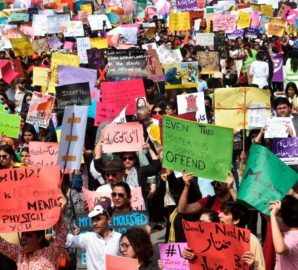
Now in its third year, the Aurat March is raising the call of Pakistan's women to abolish systems built on hegemony, patriarchy, and neo-colonialism.

Continuous attacks by machete-wielding gangs against artisanal miners in Zimbabwe disproportionately affect women miners, highlighting longstanding impediments for women to access the sector and threatening the government's target for an annual mining revenue of $12 billion by 2023.

Last August, India's Hindu nationalist government scrapped Articles 370 and 35A of the Indian constitution, stripping the state of Jammu & Kashmir of its special constitutional status. What followed is only the latest chapter in a documented history of sexualized violence by security forces as a means to quell dissent in Muslim-majority Kashmir.

In early 2018, the story of a baby who was raped by a relative sent shockwaves around the world. Two years later, the world has moved on, but she is no closer to receiving justice.

Countries like Spain, France, the UK, Argentina, and Norway have devised schemes that allow women to seek help without alerting their partners.

The loss of resources, support systems, and general safety puts survivors at risk of further abuse.

The coronavirus pandemic has led to a massive surge in child abuse material being uploaded, according to a story from the Fuller Project for International Reporting co-published with the UK Telegraph.

Almost six months since it was first performed, “Un Violador en Tu Camino” (“A Rapist in Your Path”) has become a universal feminist anthem that has crossed borders, languages, and cultures.
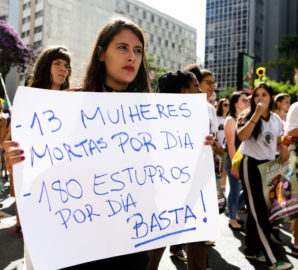
While murder rates are falling in Brazil, femicide rates continue to steadily climb, and with President Jair Bolsonaro at the helm, there are no promising signs of the violence abating.
These three categories — sexual projets, sexual citizenship, and sexual geographies — comprise a radically new framework for thinking about sex.

In Mexico's northeastern state of Nuevo León, young feminists are creating their own safe spaces to share, bond and mobilize, and demand an end to the country's pervasive gender-based violence.

More must be done to ensure that the most intimate yet essential needs of women and young girls around the world are met during this crisis.

In Australia, a government-supported initiative that provides “safe phones” to women stuck in violent homes is seeing a serious uptick in requests attributed to the virus, the Thomson Reuters Foundation reported Wednesday.

Months after Turkish forces launched an offensive in the Rojava region, which some have likened to genocide, a rise in miscarriages sheds light on the unseen impacts of the occupation.

On February 28, The César Awards, which are essentially the French Oscars, awarded the Best Director honor to Roman Polanski — a man who fled the United States after pleading guilty to the statutory rape of a 13-year-old girl in 1977.

“Believe women” has long been a rallying cry for #MeToo supporters — and a point of attack for the movement’s opponents.

While Venezuela reels from its ongoing political and humanitarian crises, attacks against members of the press, and particularly women journalists, have become especially acute.

Although media attention to the problem has waned, the harsh reality is that between 64,000 and 75,000 Black women and girls are currently missing in the U.S.
- All Categories
- Arts and culture
- Body image and body standards
- Disability
- Economy
- Education
- Environment
- Feminism
- Free Speech
- Gender-based violence
- Girls
- Gloria Steinem
- Health
- Immigration
- International
- Jane Fonda
- LGBTQIA
- Media
- Misogyny
- Online harassment
- Politics
- Race/Ethnicity
- Religion
- Robin Morgan
- Science and tech
- Sports
- Violence against women
- WMC Loreen Arbus Journalism Program