











The Women's Media Center works to make women visible and powerful in the media. Led by our president, Julie Burton, the WMC works with the media to ensure that women’s stories are told and women’s voices are heard.
We are directly engaged with the media at all levels to ensure that a diverse group of women is present in newsrooms, on air, in print and online, in film, entertainment, and theater, as sources and subjects.
The Women’s Media Center was founded in 2005 as a nonprofit progressive women's media organization by Jane Fonda, Robin Morgan, and Gloria Steinem.
This Women’s Media Center press kit contains approved WMC images, logos and biographies for reporters, editors, producers and bookers.
For additional information, please contact Cristal Williams Chancellor, director of communications, cristal@womensmediacenter.com or 202-270-8539 or mediarelations@womensmediacenter.com.
Find SheSource Experts
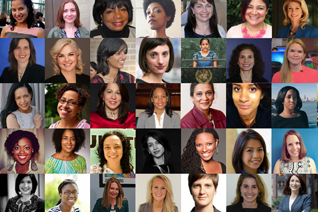
WMC SheSource has over 1,600 women experts who we connect to journalists, bookers and producers looking for a source. Find a SheSource Expert Now. For more information about WMC SheSource email: shesource@womensmediacenter.com

Women were credited with only 36.1% of total bylines or on-camera appearances as anchors or reporters, according to a 2014 study by the Women’s Media Center (WMC), de-spite the large enrollment numbers in journalism colleges.

Sometimes women are killed after they’re raped, so we don’t find about them,” said Lauren Wolfe, director of the Women Under Siege project at the Women’s Media Cen-tre in New York. “Then you have the chaos of war, and you have people moving around, and on top of that you have the stigma that prevents women from coming forward.” Ms. Wolfe has been tracking sexualized violence in Syria for three years, listening to the stories of women in Jordanian refugee camps. The problem is “definitely underreported,” she said in a phone interview. It’s not just an issue of women being silenced by shame or stigma, but by official disregard and a lack of resources. “It comes down to a lack of money — you have to have the aid workers and support systems in place.

The Women’s Media Center, which was founded by Jane Fonda, Robin Morgan and Gloria Steinem and tracks gen-der equity, or lack thereof, in the media, found that in non-acting categories, women made up under 20 percent of the nominees. In seven categories — directing, writing, original screenplay and more — dudes drew all of the nominations. The one place where women are establishing a foothold is in documentary features, with women winning four times in the last decade and nabbing two of five nominations this year.

Still, Wu says she’s more bothered that young women might steer clear of gaming development than by the intimidation she is experiencing. Women represent 47 percent of gamers but only about 12 percent of game developers, according to a 2014 report by the Women’s Media Center

“One of the things we try to do at the Women’s Media Center is to model what an alternative media would look like, not just criticize.” — Robin Morgan

There’s much more consciousness how the media impacts our lives. There’s more activism. There’s more young girls convinc-ing magazines not to photoshop their fashion photographs and distort women’s bodies. “There’s much more consciousness but there’s not nearly enough actual change of who’s on and what topics are covered. But we’ll get there.” — Gloria Steinem

“The Women`s Media Center, yearly, comes out with this, which is the Status of Women in the U.S. Media and people can get it for free at WomensMediaCenter.com and just download it. And there`s everything you didn`t want to know that was hap-pening or not happening and everything you did. There`s very little praise in here, I want you to know. But there is this sentence, ‘our researchers pointed out one example of good stuff. MSNBC commentator Chris Hayes, who sees the merits in setting race and gender quotas for the media — Hayes’ bookers must in-clude two women among the four guests on each of his shows.’ “So congratulations — and you may frame that!” — Robin Morgan

Julie Burton, president of the Women’s Media Center, an orga-nization devoted to monitoring the images of women and their impact on culture, told me: “Television has great cultural and economic power. It tells us who we are and what our roles are in society.” Burton says she is excited by some of the recent de-pictions of women as leaders and candidates, but they are still “the exception.” She concluded, “If the standard TV image of a politician is a man, women—and importantly, girls—won’t see themselves in that picture and won’t aspire to those positions. That’s a loss for everyone.”

We can turn to the news for balance, but who’s telling the story there? Last year, the Women’s Media Center counted newspa-per bylines, TV anchors and found an imbalance, 63 percent men, 36 percent women
Last summer, Lauren Wolfe, the director of Women Under Siege, a project at the Women’s Media Center, visited the Zaatari ref-ugee camp on the Jordan-Syria border. There, she met a young woman with a baby who said her husband, out of work and angry, had started beating her every day.

“This is the third year I’ve done a gender count of the Emmy nom-inees, and overall, the ratios haven’t changed much,” Rachel Lar-ris, WMC’s communications manager, told BuzzFeed. “Looking at all the names in all the categories, women made up only 26% of the nominees this year and it was the same last year.”

“It’s always good to see more women’s voices in media, particu-larly as owners, leaders and sources,” said Julie Burton, president of the Women’s Media Center (WMC). “The [WMC] hopes that as the Sarah Palin Channel develops its online network team that it will be cognizant of women’s representation behind the scenes and in front of the camera, particularly in light of recent Radio Television Digital News Association (RTNDA) and American So-ciety of News Editors (ASNE) studies showing some gains for women and people of color, yet still widespread disparity.”
In this year’s nominations, only 26 percent were women, accord-ing to an analysis by Rachel Larris of Women’s Media Center. This number isn’t improving either. In 2013, the ratio for Emmy nominations was about the same
Women are the predominant victims of rape and sexual assault; therefore, they may have some insight on the editing of a col-umn on sexual assault. A study by the Women’s Media Center showed that women staffers at newspapers are outnumbered.
Lauren Wolfe, director of the journalism project Women Under Siege, which has documented decades of wartime rape, says little has changed over the years because of prejudice against rape vic-tims based upon culture and religion. “Most victims cannot expect support or to see a prosecution. The most likely outcome would be stigma, even within families,” Wolfe said.
- 2026
- 2025
- 2024
- 2023
- 2022
- 2021
- 2020
- 2019
- 2018
- 2017
- 2016
- 2015
- 2014
- 2012
- 2009