












The Women's Media Center works to make women visible and powerful in the media. Led by our president, Julie Burton, the WMC works with the media to ensure that women’s stories are told and women’s voices are heard.
We are directly engaged with the media at all levels to ensure that a diverse group of women is present in newsrooms, on air, in print and online, in film, entertainment, and theater, as sources and subjects.
The Women’s Media Center was founded in 2005 as a nonprofit progressive women's media organization by Jane Fonda, Robin Morgan, and Gloria Steinem.
This Women’s Media Center press kit contains approved WMC images, logos and biographies for reporters, editors, producers and bookers.
For additional information, please contact Cristal Williams Chancellor, director of communications, cristal@womensmediacenter.com or 202-270-8539 or mediarelations@womensmediacenter.com.
Find SheSource Experts
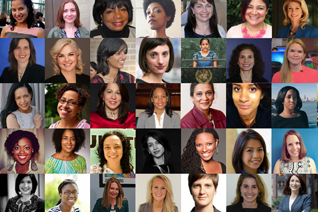
WMC SheSource has over 1,600 women experts who we connect to journalists, bookers and producers looking for a source. Find a SheSource Expert Now. For more information about WMC SheSource email: shesource@womensmediacenter.com

What we’re seeing is a larger manifestation of very common tactics of abuse,” Soraya Chemaly, a writer and director of the Women’s Media Center Speech Project, told CN-NMoney. “There’s nothing new about what we’re seeing.”

But even as our embattled profession threatens to become a pink-collar ghetto, men still hold nearly two-thirds of newspaper supervisory posts, according to a 2015 report by the Women’s Media Center

Soraya Chemaly, the director of the Women’s Media Cen-ter Speech Project, pointed out that even “the Republican men who are disavowing Trump are betraying the other side of rape culture: seemingly benevolent paternalism that casts select women as needing protection from strong men.”

The women ([Jane Fonda, Robin Morgan, Gloria Steinem] who are giving me this award have always been very pas-sionate in wanting to train other women so that they could be in positions of leadership.”

“I like anytime you can come to an event like this. It just sort of reaffirms what we do and how we do it.”Gayle King, Women’s Media Awards 2016

“It’s highly important. It’s women’s media. It’s identifying and training women in media to be able to stand toe-to-toe in a male-oriented society, to be able to tell the stories to find the stories to make sure they get out there what is accurate and is going on in the world.”Sally Field, Host, Women’s Media Awards 2016

“One of the things that the Women’s Media Center does: it trains women in media. It has a terrific website, Womens-mediacenter.com...We’re celebrating our 11th year with the gala awards.”

The Women’s Media Center released a series of studies in 2013, based on online surveys, showing how a female can-didate’s chances of winning over voters lessened when the media described her appearance, regardless of whether it was a negative, neutral or positive description.
Online, searchable collections of women experts may be the key to getting them more visibility in the media.

The Women’s Media Center analyzed 27,758 pieces of news content (TV, print, Internet, wires) and found that 62.1 percent was produced by men. As Ms. Magazine cofound-er Gloria Steinem said, “The truth will set you free, but first it will piss you off.”

About 90 percent of sports editors are men, and 90 percent are white. The Women’s Media Center’s 2015 report on “The Status of Women in the U.S. Media” showed that just 10.2 percent of sports coverage in 2014 was produced by women.
We can stop excusing a kind of manhood that belittles wom-en, bringing us down to the level of objects — objects that can be treated with not only scorn, but with actual violence.

“Last year, as the presidential election got under way, re-search conducted for the Women’s Media Center showed that men reported 65% of U.S. political stories in 2014. Research commissioned by the center on the 2012 presi-dential election found that 71% of front-page stories were written by men and that on cable and network TV, political news show guests and experts were 77% men.

The 1998 conviction of Jean-Paul Akayesu—a former may-or of Taba, a small commune 40 miles west of the capital Kigali—was a “watershed” moment, says Lauren Wolfe, journalist and director of Women Under Siege. “Until then, rape had been on the books as a prosecutable crime in war, but it hadn’t actually been prosecuted,” says Wolfe. “[Akayesu] was a real sea-change moment.”

“Look at your neighborhood paper and local news station to see how many women are represented,” says Jane Fonda. “When you see an imbalance, contact the Women’s Media Center.”
- 2026
- 2025
- 2024
- 2023
- 2022
- 2021
- 2020
- 2019
- 2018
- 2017
- 2016
- 2015
- 2014
- 2012
- 2009