





The Women's Media Center works to make women visible and powerful in the media. Led by our president, Julie Burton, the WMC works with the media to ensure that women’s stories are told and women’s voices are heard.
We are directly engaged with the media at all levels to ensure that a diverse group of women is present in newsrooms, on air, in print and online, in film, entertainment, and theater, as sources and subjects.
The Women’s Media Center was founded in 2005 as a nonprofit progressive women's media organization by Jane Fonda, Robin Morgan, and Gloria Steinem.
This Women’s Media Center press kit contains approved WMC images, logos and biographies for reporters, editors, producers and bookers.
For additional information, please contact Cristal Williams Chancellor, director of communications, cristal@womensmediacenter.com or 202-270-8539 or mediarelations@womensmediacenter.com.
Find SheSource Experts
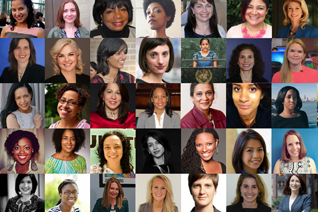
WMC SheSource has over 1,600 women experts who we connect to journalists, bookers and producers looking for a source. Find a SheSource Expert Now. For more information about WMC SheSource email: shesource@womensmediacenter.com

WMC AWARDS will be presented to outstanding leaders and champions for women in media, including Lisa Borders, Abigail Disney, Fatima Goss Graves, Cindy Holland, Maria Teresa Kumar, and Congresswoman Pramila Jayapal.
Soledad O'Brien, three-time Emmy-winning anchor and producer of “Matter of Fact with Soledad O’Brien,” founder and CEO of Starfish Media Group, and a past WOMEN’S MEDIA CENTER honoree, will host the WOMEN’S MEDIA AWARDS.

Racial disparities in the job market not only disproportionately impact how much money black women earn — it can affect our career trajectories, too, leaving us with less opportunity to advance in the job market. For example, I’m a journalist, and have been for six years. According to a report from Women’s Media Center, women make up 32 percent of staff in U.S newsrooms, but women of color represent just 7.95 percent.

Most kids want to see more female superheroes and superheroes that look like them.
According to a new study by the Women’s Media Center and BBC America released Monday, most girls believe there are not enough female role models, strong female characters and relatable female characters on film and television. Both girls and boys agree that they’d like to see more female superheroes on-screen.

The world still needs more superheroes who are women, according to the findings of a report from BBC America in collaboration with the Women’s Media Center. The science fiction genre is not inclusive enough, says the study, which looked at how the depictions of women on screen affect young women and girls and presented its findings in a series of infographics.
“Media tells us our roles in society,” the report’s introduction reads. The bottom line: Children believe there is not enough representation in the superhero and sci-fi genres, and they want more superheroes and role models who look like them.

A new study suggests the gender gap in onscreen representation in superhero and sci-fi films and TV series can have real-world effects on even the youngest consumers of such media. Teenage girls are less likely than boys to describe themselves as confident, brave and listened to, and nearly two-thirds of girls 10-19 say they don't see enough role models or strong and relatable characters of their own gender onscreen. The study, titled SuperPowering Girls and conducted by BBC America and the Women's Media Center, says better onscreen representation can help close the confidence gap for girls and allow them to see themselves as leaders and heroes.

The number of articles on sexual assault has increased more than 30% between May 2017 and August 2018, according to a study of the content of headlines, bylines, and articles on 15,228 pieces of news conducted by the Women’s Media Center. When articles focused solely on the#MeToo movement are added, total coverage has increased 52%, according to the report.

The Women's Media Center released a scathing report in early September that said 70 percent of all non-acting nominations went to men, essentially unchanged from the year before.
BBC America and Women’s Media Center (WMC) are working together to improve the media’s depictions of women. A press release has announced that the TV network and the feminist organization have formed “a strategic alliance” that will see them developing initiatives “with the goal of expanding both the diversity and representation of women in media.”
The fight for representation of women in entertainment has been a tumultuous one, but now two organizations are teaming up to face it head-on. BBC America and Women’s Media Center announced what they’re calling a “strategic alliance” on Tuesday “with the goal of expanding both the diversity and representation of women in media.”

“Engaging men, particularly young men, in gender disparity conversations, leads to awareness about the issue. And wider awareness about gender disparity is critical to address the issue,” Cristal Williams Chancellor of the Women’s Media Center said in an exclusive interview to CNN News18 in which she also revealed details of a four-year-long study on sexual assault reportage in India conducted by the institution.
BBC America and Women’s Media Center have partnered to expand diversity and representation of women in media. The two organizations will partner on initiatives to create change and engage the public.

In a 2017 video by the Women’s Media Center, elected officials — including seasoned politicians like Representatives Katherine M. Clark, 55, Democrat of Massachusetts, and Ileana Ros-Lehtinen, 66, Republican of Florida — described their experiences as part of a campaign called #NameItChangeIt, which encourages women to speak out about harassment. And women are more willing to do so than they were even a few years ago.

Lessons from the American Women’s Media Centre on amplifying women’s voices.

Cristal Williams Chancellor of the U.S.-based non-profit Women’s Media Center (WMC) says the current media situation worries as her without free press, democracy cannot exist.
WE FACE A STAGGERING ARRAY OF FOREIGN POLICY CHALLENGES today: climate change, extremism, epidemics, increasing inequality, threats of nuclear war, and cyber-attacks. Yet, somehow, we continue to underutilize a valuable resource to address these challenges: women.
- 2026
- 2025
- 2024
- 2023
- 2022
- 2021
- 2020
- 2019
- 2018
- 2017
- 2016
- 2015
- 2014
- 2012
- 2009