















With this morning’s news that the Islamic State has claimed responsibility for the suicide bombing at the UK’s Manchester Arena Monday night, the obviousness of the target begins to make a sick kind of sense.

This is meant as an informal guide for journalists who cover sexualized violence or want to, mainly in an international context.

Emerging from a crowd of around a dozen women, Farida, a 32-year-old Syrian refugee living in Istanbul, stood in front of a cabinet full of bright and colorful threads and beads. Looking at the materials with friends, she mused what color she should use for her next earring project. “Let’s not use orange and pink this time,” she murmured to one of her friends, another Syrian refugee.
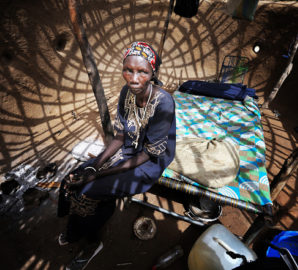
No one should ever have to choose between starving to death and exposure to HIV, however millions of women and children struggling to survive in the drought-stricken countries of southern Africa aren’t being given a choice.

In the languages of the former Yugoslavia “suza” means “tear.” And in the more than 20 years that have passed since the end of the wars that dismantled the country in the 1990s, it seems that there is one, very last tear that many mothers, wives, daughters, and sisters cannot shed until the mortal remains of their closest kin are found, identified, and properly buried.

I remember I was 5 years old as I watched my mother repeatedly climb to the highest part of the bed only to jump right back off again. I was confused. I could see that she was in emotional and physical pain. I was sad for her.
With Tuesday’s gruesome chemical attack in Syria all over the news, attention has suddenly turned toward the crimes of Bashar Al-Assad’s regime—and away, for a moment, from those of the Islamic State. It is about time.
In the Trump administration’s proposed mass slaying of any and all programs the United States financially supports in terms of human rights, one in particular is troubling for women around the world—and it’s an angle media have missed in their reporting.

Grace sits staring vacantly ahead, her hands tightly clasped in her lap. She is 16 years old but has a tiny frame that makes her look no older than 13. Underneath her checkered school dress, a small bump sticks out. In four months’ time, she is due to give birth to her stepfather’s child.

Nargez* was 14 when her father arranged her marriage to a 55-year-old stranger who offered a large amount of money. After years of sexual and physical abuse, she fled with her brother’s help and sought safety in his home. But when she tried to file for divorce, her husband pressed charges against her for running away and against her brother for helping her. They were sentenced to seven years.

Thirteen-year-old Jane* lived in Melito Porto Salvo, a village in Calabria, a region that is commonly referred to as Italy’s toe. She was young, confused, and lonely after her parents decided to separate. Like many children in this situation, she struggled to make sense of her new world. All of that changed when she met 19-year-old Davide Schimizzi in the summer of 2013. Their romance filled an emotional void in her life.

Earlier this month, Amnesty released a report detailing allegations of government-sanctioned abuses in the two buildings of Saydnaya military prison outside of Damascus, between 2011 and 2015. The findings show a systematic policy of mass executions, torture and deprivation of food, water, medicine and medical care, which could amount to war crimes and crimes against humanity.

On December 14, 2016, 23-year-old feminist activist Débora Soriano de Melo was bludgeoned to death with a baseball bat in a bar in São Paulo, Brazil. There was evidence that the young activist suffered sexual abuse that same night. Detectives suspected Willy Gorayeb Liger, a manager of the bar, in the assault and called for his arrest on rape charges.

After her husband died, Margaret, 55, saw no alternative but to sell her body in order to feed her four children. She would walk down to Lake Victoria every day to buy fish to sell in the market. But first she had to have sex with a fisherman. For at least the past two decades, fishermen at Lake Victoria have demanded sex before selling their catch to female fish traders.

“No hate! No fear! Refugees are welcome here!” Shouts are rising into the night sky in Brooklyn as I write this. I just left the Brooklyn federal courthouse, where hundreds of people are chanting that and more, some slogans more angry and profane than others.
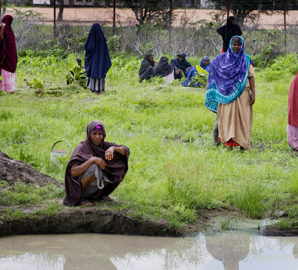
Once known as a refugee-friendly nation, Kenya is becoming more resistant to taking in people who have been forced to flee their homes. That means added challenges for the nonprofit Heshima and the refugee girls it supports, says executive director Alisa Roadcup.

In September 2016, when I arrived at a gloomy, two-star Econo Lodge hotel in Fort Lee, New Jersey, Daey*—which means “mother” in Kurdish—was sleeping.

Throughout the conflict in DRC, children have been abducted and made to serve as soldiers. While most are male, it is estimated over a third are female, used mainly as domestic and sexual servants, but sometimes as fighters. Now an NGO has released a report showing that many of the girls weren’t enlisted by force.

On April 20, Marcia Mejía Chirimia, 28, an indigenous Colombian peace and women’s rights activist, received a text message from someone she believes is a member of a paramilitary group.

When Luna Watfa refused to reveal any information to her interrogators, they took her son, 17, and threatened to torture him. “They put my son’s hands behind his back, his T-shirt over his head and they took him,” she says.

Wars fought because of ethnic hatred often seem to be more brutal than others. This is just a personal observation, having studied many. Just look at Rwanda, whose 1994 war saw between 250,000 and half a million women raped, often with objects and often publicly, in order to spread maximum humiliation and terror.
The recent Lancet Series on Maternal Health confirms a well-established reality: The majority of preventable maternal deaths continue to occur in areas affected by humanitarian crisis, largely as a result of poor maternal care. But this reminder is also accompanied by a chronic offense. Contraception is not given the spotlight it deserves.


