















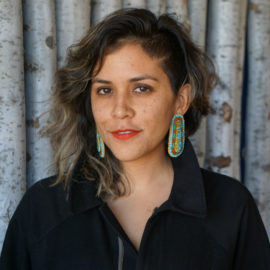
Emma Robbins is the director of the Navajo Water Project, which provides infrastructure for families to access clean running water in their homes on the Navajo Nation. The project is a part of the human rights nonprofit DigDeep. She was a 2020 Aspen Institute Healthy Communities Fellow and is a Diné artist, using her work to raise awareness about the need for clean water across all Native Nations. She splits her time between the Navajo Nation and Los Angeles, CA. Native American households face barriers to accessing running water - about 30% of families on the Navajo Nation don’t have access to clean running water. Robbins grew up on the reservation, in one of the areas with the largest concentrations of water poverty, and always knew the importance of water. She then went on to lead the Navajo Water Project. To date, the Navajo Water Project has installed running water in approximately 300 homes, and is continuing their work to ensure families on the Navajo Nation have access to safe water to drink and stay clean by delivering bottled and trucked water to homes during the COVID pandemic. Media includes: PBS Democracy Now, Marie Claire, Nylon, NPR.

Seánna Howard teaches courses in international human rights and Indigenous peoples and is the director of the International Human Rights Advocacy Workshop. Professor Howard has been a staff attorney and professor with the University of Arizona Indigenous Peoples Law and Policy Program since 2006. She has represented indigenous communities before the Inter-American and United Nations human rights systems, including the Western Shoshone, the Chiricahua Apache, the Navajo Nation and the Water Protectors Legal Collective in the US; the Maya of Belize; and the Hul'qumi'num Treaty Group of Canada. Since the Fall of 2020, Professor Howard has served as external advisor for the United Nations Special Rapporteur on the rights of Indigenous Peoples. Professor Howard's previous legal experience includes working for the Canadian Lawyers Association for International Human Rights in South Africa, the Attorney General of Ontario -Office of the Children's Lawyer and the Children's Aid Society of Hamilton-Wentworth. Media includes: Ladysmith Chronicle, Arizona Native Net, Elko Daily Free Press.

Michelle Schenandoah (Oneida Nation) is a trained lawyer, writer, producer and Founder of Rematriation, a nonprofit highlighting the untold stories and contributions of Indigenous Peoples in North America. Schenandoah is currently teaching a course on Indigenous law at Syracuse University College of Law. Her expertise draws on 40+ years of experience as a traditional member of the On^yota’:aka Oneida Nation of the Haudenosaunee Confederacy as well as her roles as Founder of the nonprofit Rematriation; and Co-Founder, with her husband Neal Powless, of Indigenous Concepts Consulting. As an in-demand keynote speaker, Schenandoah talks about the Haudenosaunee Confederacy’s influence on the formation of U.S. democracy, the U.S. Constitution and women’s rights. She creates healing narratives about truth telling, racial justice and intergenerational trauma for public and private audiences to process harmful histories and inspire meaningful action. Media includes: Associated Press, Al Jazeera, Neha Magazine, PBS.

Lael Echo-Hawk (Pawnee) represents tribes and tribal organizations across the United States. She leads the tribal advocacy group MThirtySix and is General Counsel for the Wampanoag Tribe of Gay Head (Aquinnah). After serving as in-house counsel for a tribe and its economic enterprises, Echo-Hawk moved to Washington, D.C. to take a position as Legislative Director for the Native American Contractors Association and Counselor to the Chairwoman of the National Indian Gaming Commission. Echo-Hawk provided advice on tribal internal governance issues and economic development activities and strategic policy analysis on national tribal legislative and regulatory proposals. Echo-Hawk is a past-president of both the National Native American Bar Association and the Northwest Indian Bar Association. Media includes: Indian Country, Boston Herald, WMC Live with Robin Morgan.
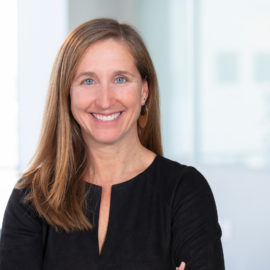
Jen Sokolove is director of programs and strategy at the Water Foundation, where she drives grantmaking to secure safe water for people, restore and sustain freshwater ecosystems, and build climate resilience. As a member of the senior management team, Sokolove helps implement the foundation’s overall mission and works closely with the CEO to engage new partners, develop campaign strategies, and grow field capacity. She has been working on sustainability issues for more than two decades. Prior to joining the Water Foundation, she led strategy and grantmaking at the Compton Foundation around movement-building and narrative in climate change, reproductive justice, and peace and security. She joined Compton initially to advance its environmental programs on fresh water, climate, and rural conservation in the western United States, as well as sustainable food systems and art for social change. Extensive media experience.

Mary Kathryn Nagle (citizen, Cherokee Nation) is an attorney/playwright working to restore and preserve tribal sovereignty and jurisdiction. Nagle graduated summa cum laude from Tulane Law School and subsequently clerked on both the federal district court and United States Fifth Circuit Court of Appeals. As a former Partner at Pipestem and Nagle Law PC, she has filed briefs in the United States Supreme Court that advocate for safety for Native women from domestic violence and sexual assault. She is counsel to the National Indigenous Women’s Resource Center and represents families of murdered and missing Indigenous women and girls. Her plays have been featured at theaters across the United States. She has received commissions from Arena Stage (Washington DC), Rose Theater (Omaha, NE), and Portalnd Center Stage (Portland, OR). Nagle’s media appearances include MSNBC, MoveOn, Slate, Al Jazeera, and more.
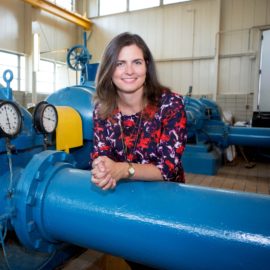
Elin Betanzo is the president and founder of Safe Water Engineering LLC, a small consulting firm working to improve access to safe drinking water through engineering and policy consulting. In August of 2015, Betanzo played a critical role in uncovering the Flint Water Crisis by encouraging Dr. Mona Hanna-Attisha, a Flint pediatrician, to conduct a study that discovered elevated lead levels in children living in Flint, Michigan. Betanzo continues to work on lead and drinking water policy at federal, state, and local levels. Betanzo has nearly 20 years of experience working on drinking water science, engineering, and policy issues. She worked for the Environmental Protection Agency in the Office of Ground Water and Drinking Water writing and implementing national drinking water regulations, the Washington Suburban Sanitary Commission where she led water system master planning and hydraulic modeling, and for the Northeast-Midwest Institute leading their Safe Drinking Water Research and Policy Program. Media includes: The New York Times, The Detroit News, WNET, PBS.

Soma Bhadra, CEO of PROTEUS Consulting, is an innovation consultant and technology integrator across water, energy, and CleanTech sectors. Soma has the intuitive ability for identifying gaps in markets and developing new markets in those gaps. Soma has a BE is civil engineering from Bengal Engineering and Science University, India; and a MS in environmental engineering from University at Buffalo (SUNY), and has over 14 years of experience in design, construction, and operation of water, wastewater, ultra-pure, and recycled water treatment plants and conveyance systems. With PROTEUS Consulting, she is altering the way the water industry works by infusing new ideas and products from energy, IT, communications, and economics sectors. She is also a very committed supporter of Water For People. Bhadra lives in San Diego with her husband and two adorable poodles. In her spare time she experiments with fusion cuisine and teaches Indian cooking classes. Extensive media experience.

Gwen Leaffe Carr is an award-winning artist, musician, singer, writer, storyteller advocate and activist on American Indian and Social Justice issues. Carr is an enrolled member of the Cayuga Nation of New York, Heron Clan. She is currently serving as the executive director of the Carlisle Indian School Project, which honors the students of the first government-run boarding school for Native Americans. Carr is the founder of the Wisconsin American Indian Democratic Caucus. She has turned out the greatest number of American Indian voters in the history of Wisconsin. Her political expertise has successfully elected numerous officials locally and nationally. Carr is a tireless advocate for social justice and American Indians in particular. She has also had over 30 years of experience in working with American Indian Tribes. Some of her achievements include; working in Intergovernmental Affairs at the White House in the Clinton Administration and being the first National Political Director for American Indians at the Democratic National Committee in Washington D.C. Gwen also served as the Deputy Secretary for the Oklahoma Indian Affairs Commission. Extensive media experience.
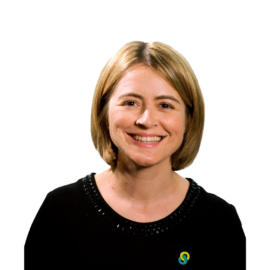
Catarina de Albuquerque joined Sanitation and Water for All in 2014 and has since increased political will in favor of water, sanitation and hygiene, and positioned SWA as a vital contributor to the achievement of Sustainable Development Goal 6. In July 2018, following a wide-ranging governance review, SWA created the position of Chief Executive Officer and de Albuquerque was chosen for the position in a competitive process. Through her strategic leadership as CEO, she is an influential and powerful advocate for SWA and the human rights to water and sanitation. In 2008, de Albuquerque was appointed by the Human Rights Council to become the first UN Special Rapporteur on the human rights to safe drinking water and sanitation. In 2010, she played a pivotal role in the recognition of water and sanitation as human rights by the UN General Assembly. Her work helped ensure that the rights to water and sanitation were incorporated into the language of the Sustainable Development Goals. Media includes: Los Angeles Times, Al Jazeera, The Guardian, Reuters.
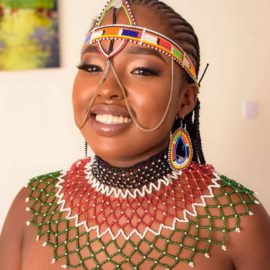
Anita Soina is a Kenyan climate activist and the 2023-2024 Global Youth Champion for Water, Sanitation and Hygiene at the UN-hosted Sanitation and Water for All global partnership. A member of the Maasai community in Kenya, she is the founder of Spice Warriors - a group of climate change activists. She also recently launched The Soina Foundation which addresses social issues like sanitation, health, education and sexual and reproductive wellness. Her book, The Green War, talks about her journey and the challenges faced by environmental warriors from the Global South. Today she speaks regularly on issues around WASH (water, sanitation and hygiene), climate, food security, women's rights, and sexual and reproductive health. Media includes: Deutsche Welle, The Mail & Guardian South Africa, PBS Newshour, TEDx Talks, BBC.

Sarah Deer (J.D., University of Kansas) is a citizen of the Muscogee (Creek) Nation of Oklahoma and a professor at the University of Kansas, where she has a dual appointment in the Women, Gender, and Sexuality Department and the School of Public Affairs and Administration. Her scholarship focuses on the intersection of Federal Indian law and feminism, with a focus on violence against Native women. Her 2015 book, The Beginning and End of Rape, has received several awards, including the best first book award from the Native American Indigenous Studies Association. She also serves as the Chief Justice for the Prairie Island Indian Community Court of Appeals and has testified in four Congressional hearings. Deer is a co-author of four textbooks on tribal law and has been published in a wide variety of law journals, including the Harvard Journal of Law and Gender, the Yale Journal of Law and Feminism, and the Columbia Journal of Gender and Law. Media includes: The New York Times, The Washington Post, Democracy Now, MSNBC, NPR.
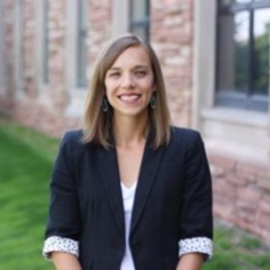
Kate R. Finn is executive director of First Peoples Worldwide. Her expertise concerns articulating how the impacts of development in Indigenous communities must be addressed at all levels of business and investment in order to strengthen Native economies and communities for generations. Prior to her directorship, she served as staff attorney for First Peoples. Finn served as the inaugural American Indian Law Program Fellow at the University of Colorado Law School where she worked directly with Native American tribes and Indigenous Peoples globally. Finn's areas of focus and research expertise include Indigenous Peoples law and policy, federal Indian law, preventing violence against women, victim services, and business and human rights. She has co-authored several articles on the intersection of resource development and violence against women in Native communities. At First Peoples Worldwide, Finn leads the organization to deploy the tools and strategies of shareholder advocacy to ensure corporate accountability to the rights of Indigenous Peoples. Finn is an enrolled member of the Osage Nation. Media includes: The Washington Post, Denver Post, CNN.
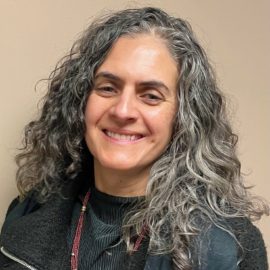
Dr. Cristina L. Azocar is a citizen of the Upper Mattaponi Indian Tribe and a Professor of Journalism at San Francisco State University. She is the author of News Media and the Indigenous Fight for Federal Recognition, which examines how past coverage has prioritized gaming over sovereignty and interfered in Tribes’ ability to be federally recognized. Dr. Azocar is the Faculty Coordinator of the Presidential Scholars Program, the most prestigious scholarship offered at SF State, and is the faculty advisor to the Student Kouncil of Intertribal Nations (SKINS). Her research focuses on the intersection of race and journalistic practice, particularly in the area of news coverage of Indigenous people. Dr. Azocar served as a past president of the Native American Journalists Association, directed the Center for Integration and Improvement of Journalism for 10 years, was a former editor of American Indian Issues for the Media Diversity Forum, and was an inaugural board member of the Women’s Media Center. Extensive media experience.

Rebecca Nagle is an award-winning advocate, writer, and citizen of Cherokee Nation. As the host of the chart-topping podcast “This Land,” Nagle told the story of one Supreme Court case about tribal land in Oklahoma, the small-town murder that started it, and the surprising connection to her own family history. Season two of “This Land” is ”a timely exposé about how the far right is using Native children to quietly dismantle American Indian tribes and advance a conservative agenda”. In addition to being an outspoken advocate for advancing Native rights and Native representation, Nagle lends her voice to fighting violence against women. With her years of organizing and advocacy work, Nagle empowers her audiences to build community advocacy movements that are diverse and inclusive. In 2016, Nagle was named one of the National Center American Indian Enterprise Development’s "Native American 40 Under 40" for her work to support survivors and advocate for policy change to address the crisis of violence against Native women. Her writing about Native representation and tribal sovereignty has been featured in The Washington Post, The Guardian, USA Today, Teen Vogue, The Huffington Post, and more.

Rebecca Adamson, an Indigenous Economist of Cherokee Descent, is Founder of First Nations Development and First Peoples Worldwide. A leader, activist, and ground-breaking Indigenous woman, Adamson holds a distinct perspective about how Indigenous people’s systems thinking and the value system behind Indigenous economies can be used to catalyze change. Adamson has worked directly with grassroots indigenous communities, and internationally as an advocate of Indigenous self-determination since 1970. Her first five years at the Coalition of Indian Controlled Schools were spent in and out of jail until the Indian Self Determination and Education Act was passed in 1975 making Indian self-determination legal. Extensive media experience.ad

Amanda Clinton is the owner and principal of A.R. Clinton: Communications, Content and Strategies. For nearly 15 years, she oversaw external communications for the Cherokee Nation and its corporate arm, Cherokee Nation Businesses. Prior to that, she worked as a television news producer in Oklahoma and Kansas. She created and was a producer for the first all-Native American directed and produced docuseries, “Osiyo, Voices of the Cherokee People,” which highlights tribal culture, history, heritage and language. In 2019, she launched the Cherokee Nation Film Office, the first AFCI-accredited tribal film office in the United States. Clinton is a proud citizen of the Cherokee Nation and her passions and areas of expertise include combating issues that adversely affect Indigenous people and communities, increasing female and Indigenous representation in film and television, protecting and advancing women’s rights, fighting climate change and protecting rural communities from factory and industrial farming. Media includes: Tulsa World, HuffPost, Native Business Magazine, The Mercury News, CBS.
 Dr. Jeanine N Gordon, DNP, RN, OCN, NE-BC
 Sharon Louden
 Dr. Anita Manion
 Dr. Maura Mills, Ph.D.
 Dr. Sarah Elizabeth Bruhn