

















While the news cycle in January was dominated by reports on Japanese hostages held by the militant group Islamic State and the Paris attacks on the offices of the satirical newspaper Charlie Hebdo, some stories didn’t receive as much attention.
The author, a former sex crimes prosecutor, points out that true reports of rape are all too common, false reports of rape are rare but they exist, and good investigations can tell them apart.

The conflict in eastern Ukraine, now in its 10th month, has taken a heavy toll on the country’s population. Wide-ranging violations of international humanitarian law have been documented on both sides of the conflict, following clashes between Russian-backed rebels and the Ukrainian government forces in the eastern regions of the country.
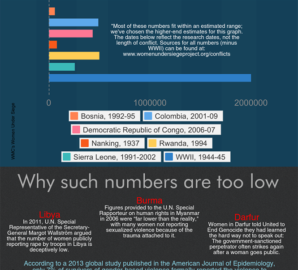
We know there’s a problem but we don’t know how big it is. That’s what governments, scholars, and others argue when trying to figure out how to allot funds toward this problem of sexualized violence in conflict. If we don’t know the numbers, they ask, how can we help properly? How can we mount prosecutions? Offer reparations? Put in place proper advocacy? So the thinking goes.

- All Categories
- Arts and culture
- Body image and body standards
- Disability
- Economy
- Education
- Environment
- Feminism
- Free Speech
- Gender-based violence
- Girls
- Gloria Steinem
- Health
- Immigration
- International
- Jane Fonda
- LGBTQIA
- Media
- Misogyny
- Online harassment
- Politics
- Race/Ethnicity
- Religion
- Robin Morgan
- Science and tech
- Sports
- Violence against women
- WMC Loreen Arbus Journalism Program