








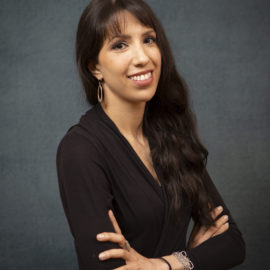
Dr. Emilia Javorsky, MD, MPH
Media Experience
BBC Click
BBC World Service
Netflix
ABC (Australia)
IEEE Spectrum
The Wall Street Journal (Journal House)
Noema
Bulletin of the Atomic Scientists
The BMJ
Your Undivided Attention (Center for Humane Technology)
Available for Interviews In
Emilia Javorsky, MD, MPH, is a physician-scientist and Director of the Futures Program at the Future of Life Institute, where she leads work on steering AI toward real benefits for health and science. She is also a mentor at Harvard's Wyss Institute. Javorsky works where medicine, invention and technology policy meet. Her 2026 essay, "How AI Can, and Can't, Cure Cancer," argues that progress against disease is limited by data, incentives and regulation rather than by machine intelligence. Its argument has been taken up by The Guardian, IEEE Spectrum and ABC Australia.
Her research spans dermatology, medical devices, radiation injury and space medicine, with papers in Nature, Nature Communications, The BMJ and Plastic and Reconstructive Surgery. She is an inventor on eight granted U.S. patents for injectable ice-slurry technology, licensed for commercial development. She co-founded the skin-health company Sundaily, acquired by Grove Collaborative in 2020.
At the Future of Life Institute she previously led policy and advocacy on lethal autonomous weapons. She has written on AI governance for Noema, IEEE Spectrum and the Bulletin of the Atomic Scientists, including a proposal for an FDA for artificial intelligence. She is a member of the CNAS AI Governance Forum and a Fellow of the Aspen Institute's inaugural Technology Leaders Initiative.
She has been featured or quoted by The Guardian, BBC Click, BBC World Service, Netflix's "Unknown: Killer Robots" and ABC Australia, and has spoken at SXSW and Web Summit. Javorsky was named to Forbes 30 Under 30 in Healthcare, a Fulbright-Schuman Scholar to the European Union and a World Economic Forum Global Shaper. She holds an MD from the University of Massachusetts, an MPH from Boston University and an undergraduate degree from Columbia University. She completed postdoctoral research in dermatology at Massachusetts General Hospital.
Sub-specialties:
• What AI can and cannot do for cancer research and drug discovery
• Separating AI health hype from evidence, including claims that superintelligence will cure disease
• Health data infrastructure, data commons and why biology is data-limited, not intelligence-limited
• Regulating AI in medicine: the FDA, clinical validation and an "FDA for AI"
• Big Tech, AI and the concentration of power in health and science
• Translating biomedical inventions from lab to market: patents, licensing and startups
• Medical devices
• Radiation countermeasures or radiation safety
• Space medicine and astronaut health
• Dermatology, skin health and sun protection
• Lethal autonomous weapons and military AI
• Storytelling, film and public imagination around aspirational futures with technology

-
How AI Can and Can't Cure Cancer
[March 2026] -
Big tech says AI can find a cure for cancer. So where is it?
The Guardian [September 2026] -
Could AI really cure cancer?
ABC Australia [Sept 27, 2026] -
Do We Really Need Smarter AI to Cure Cancer?
IEEE Spectrum [May 5, 2026] -
Why Superintelligence Won’t Cure Cancer
Your Undivided Attention [April 30, 2026] -
We Need An FDA For Artificial Intelligence
Noema Magazine [July 16, 2024] -
A second space age spanning omics, platforms and medicine across orbits
Nature [June 11, 2024] -
A human lung alveolus-on-a-chip model of acute radiation-induced lung injury
Nature Communications [October 16, 2023] -
Unknown Killer Robots
Netflix Documentary [July 10, 2023] -
Emilia Javorsky on the Risks and Opportunities of AI
WSJ Journal House [September 24, 2025]