















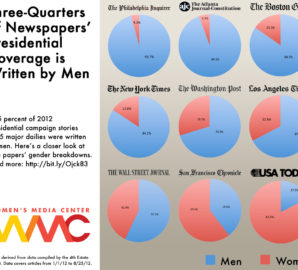
On Monday the Women’s Media Center released the shocking statistic, calculated by The 4th Estate Project, that from the presidential primary period (January 1 to April 15) to the general election (April 15 to August 25), 72 to 76 percent of newspaper stories covering the 2012 presidential election were written by men.
A new survey of newspaper bylines shows that three-quarters of the 2012 presidential coverage is written by men.
The nominees for the Academy of Television Arts and Sciences 64th Primetime Emmy Awards were announced last week and once again women were missing or underrepresented in some of the most influential roles in television production.

A woman swathed in black squares her shoulders and calmly looks into a camera. She holds a Quran. Only a sliver of her face—her eyeglasses—shows. “What happened to me hasn’t happened to anyone, or if it has affected anyone else I do not know,” she says. “But I will speak and let all the people know what [Syrian leader] Bashar al-Assad and his men are doing.” Over the next four minutes, her breathing grows labored and her voice breaks as she describes how, in May 2011, five men wearing black entered her home on the outskirts of Homs and raped her.
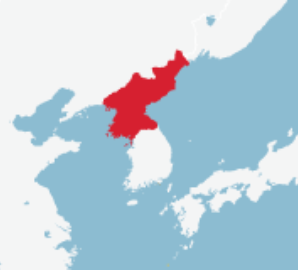
North Korea’s government has been enslaving citizens roughly 12 times longer than the Nazis held prisoners in concentration camps. Yet in most circles, the concentration camps run by the Democratic People’s Republic of Korea are far less talked about than the quirks and nuclear capacities of the regime. Due to a combination of distraction and difficult reporting, the systematic sexualized violence that occurs within those camps rarely garners attention.
Got your Oscar scorecards ready? The Women Media Center has ours: Here’s the “scorecard” of women nominated for 84th Annual Academy Awards.

The Women’s Media Center released a report that shines a light on the status of women in media. The Women’s Media Center 2012 Report on the Status of Women in US Media underscores the crucial need to hold media accountable for an equal voice and equal participation. Women’s Media Center co-founders, Jane Fonda, Robin Morgan, and Gloria Steinem hailed the report as a wake-up call for media makers and media consumers.

Sierra Leone’s civil war began in 1991, spanned 11 years, and left hundreds of thousands displaced and more than 50,000 dead. Yet the toll for women and girls was much higher than the war dead: Physicians for Human Rights estimates that during the conflict, between 215,000 and 257,000 of them were subjected to sexualized violence.

The Bangladesh War of 1971—in which up to 3 million people were killed, and hundreds of thousands of women raped—seemingly has its roots in strange cartography. As University of Chicago professor Rochona Majumdar puts it, the 1947 Partition between India and Pakistan was geographically “very weird,” with the nation of Pakistan split into two noncontiguous land masses.

Four women are raped every five minutes in the Democratic Republic of Congo, according to a study done in May 2011 by three researchers, including SUNY’s Tia Palermo. “These nationwide estimates of the incidence of rape are 26 times higher than the 15,000 conflict-related cases confirmed by the United Nations for the DRC in 2010,” says Palermo.

In February 2011, protests broke out in Benghazi, the second largest city in Libya, against the more than 40-year rule of Muammar Gaddafi. During the protests, security forces fired on civilian protesters, causing a broader uprising that led to the establishment of the National Transitional Council (NTC), an interim governing body in opposition to Gaddafi’s regime.

The Egyptian Revolution began on January 25, 2011, with millions of Egyptians demanding the ouster of President Hosni Mubarak. The revolution, while predominantly nonviolent compared to other Arab Spring protests, saw a number of violent clashes between security forces and protesters.
- 2026
- 2025
- 2024
- 2023
- 2022
- 2021
- 2020
- 2019
- 2018
- 2017
- 2016
- 2015
- 2014
- 2013
- 2012
- 2010
- 2008