
















Colin Kaepernick is unemployed because he decided to kneel while the national anthem played before games in protest of racial injustice, namely the string of police killings of unarmed black men, in the United States.

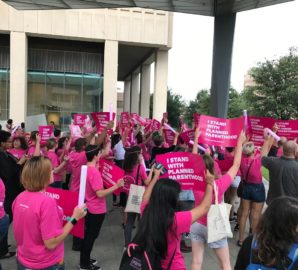
While frustrating and dangerous, these constant attacks on women’s bodily autonomy provide all the more reason to support facilities like Planned Parenthood.
Robin on Puerto Rico, Las Vegas, the fast-food industry's secret pact against women, Rosanne Cash, and female mayors. Guests: Maria Teresa Kumar on Hispanics in the crosshairs; Ann Hornaday on critics' tips for watching movies. Surrealism Corner.
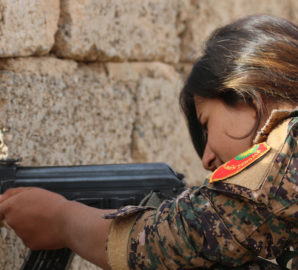
Ekhlas was 14 years old when Islamic State militants attacked the northern Iraqi city of Sinjar in August 2014. Her family tried to flee to nearby Mount Sinjar, but they never made it.

The privilege of fully being oneself is harder for students with whom schools take issue — specifically black students, who are often disproportionately affected by dress code sanctions.
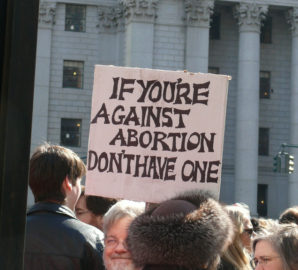
With a 237 to 189 vote, a bill that would ban abortions after 20 weeks in the U.S. was approved by the House of Representatives on Tuesday.
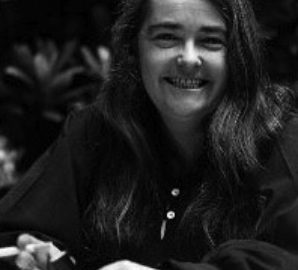
Robin Morgan offers a very personal remembrance of her friend, the artist and author Kate Millett, who died last month.

A new study found that most female characters could be removed from a film's narrative without significantly disrupting the plot. This suggests that even when women do show up in films, they don’t really have any agency.

The oversight of Flint, Michigan, officials caused lead to trickle into the city’s water supply for 18 months from the city’s aging pipes, wreaking havoc on the health and lives of Flint’s citizens.

Joe Arpaio, according to Trump, was the one cheated and attacked by the criminal justice system — not his victims.
Robin on Saudi women driving (!), campus sexual-assault setback, Obamacare resurrected, and the NFL gladiators vs. Trump. Guest: Ani DiFranco—Part 2 of an exclusive in-depth conversation. Plus, Surrealism Corner and A Word from My Lower Self.

Just out of graduate school in Mexico City, Lissette Marquez longed to travel the world on an American cruise ship. She was thrilled to obtain a guest-worker visa that allowed her to join a ship crew in California. But instead of the ideal job she had envisioned, Marquez said she found herself toiling long hours, earning less than a $4 hourly wage, and feeling isolated.

Dr. Martha Lauzen has been conducting the Boxed In study of women in television for 20 years. Here she highlights what this year's report tells us.

YouTubers should treat the message of condemning assault as something important enough to stand independently from a childish vlog video.
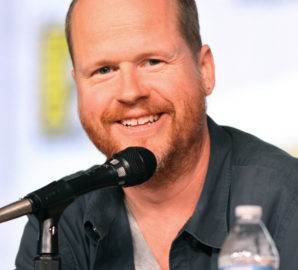
Whedon’s behavior is not unlike many “feminist” men, which in turn points to a bigger problem: the way in which many male feminists use that identity to excuse themselves from wrongdoing.

In 2014, the so-called Islamic State abducted thousands of women and children when they invaded large parts of Iraq and tortured, enslaved, and killed many people affiliated with the Yazidi religious group. In response, in November 2015, the Jiyan Foundation for Human Rights, an Iraq-based organization that helps victims of human rights violations, opened a trauma clinic for women in the Kurdish city of Chamchamal.
Young activists are on the ground every day, fighting for and within their own communities in ways both big and small.
Robin on Aung San Suu Kyi, modern slavery, deconstructing deconstructionism, and "the genuine article." Guest: Ani DiFranco in an in-depth personal interview. Also Surrealism Corner, and the new feature, "A Word From My Lower Self."

On computer screens thousands of miles away from one another, some of the world’s leading feminist figures joined in solidarity with women in the Democratic Republic of the Congo at the country’s first-ever women’s summit on September 14.

A new study finds that mainstream media outlets were complicit in spreading right-wing propaganda during the 2016 campaign.

Republican lawmakers are trying to rush through another bill to repeal the Affordable Care Act, and it’s their most harmful proposal yet.

As world leaders descend on New York City this week for the United Nations General Assembly, one group has released a report that exposes a frightening lack of government knowledge of how the rights of women are progressing in various countries.

Black women are supposed to relate to and admire these two-dimensional characters, but in reality their lives are multi-dimensional: they’re real people who face obstacles outside of combating racism. Most black girls have gained enough life experience by adolescence to understand that “black girls are pretty, too” and “racism is wrong.” What we’re still grappling with is that being a black girl is still really hard because while we may believe those messages, the people we interact with on a daily basis don’t necessarily understand or believe those messages. And, of course, we are dealing with that racism at the same time that we deal with the everyday problems any other complicated person does.

Plenty of Texans didn’t have the privilege of choosing whether to stay or not. Fleeing is an unaffordable luxury for many.
Robin on hurricane coverage, Trump's gutting Title IX, Big Tech malfeasance--and a personal word about Kate Millett. Guests: Journalist Amanda Sperber on an untold story--South Sudan's rapes; Mary Mattingly on Swale, the first floating food forest.
- All Categories
- Arts and culture
- Body image and body standards
- Disability
- Economy
- Education
- Environment
- Feminism
- Free Speech
- Gender-based violence
- Girls
- Gloria Steinem
- Health
- Immigration
- International
- Jane Fonda
- LGBTQIA
- Media
- Misogyny
- Online harassment
- Politics
- Race/Ethnicity
- Religion
- Robin Morgan
- Science and tech
- Sports
- Violence against women
- WMC Loreen Arbus Journalism Program